Google Ads are changing quickly in 2026. If you have used Google Ads before, you may have noticed that the platform is becoming more automated and more dependent on artificial intelligence. But this does not mean that keywords, good ad copy, landing pages, and proper tracking have become less important.
In fact, the opposite is true. As Google takes over more of the technical work, advertisers need to focus more on giving the system the right information and setting clear business goals.
For someone who is starting Google Ads in 2026, this can be confusing. There are lots of new AI features that change to Search campaigns or smarter bidding options, and many new ways for ads to appear across Google’s search experience.
This blog explains the major Google Ads changes in 2026 in simple terms and shows what beginners should know before spending money on advertising.
Why Google Ads Is Changing in 2026
Now Search behaviour is no longer as same or simple as typing two or three keywords into Google and choosing one of the first results.
People are asking longer questions, comparing products, looking for recommendations, and using AI-powered search experiences to find information. Google is responding by making its advertising system better at understanding the meaning behind a search instead of depending only on the exact keywords an advertiser has selected for the ads.
Artificial intelligence is now involved in areas such as search-term matching, ad creation, landing-page selection, bidding, reporting, and campaign optimisation for better results.
For advertisers, the biggest change is the move from managing every small campaign setting manually to giving Google better signals and letting automation handle more of the work.
AI Max Is Changing Google Search Campaigns
One of the biggest Google Ads developments in 2026 is AI Max for Search campaigns.
AI Max is not a separate campaign type. It is an optimization layer that works within Search campaigns. It combines AI-powered targeting and creative features to help advertisers reach relevant searches that they may not have found through traditional keyword targeting.
For new Search campaigns, Google says AI Max is turned on by default, although advertisers can choose the features they want to use.
This is important for beginners because the way you think about Search campaigns needs to change.
Instead of trying to build a huge list of every possible keyword, you need to give Google a clear understanding of your business, products, services, customers, and conversion goals.
Search Matching Is Becoming More Flexible
Traditionally, advertisers spent a lot of time researching keywords and deciding which exact phrases should trigger their ads.
Keywords are still important, but Google is now using AI to understand the intent behind searches more broadly.
AI Max includes improved search-term matching that can use broader and keywordless signals to find relevant queries. The idea is to help advertisers discover valuable searches they may not have specifically added as keywords.
For example, suppose you run a company that provides website development services.
A potential customer may search for:
“company to build a business website”
while another person searches:
“professional website development services for small businesses.”
Both searches can indicate a similar need, even though the wording is different.
This is where Google’s understanding of search intent becomes more useful than simply matching one keyword to one query.
However, broader targeting does not mean you should stop monitoring your search terms. Businesses still need to check which searches are generating useful traffic and which ones are wasting their budget.
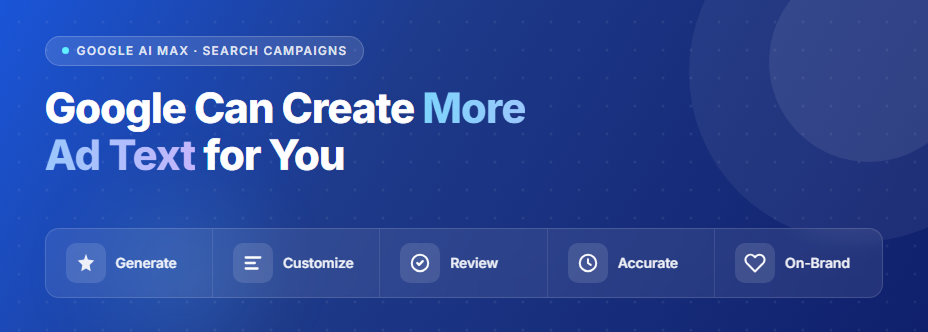
Google Can Create More Ad Text for You
Writing several strong headlines and descriptions for a Search campaign can take time.
AI Max includes a feature called text customization, which can generate additional headlines and descriptions based on information such as your website, landing page, existing ads, and keywords.
This can help advertisers test more relevant variations without manually writing every possible version.
But there is an important point here: AI-generated copy should not replace human review.
Your ads still need to sound like your company. Claims should be accurate, offers should be clear, and the wording should make sense to the people you are trying to reach.
AI can create variations quickly. Your marketing team still needs to decide whether those variations are actually good.
Your Landing Page Matters More Than Ever
Getting someone to click an ad is only one part of the job.
What happens after the click matters just as much.
AI Max includes Final URL expansion, which can help Google select a relevant page from your website based on the user’s search intent. This means a visitor may not always be sent to the same landing page you originally expected.
This makes website structure increasingly important.
If your website has clear service pages, useful content, logical navigation, and pages that closely match different customer needs, Google has more useful information to work with.
On the other hand, if your website has poor-quality pages or unclear information, automation cannot magically fix the underlying problem.
Your website and Google Ads strategy need to work together.
Smart Bidding Is Becoming More Important
Another major part of Google Ads in 2026 is automated bidding.
Google’s Smart Bidding uses AI to adjust bids for individual auctions based on signals that can help predict the likelihood of a conversion or conversion value.
For beginners, this can be useful because you do not have to manually decide how much to bid for every search.
Google currently offers strategies such as:
- Maximize Conversions
- Maximize Conversion Value
- Target CPA
- Target ROAS
Google also changed the way some of these strategies are labelled in 2026. For example, “Maximize conversions with a Target CPA” is being shown as “Target CPA,” while “Maximize conversion value with a Target ROAS” is being shown as “Target ROAS.” Google says the underlying bidding behaviour has not changed because of this naming update.
The important thing is not the name of the strategy. The important thing is whether your campaign has reliable conversion data and a clear business goal.
Conversion Tracking Should Be a Priority
This is one area where beginners often make mistakes.
Some advertisers launch a campaign, see clicks coming in, and assume everything is working.
Clicks alone do not tell you whether the advertising is helping your business.
If your goal is lead generation, you need to know how many people actually submitted a form, called your business, requested a quotation, or completed another valuable action.
If you run an e-commerce business, you need reliable purchase and revenue data.
Google’s automation becomes much more useful when it has good conversion signals to learn from. Google itself recommends aligning Search strategy and Smart Bidding with accurately measured conversions and business outcomes.
So before increasing your advertising budget, check your tracking.
Performance Max Still Has an Important Role
Search is not the only place where Google Ads can reach potential customers.
Performance Max campaigns allow advertisers to reach customers across Google’s advertising channels from a single campaign. They are also heavily powered by Google’s AI systems.
For businesses that have enough conversion data and suitable creative assets, Performance Max can be useful for finding customers beyond traditional Search campaigns.
But Performance Max should not simply be treated as a campaign you turn on and forget about.
Your product or service information, creative assets, conversion tracking, audience signals, budget, and landing pages all affect the quality of the campaign.
The more useful information you provide, the better Google can understand what you are trying to achieve.
Google Is Bringing More AI Into Ad Experiences
Google is also experimenting with new advertising experiences designed for an AI-driven search environment.
In 2026, Google announced new ad formats built with Gemini and described experiences such as conversational discovery ads, highlighted answers, and AI-powered shopping ads. These developments are aimed at making advertising more useful within increasingly conversational search journeys.
This is an important change because customers may not always follow the old pattern of:
Search → Click Ad → Visit Website → Buy
Their journey can involve multiple questions, comparisons, recommendations, and interactions before they decide what to do.
Advertisers therefore need to think about the complete customer journey instead of focusing only on getting the first click.
Google Ads Reporting Is Becoming More AI-Powered
Another useful development in 2026 is the growing use of AI to help advertisers understand their campaign data.
Google has introduced AI-powered summaries and other tools designed to help advertisers identify performance changes, trends, and opportunities more quickly.
This can be helpful when managing multiple campaigns because you do not always have time to manually examine every number.
However, automated summaries should be treated as a starting point for analysis, not the final decision.
A report can tell you that performance changed. You still need to understand why it changed and whether the change matters to the business.
What Should Beginners Do Differently in 2026?
The biggest mistake would be trying to control every part of Google Ads manually.
Google’s advertising system is becoming better at handling bidding, targeting and creative optimisation. Instead of fighting that automation, advertisers should focus on giving it good information.
Start by understanding your customer.
What are they searching for? What problem are they trying to solve? Why should they choose your business instead of another company?
Once you understand that, build your campaigns around clear goals.
Your website should explain your offer properly. Your landing pages should match your advertisements. Your conversion tracking should record meaningful actions. Your ad copy should be clear and relevant.
Then you can use Google’s AI features to expand and optimise your campaigns.
A Simple Google Ads Setup for Beginners
If you are launching your first campaign in 2026, you do not need to use every feature available on day one.
Start with one clear objective.
If you want leads, focus on lead generation. If you sell products online, focus on purchases and revenue. If you want phone calls, make calls an important conversion action.
Next, identify the locations and customers you actually want to reach.
Then prepare your website and landing pages before launching the campaign. Make sure visitors can quickly understand what you offer and what they should do next.
Create strong headlines and descriptions. Give Google enough useful assets to work with, but do not blindly accept every AI-generated suggestion.
Set up conversion tracking before spending heavily.
After launching, give the campaign enough time to collect useful data. Review search terms, conversions, cost per conversion, landing pages and ad performance regularly.
Make changes based on business results, not just clicks or impressions.
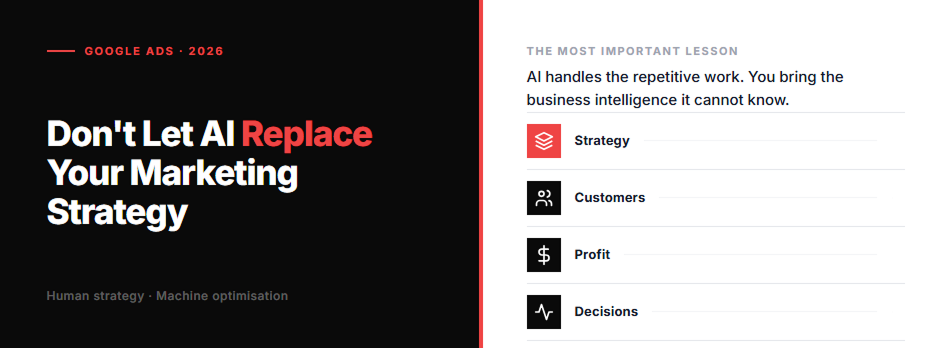
Don’t Let AI Replace Your Marketing Strategy
This may be the most important lesson for Google Ads in 2026.
AI can help you find searches, create ad variations, adjust bids and analyse information. But it does not understand your business in the same way you do.
It does not automatically know which customers are the most valuable, which services have the highest profit margin, which leads are worth following up, or which promises your sales team can actually deliver.
That information needs to come from your business.
Good Google Ads campaigns will therefore combine human strategy with machine optimisation.
The technology can handle more of the repetitive work, while marketers can spend more time understanding customers, improving offers and making better business decisions.
Common Google Ads Mistakes to Avoid in 2026
One common mistake is focusing too much on traffic and not enough on conversions. A campaign can generate thousands of visitors and still produce very little business.
Another mistake is sending every visitor to the homepage. A person searching for a specific service should ideally land on a page that directly explains that service.
Ignoring conversion tracking is another serious problem. Without reliable data, it becomes difficult to know where your advertising budget is going.
You should also avoid making major changes every day. Automated campaigns need time to learn, and constant changes can make it harder to understand what is actually working.
Finally, do not assume that AI means “set it and forget it.” Automated campaigns still need human supervision.
Final Thoughts
Google Ads in 2026 is less about manually controlling every keyword and bid and more about giving Google’s systems the right information to make better decisions.
AI Max is changing how Search campaigns find queries and create ad experiences. Smart Bidding is handling more auction-level decisions. AI is also becoming part of reporting, creative development and the wider search experience.
For beginners, this may sound complicated, but the basic principles have not changed.
Know your customer. Have a clear offer. Build useful landing pages. Track real conversions. Write relevant ads. Monitor your results.
Then use Google’s AI tools to do more of the repetitive work.
The businesses that perform well with Google Ads in 2026 will not necessarily be the ones using the most automation. They will be the ones that combine good marketing fundamentals, reliable data and smart use of AI to reach the right customers at the right time.