Google Ads has never been a platform where you can simply set a budget, choose a few keywords, and expect a steady flow of customers.
That was never really the case, but in 2026, the difference is even more noticeable.
Google Search is changing. People are using longer and more conversational queries, AI is becoming a bigger part of the search experience, and Google is giving advertisers more automation than ever. At the same time, competition for valuable keywords can make paid search expensive, especially in industries where several businesses are targeting the same customers.
So, is Google Ads still worth the investment in 2026?
Yes, but only when the campaigns are built around business outcomes rather than clicks.
Google Ads can still put a business in front of people who are actively looking for a product, service, or solution. But getting good results now requires better conversion tracking, stronger landing pages, relevant messaging, and a willingness to test Google’s AI-powered campaign features instead of managing everything manually.
Let’s look at what has changed and how businesses can approach Google Ads in 2026.
What Has Changed in Google Ads in 2026?
The biggest change is the growing role of AI in campaign management.
Google is moving Search campaigns toward a more automated model through AI Max for Search campaigns. AI Max is not a separate campaign type. It works as an optimization layer within Search campaigns and can help with search-term matching, ad text customization, and choosing more relevant landing pages.
This does not mean keywords and campaign strategy no longer matter.
It means the role of the advertiser is changing.
Instead of manually controlling every possible search query, marketers increasingly need to provide Google with good business information, quality conversion data, strong creative assets, useful landing pages, and clear campaign goals.
Google has also announced that eligible campaigns using features such as campaign-level broad match and automatically created assets will begin moving to AI Max from September 2026. Dynamic Search Ads are scheduled for a later transition beginning in February 2027.
For businesses running Google Ads today, this is a good reason to review existing campaigns rather than simply continuing with an old setup.
Are Google Ads Still Worth It for Businesses?
There is no universal answer.
Google Ads can be extremely valuable for one business and a poor investment for another.
The difference usually comes down to intent, economics, tracking, and execution.
For example, imagine a company offering .NET development services.
Someone searching for:
“.NET development company in India”
has a very different intent from someone searching:
“what is .NET”
The first person may be looking for a service provider. The second person is probably researching a technology.
If the business has a good offer, relevant landing page, proper conversion tracking, and a sales process capable of handling those leads, paid search can make sense.
But if the same business sends every visitor to its homepage, has no reliable conversion tracking, and measures success only by clicks, even a large advertising budget can disappear quickly.
That is why the question should not simply be:
“How much does Google Ads cost?”
A better question is:
“How much does it cost us to acquire a customer, and is that customer profitable?”
When Google Ads Makes Sense
Google Ads tends to work particularly well when people already have some level of demand for what you sell.
Here are a few situations where it can make sense.
1. People are actively searching for your service
Search advertising is particularly useful when your audience already knows what they need.
Examples include:
- Software development services
- Digital marketing services
- IT consulting
- Accounting services
- Legal services
- Home repair services
- Healthcare appointments
- B2B technology solutions
- E-commerce products
You are not necessarily trying to convince someone that they need the service from scratch. You are trying to appear when they are already looking.
2. One customer is worth enough to justify the acquisition cost
Suppose a business sells a service worth ₹1,00,000.
Spending ₹1,000 to acquire a qualified lead could be reasonable if a percentage of those leads become customers.
Now compare that with a low-value product where the profit from one sale is only ₹100.
The same advertising cost could make the second business unprofitable.
This is why customer lifetime value, average order value, profit margin, and conversion rate matter more than CPC alone.
3. You can respond to leads quickly
Paid traffic is not useful if leads sit unanswered for two days.
For service businesses, response time can have a major effect on whether a lead becomes a real sales opportunity.
Google Ads brings the opportunity. Your sales process still has to close it.
4. Your website supports the campaign
A good advertisement cannot completely fix a poor landing page.
If the ad says:
“Custom AI Development Services”
but the visitor reaches a generic homepage with no clear information about AI services, the campaign is already working against itself.
The landing page should continue the same conversation started by the advertisement.
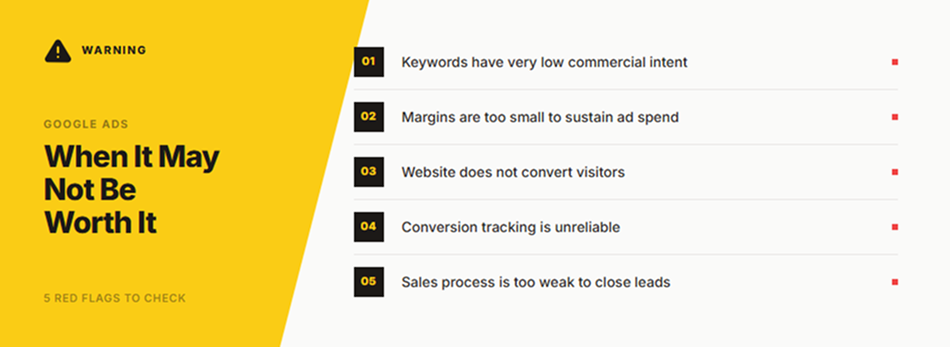
When Google Ads May Not Be Worth It
There are also situations where increasing the advertising budget is not the right answer.
Your keywords have very low commercial intent
Getting traffic for informational searches is not automatically bad, but informational traffic does not always translate into sales.
Your margins are too small
A campaign can generate sales and still lose money.
Always calculate the actual economics behind the campaign.
Your website does not convert
If paid visitors regularly leave without taking action, increasing traffic will only increase the number of people who leave.
Your conversion tracking is unreliable
If Google cannot distinguish between a valuable lead and a low-quality action, automated bidding has less useful information to work with.
Your sales process is weak
Marketing and sales cannot operate as completely separate systems.
If 100 qualified leads come in but the sales team follows up with only 30, the advertising campaign may appear worse than it actually is.
AI Max Is Changing How Search Campaigns Work
One of the biggest Google Ads developments businesses need to understand in 2026 is AI Max.
AI Max combines several AI-powered features inside Search campaigns.
These include:
- Search term matching
- Text customization
- Final URL expansion
- Brand controls
- Location controls
- Additional reporting and optimization capabilities
Search term matching can use broader signals to find relevant searches beyond the exact keywords an advertiser manually entered.
Text customization can generate additional headlines and descriptions using information from existing ads, landing pages, keywords, and the website.
Final URL expansion can direct users to a more relevant page on the website when Google determines that another page better matches the search intent.
This creates an important shift.
Your website content is becoming even more important to your advertising strategy.
If your website has clear service pages, useful information, strong positioning, and well-organized content, Google’s systems have more context to work with.
If the website is vague, outdated, or poorly structured, automation does not magically solve the problem.
Should Every Business Turn On AI Max?
Not blindly.
AI Max gives advertisers more automation, but automation still needs direction.
Before enabling new campaign features, businesses should review:
- Conversion tracking
- Search terms
- Negative keywords
- Landing pages
- Geographic targeting
- Brand controls
- Budget limits
- Ad messaging
- Lead quality
- Existing campaign performance
Google also provides AI Max experiments, allowing advertisers to test AI Max against an existing Search campaign before applying the changes more broadly.
For businesses that are cautious about changing a campaign that already performs well, testing is often a better approach than making a major change overnight.
Google Ads Is Becoming More Intent-Focused
Traditional PPC thinking often starts with keywords.
Modern PPC needs to start with intent.
Consider these searches:
- “CRM software”
- “best CRM for small business”
- “CRM implementation company”
- “custom CRM development company India”
They may all contain related concepts, but the commercial intent is different.
A strong Google Ads strategy should identify what the person is trying to accomplish, not just which words they typed.
This becomes even more important as searches become longer and more conversational.
Google has also been developing new ad experiences for the AI era of Search, including formats designed around more conversational and discovery-oriented experiences.
For marketers, this means ad copy and landing-page content need to answer real questions and make the next step obvious.
Performance Max Still Has a Role
Search is not the only place where businesses can use Google Ads.
Performance Max allows advertisers to run campaigns across Google’s advertising inventory using automation to help find conversions.
For businesses with enough reliable conversion data, Performance Max can be useful for expanding beyond traditional keyword-based Search campaigns.
But it should not be treated as a “set it and forget it” campaign.
The quality of:
- Conversion signals
- Creative assets
- Audience information
- Product feeds
- Landing pages
- Budget
- Business goals
still affects the quality of the campaign.
For e-commerce businesses in particular, Google’s AI Max developments are also moving into Shopping, with tools designed to better respond to conversational and discovery-oriented searches.
The Landing Page Matters More Than Many Advertisers Think
One of the easiest ways to waste Google Ads money is to focus heavily on the campaign and barely think about the landing page.
Your ad has one job:
Get the right person interested enough to click.
Your landing page has a different job:
Convince that person to take the next step.
A good landing page should make it clear:
- What you offer
- Who the service is for
- What problem you solve
- Why the visitor should trust you
- What makes your company different
- What the visitor should do next
For example, a Google Ad for “AI development company” should ideally lead to a page that actually explains the company’s AI development capabilities.
Sending that visitor to a generic “About Us” page creates unnecessary friction.
Better Conversion Tracking Is Becoming Essential
Google’s automation depends heavily on conversion signals.
If your campaign counts every form submission as an equally valuable conversion, the system may optimize toward quantity instead of quality.
For a B2B company, you may have several stages:
Ad click → Form submission → Qualified lead → Sales conversation → Proposal → Customer
The final customer is more valuable than the initial form submission.
Businesses should therefore look at ways to connect advertising data with actual business outcomes wherever possible.
This helps answer a more important question than “How many leads did we get?”
The question becomes:
“How many valuable customers came from our advertising investment?”
What About Rising Google Ads Costs?
Competition can make some keywords expensive.
But a high CPC does not automatically mean a campaign is bad.
Imagine two campaigns:
Campaign A
CPC: ₹30
Conversion rate: 1%
Cost per lead: ₹3,000
Campaign B
CPC: ₹80
Conversion rate: 8%
Cost per lead: ₹1,000
Campaign B has the higher CPC but the lower cost per lead.
This is why looking at CPC in isolation can lead to poor decisions.
The metrics that matter will depend on your business, but they can include:
- Cost per qualified lead
- Cost per acquisition
- Conversion rate
- Lead-to-customer rate
- Customer acquisition cost
- Revenue from advertising
- ROAS
- Profit after advertising costs
Google Ads vs SEO in 2026
It does not have to be Google Ads or SEO.
For many businesses, the stronger approach is to use both.
Google Ads can help you get visibility quickly for valuable searches.
SEO can build organic visibility over time.
Paid campaigns can also provide useful information about:
- Which keywords generate leads
- Which offers attract customers
- Which messaging gets clicks
- Which landing pages convert
- Which locations perform well
That information can influence your SEO and content strategy.
At the same time, strong organic content can support paid campaigns by giving users more information after they discover your business.
A balanced strategy might look like this:
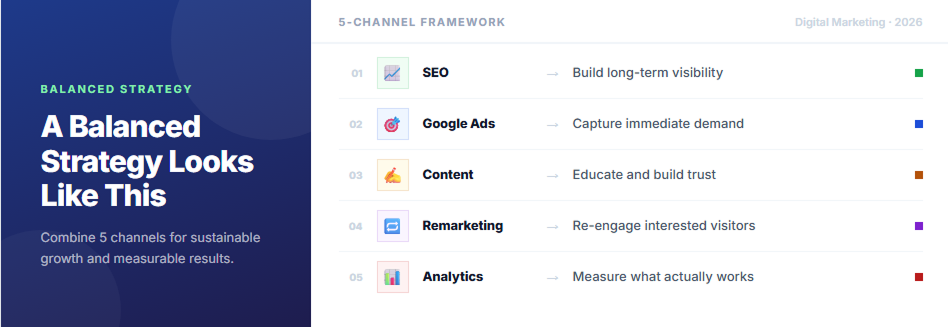
7 Google Ads Strategies Businesses Should Focus on in 2026
1. Build campaigns around business goals
Do not start with “Which keywords should we bid on?”
Start with:
What business result do we want?
That could be qualified leads, online sales, phone calls, bookings, or another measurable action.
2. Give Google better conversion data
Automation works better when the signals going into the system are meaningful.
Review your conversion actions regularly and remove actions that do not represent real business value.
3. Test AI Max instead of blindly adopting it
AI Max is an important part of Google’s direction for Search, but every business has different requirements.
Use experiments and performance data to understand whether the additional reach and automation are helping your specific account.
4. Keep your website content clear
Your website is not separate from your PPC strategy.
Google’s AI-powered features can use information from your website and landing pages when optimizing ad experiences.
Make your service pages specific and useful.
5. Keep testing ad messaging
Do not assume the first successful headline will remain the best option forever.
Test different approaches around:
- Business benefits
- Pain points
- Services
- Industry expertise
- Location
- Trust signals
- Offers
6. Watch lead quality, not just lead volume
Twenty poor-quality leads are not necessarily better than five qualified leads.
Connect marketing performance with actual sales results whenever possible.
7. Review campaigns regularly
Automation reduces manual work, but it does not remove the need for strategy.
Review:
- Search terms
- Conversion quality
- Budget distribution
- Landing pages
- Geographic performance
- Ad assets
- Negative keywords
- Cost per qualified lead
Regular reviews can help prevent small problems from becoming expensive ones.
Common Google Ads Mistakes to Avoid in 2026
Sending every ad to the homepage
A dedicated landing page is often more relevant.
Measuring success only through clicks
Clicks are an activity metric, not a business result.
Changing campaigns every few days
Automated campaigns need enough data to learn. Constant changes can make it difficult to understand what is actually working.
Ignoring negative keywords
Automation can expand reach, but advertisers still need to monitor irrelevant searches and maintain appropriate controls.
Using weak conversion goals
If the system is optimizing for low-value actions, campaign performance can look good in the dashboard while producing poor business results.
Increasing budget before fixing conversion problems
More traffic cannot solve a fundamentally weak offer or landing page.
So, Are Google Ads Still Worth It in 2026?
Yes. But Google Ads is no longer simply a keyword bidding platform.
The strongest campaigns in 2026 are likely to combine human strategy with Google’s growing automation.
Advertisers still need to understand their customers, offer, market, margins, and sales process. Google can help with matching, bidding, creative variations, and campaign optimization, but it cannot decide what makes a business genuinely valuable to its customers.
AI Max is one of the clearest examples of this shift. Google is moving Search toward broader intent signals, automated creative adaptation, and more dynamic landing-page experiences.
That makes strategy more important, not less.
A business that has clear goals, good conversion data, relevant landing pages, strong messaging, and a process for reviewing campaign performance can still make Google Ads a valuable acquisition channel.
The goal should not be to get the most clicks.
It should be to get the right clicks from people who are likely to become customers.
Final Thoughts
Google Ads is still worth considering in 2026, but the old approach of simply adding keywords, setting bids, and waiting for leads is becoming less effective.
Search is becoming more conversational. Google’s advertising systems are becoming more automated. AI is playing a larger role in targeting, creative generation, bidding, and campaign optimization.
Businesses that adapt to these changes have a better opportunity to use paid search effectively.
Start with the fundamentals: understand your audience, define valuable conversions, create relevant landing pages, track actual business outcomes, and test new Google Ads features carefully.
Then let automation handle more of the repetitive work while your marketing team focuses on the decisions that actually affect growth.