Search engines are getting better at understanding what a website is actually about. Because of this, simply targeting a keyword is no longer enough to build long-term search visibility. Websites need to show that they understand a subject and can provide useful information around it.
This is where topical authority comes into the picture.
Topical authority is not about publishing hundreds of blogs or repeating the same keyword across different pages. It is about covering a subject properly, answering the questions people have, connecting related information, and providing content that is genuinely useful.
But how do you know if your website is building topical authority?
There is no single score in Google Search Console or Google Analytics that gives you the answer. Instead, you need to look at several SEO signals together.
What Is Topical Authority?
Topical authority describes how well a website covers a particular subject.
For example, a company that wants to build authority around .NET development should not only have a service page for “.NET development.” It should also provide useful information about related areas such as ASP.NET Core, .NET application development, .NET APIs, application migration, cloud integration, security, performance and other relevant topics.
These pages should also have a logical relationship with each other.
When visitors can move from one useful topic to another and find answers to related questions on the same website, the site provides a more complete resource around that subject.
That is what makes topical authority different from simply having a large amount of content.
Why Does Topical Authority Matter?
People rarely search for a subject only once or from one angle.
Someone looking for an ERP system, for example, may first search for what an ERP system is. Later, they may want to know how ERP works, what features it should have, how much it costs, how it can be integrated with existing software, and whether AI can be added to it.
A website that covers these related questions can provide much more value than a website with one general article.
Search engines can also better understand the relationship between pages when the content is organised around a clear subject.
This does not mean that businesses should create a page for every keyword variation. The focus should be on answering meaningful questions and providing information that helps the reader.
How Can You Measure Topical Authority?
Because there is no official Google topical authority score, you need to look at several areas of your website.
1. Review Your Topic Coverage
Start by choosing the main subject you want your website to be known for.
Then list the important questions and subtopics related to that subject.
For example, if your main topic is digital marketing, your supporting topics might include SEO, paid advertising, social media marketing, content marketing, local SEO, email marketing and conversion optimization.
Now compare this list with your existing content.
You may discover that some important areas have no content at all. You may also find several articles covering almost the same topic.
This simple review can show you where your content is strong and where there are gaps.
2. Check Google Search Console
Google Search Console is one of the most useful tools for understanding how your content is performing in search.
Look beyond your main keyword and review the different queries that are generating impressions and clicks for your pages.
For example, an article about AI integration may start receiving impressions for searches related to AI APIs, AI automation, CRM integration, ERP integration and AI application development.
This can show that your page is appearing for a wider range of relevant searches.
Pay attention to changes in impressions, clicks, average position and the number of relevant queries over time.
3. Look at Related Keyword Rankings
A strong topic usually has several related search terms rather than one keyword.
Suppose you have an article about ASP.NET development. It may receive visibility for searches related to ASP.NET Core, .NET application development, ASP.NET services, .NET APIs and other relevant terms.
Look at whether your content is gaining visibility across these related searches.
However, do not judge your authority only by the number of keywords you rank for. Relevance is more important than quantity.
Ranking for hundreds of unrelated keywords does not mean your website has strong topical authority.
4. Check Your Internal Links
Internal linking is another important part of topical coverage.
If you have several articles about .NET development, they should not exist as isolated pages.
A blog about ASP.NET Core could link to a relevant article about .NET application development. An article about application migration could link to content about legacy modernization.
These links should be useful to the reader and should make sense within the content.
A good internal linking structure helps visitors discover related information and makes your website easier to understand.
5. Measure Organic Traffic by Topic
Website-wide organic traffic does not always tell you which topics are actually performing well.
Instead, group your content by subject and look at the traffic generated by each group.
For example, you might create a group for .NET development and include your service page and related articles.
Then monitor whether traffic to this group is increasing over time.
If several related pages are bringing in organic visitors, it is a stronger indication of topic growth than one article receiving most of the traffic.
6. Watch Ranking Changes Across Multiple Pages
One page ranking well does not necessarily mean that your website has strong topical coverage.
Look at the performance of several pages covering the same subject.
If multiple pages are gaining impressions, improving their rankings and attracting organic traffic, your overall content strategy is moving in the right direction.
This is why it is useful to review a topic as a group rather than judging every article separately.
7. Review Relevant Backlinks
Links from other websites can also provide useful information.
If industry websites, publications or other relevant sources naturally reference your content, it can indicate that your content is useful enough for others to cite.
However, backlinks alone do not create topical authority.
A large number of unrelated or low-quality links is not a substitute for useful content.
The relevance and quality of the websites linking to you matter more than simply increasing the number of backlinks.
Which Tools Can Help?
You do not need one special tool to measure topical authority.
Google Search Console can help you understand search queries, impressions, clicks and rankings.
Google Analytics can show how visitors interact with your content and whether organic traffic is contributing to business goals.
SEO tools such as Ahrefs and Semrush can help with keyword research, competitor analysis, backlinks and content gaps.
You can also use Google Search manually to understand what information is appearing for your target topics and what questions users may still have.
The important thing is not to depend on one tool’s score. Use different data points to understand the bigger picture.
How Long Does It Take to Build Topical Authority?
There is no fixed timeline for building topical authority.
A new website usually needs more time because it has less content, fewer external references and less search history. An established website may already have a strong foundation around its main subjects.
Competition also makes a difference.
Instead of focusing on a specific number of months, monitor the actual progress of your website.
Are your pages receiving more impressions?
Are you ranking for more relevant searches?
Are supporting articles getting organic traffic?
Are visitors exploring related pages?
Are your organic leads or conversions improving?
These signals provide a much better understanding of progress.
Common Topical Authority Mistakes
One common mistake is publishing content simply because a keyword has search volume.
A website can publish dozens of articles and still have weak topical coverage if those articles are repetitive, shallow or poorly connected.
Another problem is creating multiple pages that target the same search intent. Instead of strengthening the topic, this can make the website’s content confusing and repetitive.
Poor internal linking is also common. Useful articles may remain disconnected from each other even though they discuss closely related subjects.
Keyword stuffing is another outdated approach. Repeating the same phrase again and again does not demonstrate expertise or make an article more useful.
Finally, changing the year in an old article does not make it a genuine content update. A proper refresh should improve the information, examples, accuracy, structure and overall usefulness of the page.
How to Build Stronger Topical Authority
Start with subjects that are closely connected to your business and your audience.
Once you choose a topic, identify the important questions people have around it. Create useful content that answers those questions instead of writing articles only to target keywords.
Keep related pages connected through natural internal links. Make sure each page has a clear purpose and provides information that is different from the other pages on your website.
You should also review older content regularly. Update outdated information, add useful examples and improve sections that no longer provide enough value.
Most importantly, add something useful that readers cannot easily get from every other website. This could be original research, practical examples, first-hand experience, expert opinions, data or a clearer explanation of a complicated subject.
Does Topical Authority Matter for AI Search?
Search is changing quickly, with AI-powered features becoming part of the search experience.
However, there is no separate shortcut for ranking in AI search. Google’s guidance continues to focus on the same basic principles: content should be useful, accessible, reliable and created to help people.
A website with well-organised information around a subject can provide useful sources for different types of searches because its content covers the topic from multiple angles.
The answer is not to create hundreds of AI-generated pages.
Instead, focus on building a website that genuinely understands its audience and provides useful information across the subjects that matter to them.
Final Thoughts
Topical authority cannot be measured with one number.
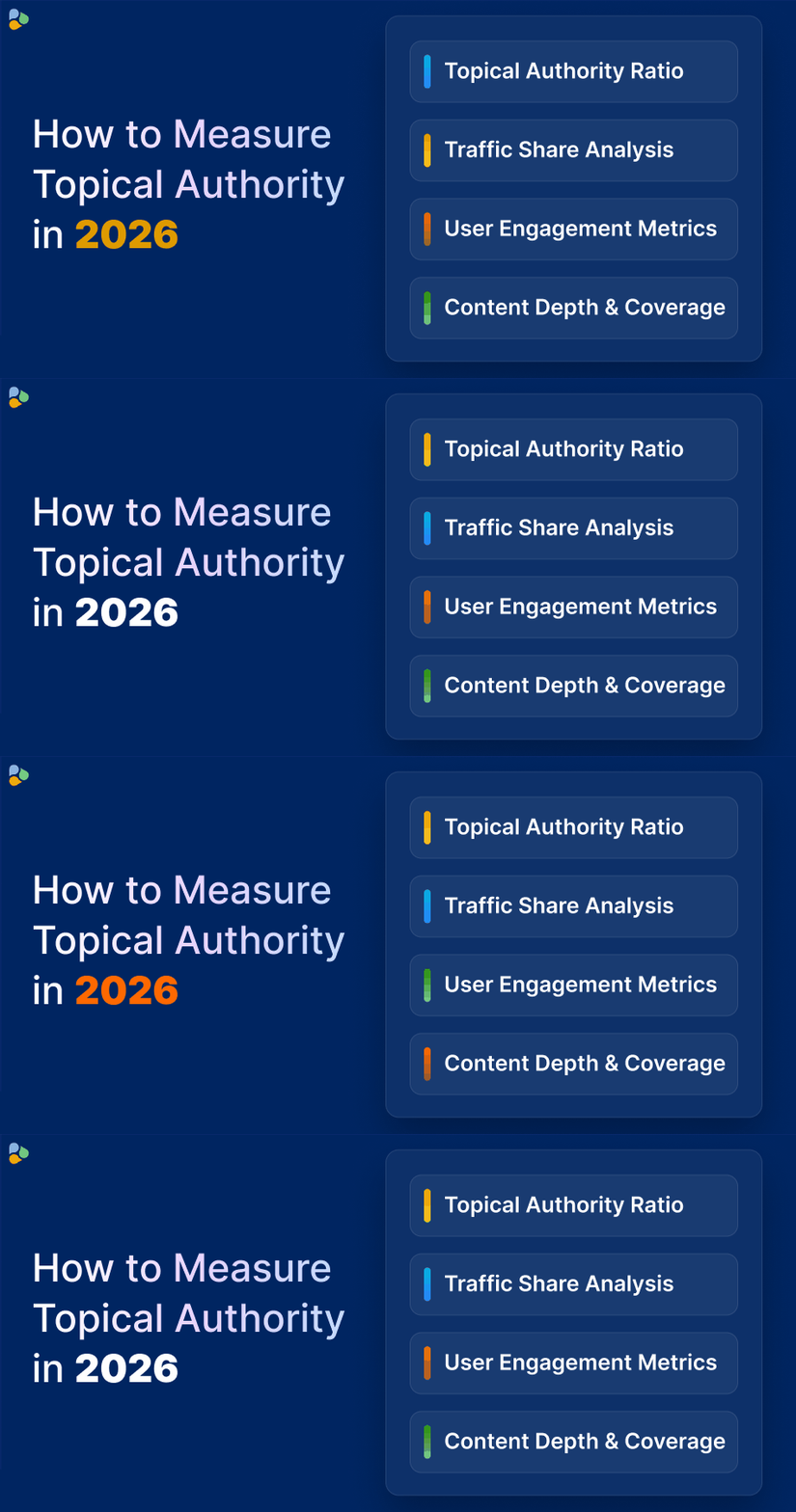
It is better understood by looking at the complete picture: how well your website covers a subject, how your pages perform in search, how they are connected, how much relevant organic traffic they attract and whether other trustworthy websites find the content useful.
The goal should not be to publish the most content.
The goal should be to become genuinely useful for a particular subject.
When your website consistently answers important questions, connects related information and provides real value to visitors, you create a stronger foundation for long-term organic visibility.
Frequently Asked Questions
What is topical authority in SEO?
Topical authority refers to how well a website covers a particular subject through useful, relevant and well-connected content.
Is there a topical authority score in Google?
No. Google does not provide website owners with a public topical authority score. Different SEO tools may have their own authority metrics, but these are third-party measurements.
How can I measure topical authority?
You can evaluate it by reviewing topic coverage, search visibility, relevant keyword rankings, internal links, organic traffic and relevant backlinks.
How many articles are needed to build topical authority?
There is no fixed number. The right amount depends on the subject and how many useful questions and subtopics need to be covered.
Does topical authority help with AI search?
Good topical coverage can support your overall search visibility, including AI-powered search experiences. However, there is no separate formula that guarantees visibility in AI search results.
Should I create one page for every keyword?
No. Create separate pages when they address different search intents or provide genuinely different values. Closely related keywords can often be covered naturally within the same useful piece of content.