There are millions of transactions that take place in banking systems each day. These include cash withdrawals, online payments, card payments and digital banking. However, with these convenient options come opportunities for financial fraud.
To combat this, banks may implement fraud detection systems. However, due to constantly evolving fraudulent methods, rule-based fraud detection systems may not be able to detect all fraudulent activity in transactions.
AI can be used to improve fraud detection in banking.
AI-based fraud detection enables banks to monitor transaction patterns, detect anomalies and identify potential fraud. Unlike rule-based systems, AI systems learn from previous transactions and can help identify patterns which may suggest fraud.
In this post we’ll look at how AI-based fraud detection works, how suspicious transactions are detected, key applications of AI-based fraud detection and the advantages of using AI to prevent financial fraud.
What is AI-based fraud detection?
AI-based fraud detection uses artificial intelligence and machine learning techniques to detect, monitor and prevent potential fraudulent activity.
Using large amounts of data in the banking system, patterns can be detected. This includes:
- The amount of money spent in a transaction
- Where in the world a payment was made
- Patterns in customer activity
- Device information
- Login activity
- Patterns in spending
For example, if a normal customer in Chandigarh suddenly starts making multiple high value transactions in quick succession from various countries, this could be suspicious.
Whilst a traditional banking system may detect this suspicious activity based on pre-set limits, an AI based fraud detection system can take multiple factors into consideration. These may be the frequency of transactions, location, device information and previous spending patterns.
If the transaction appears suspicious, a risk rating can be assigned, a flag raised or additional verification requested.
The objective of fraud detection systems is to detect suspicious activity as quickly as possible, whilst allowing genuine customers to complete their transactions with minimum disruption.
How does AI-Based Fraud Detection Work?
AI-based fraud detection looks at transaction data to understand customer patterns. Then, suspicious activity can be detected.
Machine learning models, predictive analysis, and real time monitoring systems are used in fraud detection systems.
Below outlines the general process.
Collecting data
Firstly, data is collected from the banking system.
AI fraud detection systems will look at:
- Amounts of money
- Frequencies of transactions
- History of spending
- Login activity
- Location of transactions and IP address
- Device and browser information
- Any previous fraudulent activity
- Beneficiaries and payments made
The information collected from customers can enable AI systems to understand typical customer activity.
Understanding normal customer patterns
Each customer has different patterns of activity. For example, some people frequently complete online purchases compared to only receiving salary, paying bills and transferring money in their accounts.
Historical transaction data can be analysed to understand customer patterns. For example, if a customer typically completes transfers between 9AM and 6PM, multiple large transfers completed at 3AM may need further investigation.
If a customer typically makes transactions in one geographical area, receiving a payment from a different country may seem suspicious.
Using customer patterns, AI systems can detect activity that deviates from typical financial behaviour.
Identify suspicious activity
Once customer patterns have been understood, transactions can be continuously monitored.
Machine learning models compare new transactions with previous patterns and known fraud patterns.
Transactions may be flagged if:
- A customer makes a large number of large payments in a short period of time.
- Multiple transactions are made within a few seconds.
- A payment is made from an unknown device.
- A customer logs into their account from an unusual location.
- There have been multiple failed login attempts.
- A large amount of money has just been sent to a new beneficiary.
Note: This does not necessarily mean fraud has occurred, but the transaction may require further verification.
Assign a fraud risk rating
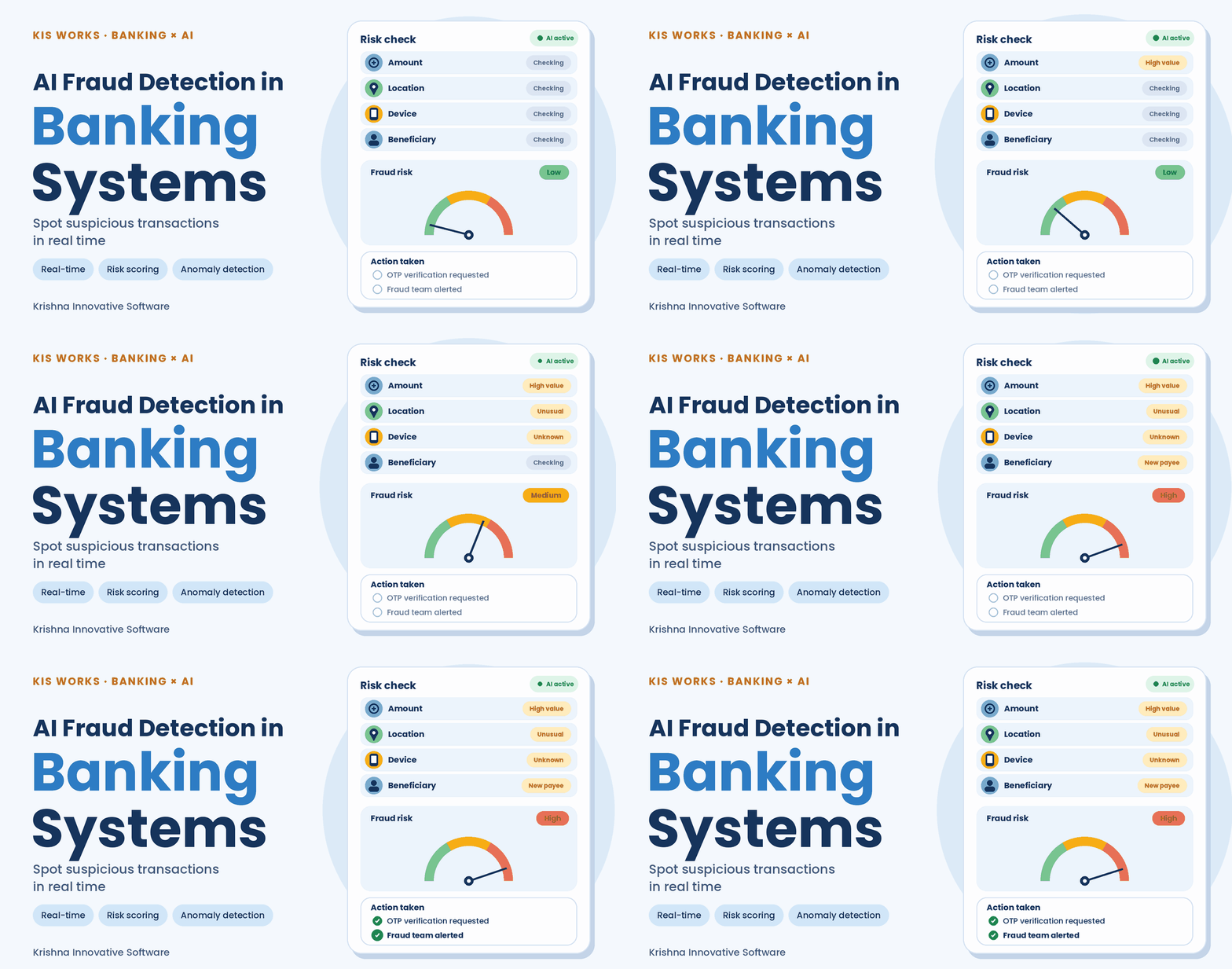
Depending on a range of factors, AI based fraud detection systems can assign a risk rating to transactions.
Low risk transactions may fit with the typical spending patterns of a customer, from a familiar location and device.
Medium risk transactions may be from an unknown device or from an unusual spend amount.
High risk transactions may include multiple suspicious factors such as unusual location, unknown device and multiple high value transactions in a short period of time.
Depending on the risk rating, banks can decide whether to allow a transaction, ask for additional verification, put it on hold or route it for further investigation.
Take action and learn from new data
If a suspicious transaction is detected, an appropriate action can be taken.
Depending on the risk level, actions may be:
- Allow the transaction
- Ask for an OTP or biometric verification
- Issue an instant notification to the customer
- Place the transaction on hold
- Raise an alert to the fraud investigation team at the bank.
AI models can also improve with time. By learning from known fraudulent activity, investigation results and new transaction patterns, AI models can be improved.
This means banks can adapt to new fraudulent techniques and improve their detection capabilities.
Technologies Used for fraud detection in banking
Multiple AI techniques can be used within fraud detection systems in banking systems.
Machine Learning
Machine learning enables systems to detect patterns in historical transactions.
By analysing previous transactions, algorithms can easily detect whether transactions are fraudulent. For example, unusual spending patterns, high frequencies of transactions and unusual changes in customer activity.
As more relevant data becomes available, models can be re-trained to detect new fraudulent patterns.
Deep Learning
Deep learning uses neural networks to detect complex patterns within large data sets.
It can detect complex connections between multiple factors in transactions. This may be difficult to detect using a rule based system.
Banks can use deep learning techniques to detect complex payment patterns, sequences of suspicious transactions and complex fraudulent patterns.
Behavioural Analysis
Behavioural analysis looks at how a customer usually interacts with the banking platform.
This may include:
- Typing behaviour
- Frequency of logins
- Device used
- Navigation
- Time of transaction
- Spending patterns
If there are any unusual patterns of activity within an account, this can be flagged for further verification.
Predictive Analysis
Predictive analysis uses historical data and statistical models to predict the probability of future events. Within banking, predictive analysis Can Help Detect accounts, transactions or activities which may pose a higher risk of fraud.
This means that preventative action can be taken, rather than reactive action after fraud has occurred.
Natural Language Processing (NLP)
Natural language processing helps AI systems understand human language.
Within banking, NLP Can Help Detect fraud in customer feedback, unusual communication, phishing and fraud reports. It can also help fraud investigation teams efficiently process large volumes of unstructured data.
Common types of fraud that AI can detect in banking systems
AI based fraud detection systems Can Help Detect many different types of financial fraud.
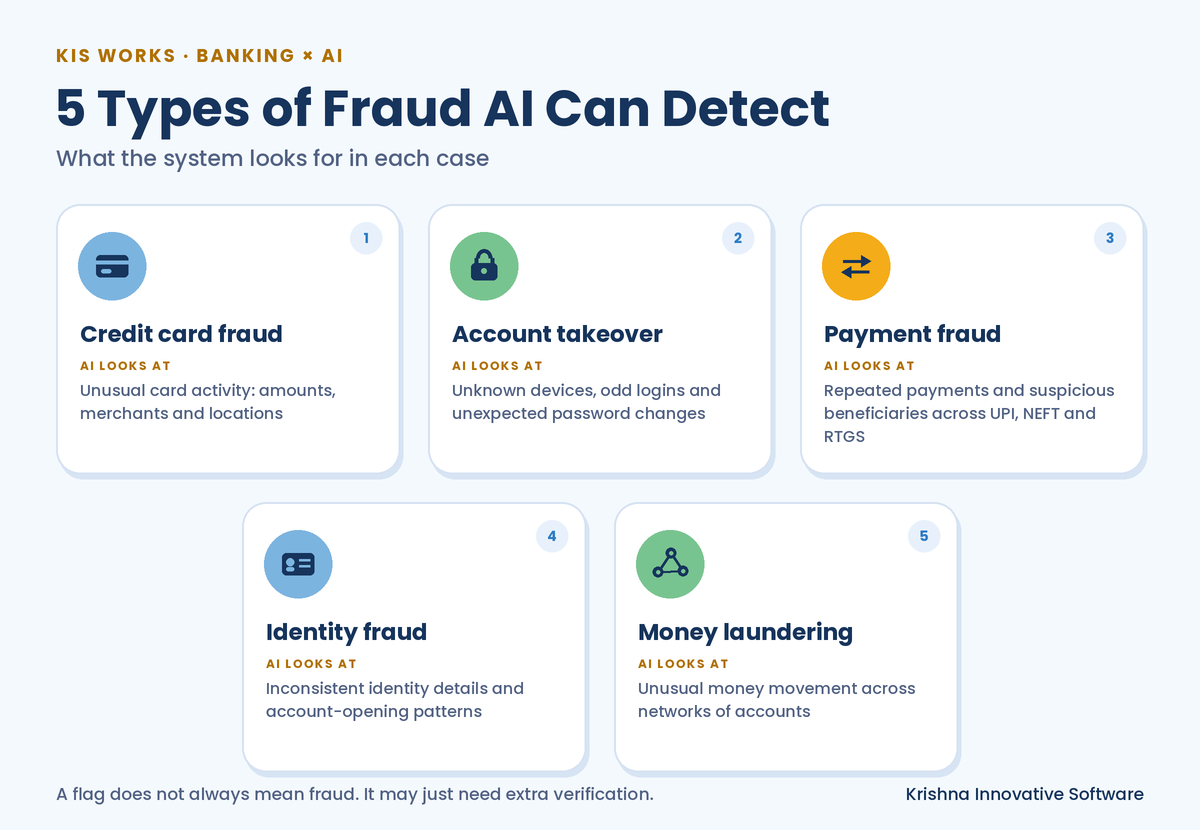
Credit card fraud
Credit card fraud involves using someone else’s card details without consent.
Card details may be obtained via phishing activity, data breaches, fake websites or stolen devices.
By looking at transaction amounts, merchant details, location of purchase and spending patterns, unusual card activity can be detected. If a customer normally makes small purchases but then suddenly has a number of expensive online payments from unfamiliar locations, these payments can be flagged for verification.
Account Takeover Fraud
Account takeover fraud involves criminals gaining unauthorised access to customers’ banking accounts. This may be done using stolen passwords, phishing links, malicious software or other techniques to get personal banking information.
Unusual login activity, unknown devices, unexpected password changes and suspicious activity within customer accounts can be identified by AI systems. If multiple risk factors are detected, additional verification may be required or restricted access may be imposed.
Payment fraud
With increased digital payments, new opportunities for fraudulent activity may be created. AI systems can detect unusual payments, repeated payments, suspicious beneficiaries and unusual payment frequency.
This can be very useful in detecting potential fraudulent activity in UPI, NEFT, RTGS and other digital payment methods.
Identity fraud
Identity fraud involves using someone else’s personal information to gain access to financial services, or open fraudulent accounts. AI systems can look at identity verification, device information, account opening patterns and spending patterns to detect inconsistencies. This can help banks identify potentially fraudulent account applications and suspicious identity activity.
Money laundering
Money laundering involves illegally gained money being moved through financial systems in order to disguise its original source. AI can help banks detect unusual money movement, by looking at networks of transactions and detecting suspicious patterns between multiple accounts.
For example, if there have been multiple transactions between multiple accounts, an unusually high frequency of transactions or complicated payment routes, this may indicate activity that needs further investigation. AI systems can help compliance teams detect these patterns and prioritise suspicious cases.
Applications of AI-based fraud detection in banking
Many banks are beginning to implement AI in their processes to improve security and reduce risk.
Below are key applications of AI based fraud detection in banking.
Real Time Transaction Monitoring
AI based systems can monitor transactions in real time. If a suspicious transaction is detected, an alert can be raised or additional verification can be requested. This means that banks can quickly respond to potential fraudulent activity.
Risk based verification
Depending on the type of transaction, levels of verification may vary.
AI systems can detect risk levels of transactions. If a high risk transaction is detected, additional verification may be required. For example, a typical bill payment from a familiar device may require simple verification, whereas a high value transaction from an unfamiliar device may require biometric verification or additional security checks.
Fraud detection in digital banking
Many transactions occur in mobile and online banking. AI systems can detect suspicious activity by analysing login details, device information, payments, and account activity. This can improve security in digital banking, without causing too many issues for genuine customers.
Detection of suspicious payment networks
Sometimes, fraudsters will move money between people/organisations using multiple accounts. AI systems can detect relationships between accounts, transactions, beneficiaries and payments. Using graph machine learning techniques, suspicious networks can be detected, that may not be so clear from individual transactions.
Assisting fraud investigation teams
Fraud investigation teams may receive large volumes of alerts. AI can be used to sort these alerts by risk level, highlight patterns in transactions and provide useful information. This means that investigation teams can prioritise cases that may require urgent attention.
Advantages of AI based fraud detection in banking
Implementing AI based fraud detection can provide many advantages to banks.
Quick detection of fraud
Compared to traditional methods, AI based detection can detect fraudulent activity quickly. As large volumes of transactions can be analysed quickly, suspicious patterns can be detected in near real time. This means that banks can respond to potential threats quickly.
Improved accuracy
As multiple factors in transactions can be considered, complex fraudulent patterns can be detected. However, accuracy will vary depending on quality of data, design and regular monitoring.
Fewer false positives
Sometimes genuine transactions can be incorrectly labelled as suspicious. For example, if a customer is overseas and makes a transaction from a location that they have not made transactions from before. By considering previous travel patterns, spending patterns, device information and previous transaction data, AI models can make a more informed risk decision. This means that fewer genuine transactions may be declined, improving customer experience.
Improved customer protection
AI based fraud detection can help protect customers by identifying potentially unauthorised activity before it causes large financial issues. Real time alerts, additional verification and suspicious activity monitoring can all help protect customer accounts.
Cost saving
Investigating fraudulent activity manually can be costly in terms of time, and staff. AI can be used to automatically monitor activity and prioritise alerts. This can reduce repetitive manual work and enable teams to manage large volumes of transactions effectively.
Improved support for risk and regulation
Banks need to adhere to strict financial regulations and security requirements. AI based systems can support monitoring transactions, detecting suspicious activity and assessing risk. However, it is important that AI solutions comply with relevant regulations and appropriate records are documented for investigations and audits.
Challenges in implementing AI based fraud detection in banking
Despite the great opportunities AI provides for fraud prevention in banking, there are some challenges.
Data Security and Privacy
As AI based fraud detection systems store sensitive customer and financial data, it is important that banks ensure that customer data is collected, stored, processed and accessed securely. Strong security measures such as encrypted data, access control, data management and data privacy should be incorporated in order to maintain customers’ trust.
Poor quality data
AI models rely on accurate, relevant data. If transaction data is incomplete, out of date, or inconsistent this may affect the quality of fraud detection. Reliable data management systems need to be in place to ensure accurate AI models.
Evolving fraud techniques
Fraudsters are always developing new techniques to bypass security. If an AI model has been trained on previous fraudulent patterns, it may not detect completely new methods. To combat this, models should be regularly monitored, assessed and updated in order to keep up with emerging threats.
False alerts
Even with advanced AI systems, genuine transactions can be detected as suspicious. Too many false alerts can cause issues for customers and put pressure on investigative teams. To overcome this, models should be continually assessed and thresholds changed in order to find a balance between security and customer convenience.
Integrating AI with current banking Systems
Many financial institutions may still be using legacy systems. Integrating AI based fraud detection systems with current core banking systems, payment gateways and customer management systems can be challenging. A good plan for integration is vital to allow efficient data to be passed between systems and to avoid any issues in banking.
Future of AI Based Fraud Detection in Banking
AI in banking will become much more advanced and intelligent in order to provide real time risk assessment. As digital payments become more common, banks will need better ways of detecting suspicious activity and protecting customer accounts. Key developments include:
Advanced behavioural biometrics
AI systems may begin to use behavioural cues such as typing, device interaction and navigation to detect unauthorised access to accounts.
Generative AI for fraud investigation
Generative AI can help support investigation teams by summarising suspicious transaction history, organising information about cases and recognising relevant patterns in large volumes of financial data. These systems should support human investigation teams rather than making decisions as to whether a customer has committed fraud.
Graph Based Fraud detection
Graph analysis and machine learning can allow banks to understand relationships between accounts, beneficiaries, devices and transactions. This Can Help Detect organised fraudulent activity.
Explainable AI
It is important for financial institutes to understand the reasons why a transaction has been flagged by an AI model. Explainable AI can provide insight into why a risk assessment has been given, providing support for investigations, governance and auditing.
Collaborative Fraud intelligence
Financial institutions may begin to explore secure ways to share fraud intelligence in order to detect suspicious activity across a number of payment networks. This must be done in a way which respects data privacy and regulations.
The aim is to create more effective banking systems in order to detect potential threats early, efficiently and create safer digital banking for customers.
How AI Development companies can help banks Implement Fraud Detection Solutions
To create an effective AI based fraud detection system, secure software architecture, reliable data, real time processing and integration with current financial systems is needed. AI development companies can support financial institutions with this.
AI development partners can support banks by:
Developing custom AI models
Creating machine learning models to detect fraud within banking transactions.
Real time processing
Creating systems which can analyse transactions in real time and create risk alerts in a timely manner.
Integrating AI
Integrating AI features with existing banking applications, APIs, payment systems and core banking systems.
Predictive analysis
Analysing historical transaction data to detect suspicious patterns and assess potential financial risks.
Intelligent automation
Automatically categorising fraud alerts, supporting investigations and completing repetitive monitoring tasks.
Secure AI Architecture
Creating scalable solutions with appropriate data security, access control, monitoring and security measures.
Krishna Innovative Software (KIS Works) can support businesses with AI driven software solutions in order to improve efficiency and make more intelligent business decisions.
With our AI development and integration knowledge, we can support financial organisations to consider custom AI applications, intelligent automation, predictive analytics and integration with current systems.
Summary
AI based fraud detection is becoming an important security measure in banking. With millions of transactions within banking systems on a daily basis, traditional rule based systems may no longer be sufficient to detect increasingly complex fraud.
By utilising AI, banks can understand transaction patterns, detect anomalies, assign risk levels and identify potential fraudulent activity in real time.
AI can support financial institutions to improve security by detecting credit card fraud, account takeovers, suspicious payment networks and money laundering activity. However, in order to successfully implement AI based fraud detection, reliable data, continual monitoring of models, good cyber security measures and appropriate human oversight should be in place.
With increasing digital banking, AI based fraud detection will become an increasingly important tool to protect financial transactions and build trust with customers.