The banking and financial sector are seeing some huge technological changes. Customers now expect fast, personalised banking and financial services with secure online banking. However, banks must also ensure they can prevent fraud, reduce costs and manage financial risk.
Many traditional banking processes can be time-consuming and involve lots of manual processes and administration.
This is where AI is coming in.
AI can help streamline banking processes. Whether it’s automating repetitive tasks, analysing financial data, identifying fraudulent activity or improving customer service, banks and financial institutions are using AI. These include chatbots, fraud detection and much more.
We will take a look at how AI is revolutionising banking & financial services. We will look at the main uses of AI in this industry, along with the benefits, challenges and future opportunities.
What is AI In Banking & Financial Services?
Artificial Intelligence in banking & financial services includes using technology to automate processes, analyse customer data and provide insights to help make business decisions.
Some examples of AI technology are:
- Machine Learning – analyse past financial data to identify patterns and predict risks.
- Natural Language Processing (NLP) – enables AI systems to understand customers queries.
- Generative AI – helps create reports, summarise documents and provide intelligent customer service.
- Predictive Analytics – uses historic data to help predict financial trends.
- Computer Vision – helps automate document verification.
With these technologies, financial institutions can create intelligent systems.
How is AI Revolutionising Banking & Financial Services?

AI is transforming many parts of the banking industry including customer service, fraud detection, loan processing, financial analysis and risk management.
1. AI Fraud Detection & Prevention
Fraud is one of the biggest issues banks face. Fraudsters are constantly finding new ways to steal customer data, gain access to their banking accounts and carry out fraudulent activity.
Traditional fraud detection systems often use rule-based systems and may not identify new patterns.
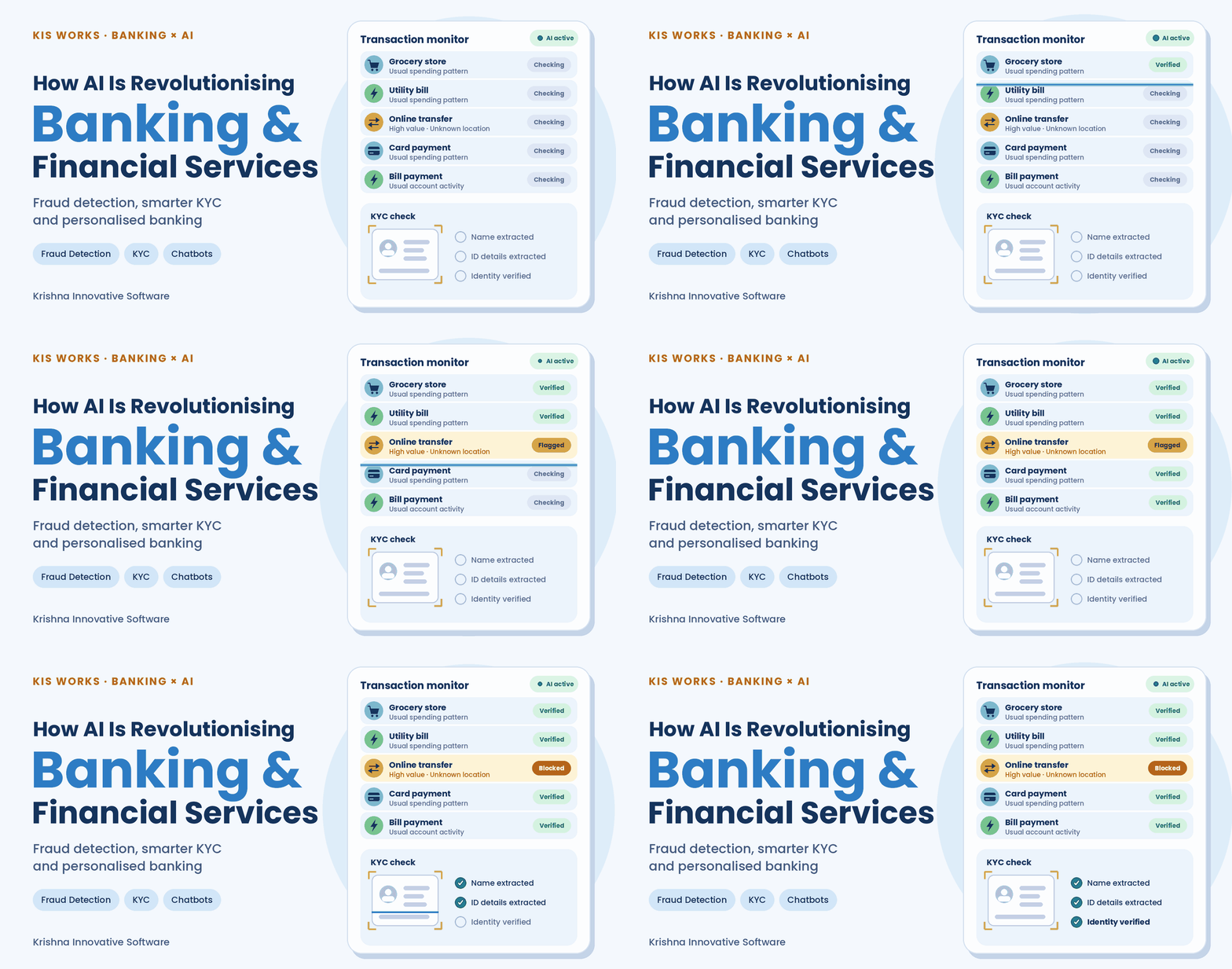
AI can help by identifying fraudulent activity through analysing transaction patterns.
Some examples of AI detecting fraudulent activity are:
- Multiple high value transactions.
- Transactions from unusual locations.
- Unusual spending patterns.
- Multiple failed logins.
- Unusual payments.
For example, if a customer usually makes small transactions within India and suddenly they are being asked to make multiple high value transactions from an unknown location, this can be flagged by an AI system.
This means fraud can be addressed quickly.
2. AI Chatbots
Banks have thousands of customer queries regarding their account balances, transactions, credit cards, loan applications and payments. This can be costly and time-consuming to process manually.
AI chatbots and virtual assistants can help automate common customer interactions.
Using natural language processing and generative AI, they can understand customer queries.
Customers can ask questions such as:
- How can I check my account balance?
- What documents do I need for a personal loan?
- How can I block my debit card?
- What is the status of my loan?
Sophisticated AI assistants can also be connected to banking systems using secure APIs. This allows them to pull information from the relevant areas.
For example, if a customer wants to know the status of their loan application, they can use an AI assistant. The AI assistant will pull the information for them.
This improves the response time and reduces pressure on customer service.
3. AI Credit Scoring & Loan Processing
When approving a loan, banks need to look at the income, repayment history, debts and creditworthiness of the applicant.
Traditional methods can be long and involve lots of documentation.
AI can speed up the process.
Machine Learning can analyse:
- Previous loan repayment history.
- Income and employment details.
- Debts.
- Credit history.
- Relevant transaction patterns.
AI systems can help financial institutions identify the risks involved.
AI can extract information from financial documents and identify any missing information.
For example, if a customer applies for a personal loan, AI can extract information from the documents provided and provide a credit risk assessment for the loan approval team.
Human oversight should be given when using AI for credit-related decisions.
4. Risk Management & Financial Analysis
Banks often have various financial risks to consider including credit risk, market risk, liquidity risk and operational risk.
AI can help financial institutions by analysing past information, monitoring financial situations and identifying patterns.
AI systems can help by:
- Analysing changes in repayment patterns.
- Identifying customers who are at risk of defaulting on repayments.
- Monitor unusual financial activity.
- Analysing market trends and financial indicators.
- Improving forecasting.
For example, banks can use AI to analyse repayment patterns on loans. This can identify customers who have recently changed their repayment patterns. This will help the risk management team investigate.
Whilst AI can’t completely remove financial risk, it can help identify warning signs.
5. Automating KYC
KYC is an important part of banking. Financial institutions need to verify customer identities.
Traditionally this can be time-consuming and involve manual processes.
AI can help simplify this process. Using document processing, computer vision and intelligent automation.
AI Onboarding systems can help by:
- Extracting information from ID documents.
- Identifying any missing information.
- Identifying any inconsistencies.
- Helping verify identities.
- Organising customer information.
For example, when a customer uploads an ID document during account setup, AI can extract the relevant information.
This can reduce repetitive tasks.
6. Personalised Banking & Financial Recommendations
All banking customers will have different financial needs, spending habits and savings goals.
AI can help analyse customer behaviour to provide more relevant recommendations.
Banks can use authorised customer data to help provide:
- Personalised saving recommendations.
- Relevant credit card offers.
- Appropriate banking products.
- Budgeting tips.
- Analysis of spending patterns.
- Personalised financial alerts.
For example, AI powered banking apps can analyse customer spending each month. This can identify any regular spending. This can then provide budgeting tips and saving recommendations.
Recommendations should be transparent.
7. Automating Financial Processes
Banks often have many repetitive admin tasks. These can include processing documents, creating reports, updating information and reconciling transactions.
AI can help streamline many of these processes with intelligent automation.
Financial institutions can use AI to:
- Extract information from financial documents.
- Categorise financial transactions.
- Summarise long financial reports.
- Automate internal document processing.
- Help with reconciliation.
- Create reports.
For example, a bank’s finance department often receive hundreds of financial documents each day. An AI powered document processing solution can extract relevant information, categorise and send to the correct department.
This will free up employees to focus on more important financial tasks.
8. Investment Management
Investment management involves analysing financial markets, economic indicators, company performance and investment changes.
AI can help financial advisors and wealth management companies analyse this information.
AI investment tools can help with:
- Analysing financial markets.
- Monitoring portfolio performance.
- Identifying investment risks.
- Identifying market trends.
- Analysing portfolio diversification.
- Providing personalised investment insights.
For example, AI powered wealth management platforms can analyse a customer’s investment portfolio. This can identify areas where they could be at greater risk. Financial advisors can then use this information to identify any potential changes.
Investment recommendations should always be checked to ensure they are suitable. AI can’t guarantee investment returns.
Benefits of AI In Banking & Financial Services
There are many benefits to using AI in banking.
Improved Efficiency
AI can help automate repetitive tasks such as document processing, customer queries and report creation. This means employees can focus on important aspects of the business.
Fast Decision Making
AI can analyse large amounts of financial data quickly. This can help financial institutions make informed decisions.
Improved Customer Service
AI chatbots and virtual assistants can provide a faster response.
Reduced Costs
AI can help reduce costs by automating repetitive tasks.
Improved Fraud Detection
AI systems can monitor transaction patterns and identify any suspicious activity.
Improved Financial Insights
AI can help banks understand customer behaviour, identify financial trends and improve planning.
Challenges Of Using AI In Banking
Whilst there are many opportunities with using AI in banking, there are challenges to overcome.
Data Security
Banks often process sensitive data relating to customers. AI systems should be secure and use encryption, security and access control.
Compliance
Financial institutions must comply with relevant banking regulations and data protection laws. AI solutions should be created in line with guidelines.
Bias
AI systems may create unfair results if there are biases in the data they are trained on. This can be a problem when using AI for credit scoring and loan approvals. Regular testing is important.
Compatibility
Many financial institutions use legacy banking systems. AI solutions must be compatible with the systems. This can be achieved by creating the correct APIs, system design and testing.
Accuracy
Sometimes AI can provide inaccurate information. Important financial decisions should be reviewed.
The Future Of AI In Banking & Financial Services
AI will play an important role in the future of financial services. Some key developments are:
AI Agents
AI agents can perform complex tasks by interacting with approved systems. They can help employees find information, create reports and manage internal processes.
Improved Fraud Detection
AI systems will continue to improve by analysing transaction patterns and identifying any suspicious activity.
Intelligent Virtual Assistants
AI assistants will become more intelligent and understand what the customer needs. They can help customers with personalised support and carry out authorised banking requests.
Increased Automation
Financial institutions will look to increase automation using AI. This can include onboarding, document processing, compliance and financial reporting.
Personalised Financial Services
AI will help banks provide personalised financial services. They can analyse customer behaviours, provide personalised saving insights and recommend relevant financial products.
How Can Banks Get Started With AI?
To implement AI into banking it is important to identify the right issues to solve.
You could start by:
- Identifying Business Needs – Identify what processes are taking up a lot of time for employees. This could be customer service, document verification and financial reporting.
- Data Availability – Review the quality, availability, security and structure of the data you need.
- Select The Right AI Technology – Choose the right technology to help solve your issues. This could include machine learning, NLP, generative AI and predictive analytics.
- Create A Solution – Create an AI solution which can connect with your banking systems securely using APIs.
- Test & Monitor – Ensure the AI solution is accurate, secure, reliable and performs well.
- Human Oversight – Decide how you will approve, who will have access and who will be responsible.
Starting with a specific use-case will help financial institutions see the results from AI.
Conclusion
Artificial Intelligence is transforming the banking & financial industry. Financial institutions can use AI to improve customer service, automate processes, identify any suspicious activity, analyse financial data and make more informed decisions.
From chatbots, automated KYC, intelligent fraud detection and personalised financial recommendations, AI is opening up new opportunities within the financial sector.
However, it is important to consider data security, compliance, compatibility, accuracy and responsible AI usage.
At Krishna Innovative Software (KIS Works) we can help businesses look at their digital transformation. We can provide AI development, AI integration, intelligent automation and bespoke software solutions. Our focus is on creating technology solutions that match your business needs.
If your organisation is looking to implement AI to improve financial processes, automate processes or create intelligent applications, using the right approach to AI development will help turn your ideas into reality.
Frequently Asked Questions
1. How is AI used in banking & financial services?
AI can be used for fraud detection, customer service, credit scoring, loan processing, KYC verification, financial analysis, risk management and automated banking processes.
2. How does AI help banks detect financial fraud?
AI can analyse transaction data and identify any unusual patterns. Machine learning models can identify suspicious activity and alert.
3. Can AI automate banking processes?
Yes! AI can help automate document processing, customer service, extracting data, monitoring transactions, creating reports and managing internal processes.
4. Is AI safe to use in banking?
AI can be used safely by ensuring correct security measures, data protection, compliance, testing models and human oversight.
5. What is the future of AI in financial services?
The future will involve using advanced AI agents, intelligent fraud detection, personalised banking, automation and improved financial analytics.