Fraud has always been a challenge for businesses, but the way fraud happens has changed significantly. With more payments, purchases, banking services, and customer interactions happening online, fraudsters have more opportunities to exploit digital systems.
Traditional fraud detection usually depends on predefined rules. For example, a company might flag a transaction when the amount is unusually high or when a customer suddenly logs in from another country. These rules are useful, but they cannot always keep up with new fraud patterns.
This is where machine learning fraud detection becomes useful.
Machine learning can analyze large amounts of transaction and customer data, identify unusual patterns, and help businesses decide whether an activity looks legitimate or suspicious. Instead of relying entirely on fixed rules, an ML-based fraud detection system can learn from historical behavior and improve as new data becomes available.
In this article, we will look at how companies implement ML-based fraud detection systems, how the technology works, which machine learning models are commonly used, and what businesses need to consider before putting such a system into production.
What Is ML-Based Fraud Detection?
ML-based fraud detection is the use of machine learning to identify potentially fraudulent activity.
The basic idea is simple. A company provides a machine learning model with historical data containing examples of normal and fraudulent behavior. The model studies this data and learns patterns that can help distinguish legitimate activity from suspicious activity.
When a new transaction takes place, the system checks it against these learned patterns.
For example, imagine a customer who normally makes small purchases from the same city. Suddenly, a large transaction is made from a new device in another location, followed by several additional transactions within a few minutes.
None of these events alone necessarily proves that the transaction is fraudulent. But when they are considered together, the activity may look unusual.
An ML-based fraud detection system can combine these signals and assign a risk score to the transaction.
A low-risk transaction can be approved normally. A transaction with a moderate risk score might require additional verification, while a high-risk transaction could be blocked or sent to a fraud analyst for review.
This risk-based approach is one of the main reasons businesses are investing in machine learning for fraud prevention.
Why Are Companies Moving Beyond Traditional Fraud Detection?
Traditional rules are still useful. In fact, most businesses do not completely remove them when implementing machine learning.
The problem is that fraud does not follow a fixed pattern.
Fraudsters change devices, locations, payment methods, accounts, and techniques. A rule created today may not work as well tomorrow.
Machine learning provides another layer of analysis. Instead of asking only whether a particular rule has been broken, an ML model can look at many signals together and identify behavior that is different from what it has learned to expect.
For businesses, this can provide several benefits.
Better Pattern Recognition
A machine learning model can consider many variables at the same time. This makes it possible to identify relationships that may be difficult to capture with individual rules.
Faster Fraud Detection
For digital payments and online transactions, speed matters. A fraud detection system may need to analyze a transaction within seconds before deciding whether it should continue.
Handling Large Volumes of Data
Large banks, payment providers, marketplaces, and e-commerce companies process huge numbers of transactions. Manually reviewing every transaction is not practical.
Machine learning can automatically evaluate transactions and help fraud teams concentrate on cases that need closer attention.
Understanding Customer Behavior
Fraud detection is not always about the transaction itself. Customer behavior can also provide useful information.
Changes in login patterns, devices, locations, spending habits, or transaction frequency can indicate that an account may have been compromised.
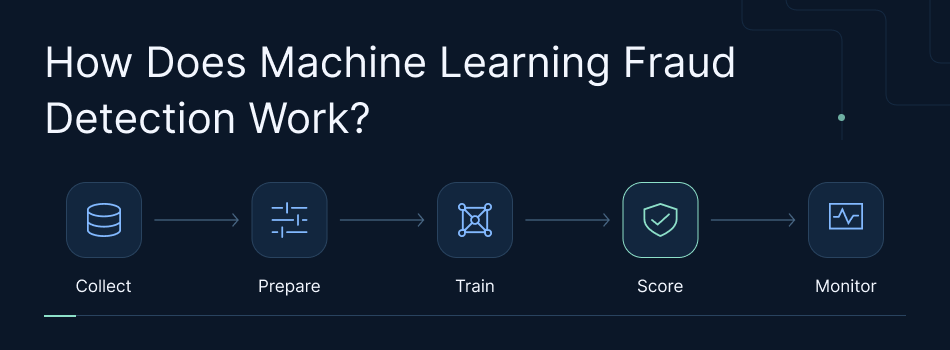
How Does Machine Learning Fraud Detection Work?
A typical fraud detection system follows a process that looks something like this:
Data Collection → Data Preparation → Feature Engineering → Model Training → Risk Scoring → Decision → Monitoring
Each stage is important. A sophisticated model cannot compensate for poor data or an unreliable data pipeline.
Let’s look at the process in more detail.
1. Collect the Right Data
The first step is to collect information that can help the system understand normal and suspicious behavior.
The exact data depends on the business and the type of fraud it wants to detect.
For a payment company, this could include:
- Transaction amount
- Transaction time
- Payment method
- Merchant information
- Customer history
- Device information
- IP address
- Location
- Login activity
- Account age
- Previous suspicious activity
- Transaction frequency
The goal is not to collect as much data as possible. The goal is to collect useful and relevant data that can help explain customer and transaction behavior.
Data privacy and security also need to be considered from the beginning because fraud detection systems can process sensitive information.
2. Clean and Prepare the Data
Raw business data is rarely ready to be used directly in a machine learning model.
Companies may have duplicate records, missing values, inconsistent formats, incorrect entries, or incomplete transaction histories.
Before training the model, data teams usually need to clean and organize the information.
Another major challenge is that fraudulent transactions are usually much less common than legitimate ones.
For example, a business might have millions of legitimate transactions but only a small percentage of confirmed fraud cases. If this imbalance is ignored, a model may appear highly accurate while still missing a significant number of fraudulent transactions.
That is why fraud detection models need to be evaluated carefully.
3. Create Useful Features
This is where feature engineering becomes important.
Instead of giving the model only raw transaction information, companies can create additional signals that provide more context.
For example, rather than simply telling the model that a transaction is worth ₹50,000, the system could also calculate:
- The customer’s average transaction amount
- How many transactions occurred in the last 10 minutes
- Whether the customer is using a new device
- How far the current location is from previous transactions
- How often the account has changed devices
- Whether the transaction amount is unusual for that customer
These additional signals can help the model understand whether the transaction is normal for that particular customer.
This is often more useful than looking at individual transaction values in isolation.
4. Choose and Train a Machine Learning Model
Once the data and features are ready, the company can begin testing different machine learning models.
There is no single algorithm that works for every fraud detection problem.
Depending on the use case, companies may experiment with:
- Logistic Regression
- Decision Trees
- Random Forest
- XGBoost
- Gradient Boosting
- Isolation Forest
- Neural Networks
- Autoencoders
- Graph-based machine learning
For structured transaction data, models such as XGBoost and other tree-based methods are often considered because they can work well with tabular data.
For anomaly detection, approaches such as Isolation Forest can be useful.
More complex applications may also explore neural networks or graph-based approaches, particularly when relationships between accounts, devices, transactions, and users are important.
The right choice depends on the data, business requirements, model performance, explainability needs, and infrastructure.
5. Test the Model Properly
One of the biggest mistakes in fraud detection is focusing only on accuracy.
Suppose a company has one million transactions and only 1,000 are fraudulent. A model could classify almost every transaction as legitimate and still achieve very high accuracy.
That would not make it a useful fraud detection model.
Businesses therefore look at other metrics, including:
- Precision
- Recall
- F1 score
- False-positive rate
- False-negative rate
- Precision-recall performance
- Detection speed
The business impact also matters.
Missing a fraudulent transaction can result in financial losses. On the other hand, incorrectly blocking legitimate customers can create frustration and potentially cause customers to leave.
A good fraud detection strategy needs to consider both sides.
6. Put Real-Time Fraud Detection Into the Workflow
Training a model is only one part of the project. The model eventually needs to work inside the company’s existing business process.
For a payment platform, the flow might look like this:
Customer makes payment → Transaction data is collected → Features are generated → ML model evaluates the transaction → Risk score is generated → System decides what to do
The decision could be straightforward:
Low risk: Approve the transaction.
Medium risk: Ask the customer for additional verification.
High risk: Hold the transaction or send it for investigation.
The exact thresholds will depend on the company’s risk tolerance and business requirements.
Real-time fraud detection is particularly important for businesses where decisions need to be made within seconds.
7. Combine Machine Learning With Rules
Machine learning does not mean that companies need to throw away their existing fraud rules.
In many real-world systems, the two approaches work together.
For example, a company may already have a rule that flags transactions involving a known compromised account. That rule can continue to operate while the machine learning model evaluates the broader behavior surrounding the transaction.
A hybrid fraud detection system might therefore include:
Rules: Handle known and clearly defined fraud conditions.
Machine Learning: Identify patterns and calculate risk.
Decision Engine: Combine the available signals and determine the next action.
This approach gives businesses the flexibility of traditional rules while adding the pattern-recognition capabilities of machine learning.
8. Use Behavioral Analytics to Understand Customers
Fraud is often easier to identify when a business understands what normal customer behavior looks like.
Consider an online banking customer who normally logs in from the same device, makes a few transactions every week, and uses the service from a consistent location.
If the account suddenly starts showing several unusual login attempts followed by high-value transactions from a new device, the behavior deserves closer attention.
Behavioral analytics allows fraud detection systems to look beyond individual transactions and consider the broader activity of an account.
This can be particularly useful for detecting account takeover and identity-related fraud.
9. Add Human Review Where It Makes Sense
Not every suspicious transaction should automatically be blocked.
Some cases are straightforward, while others require context that a model may not have.
For example, a customer may make an unusually large purchase because they are buying something expensive for a special occasion. The transaction may look unusual compared with their normal behavior, but that does not necessarily mean it is fraudulent.
This is where human review can be useful.
Companies can route borderline cases to fraud analysts who can investigate the activity and make a final decision.
The feedback from these investigations can also become valuable training data for future model improvements.
10. Monitor the System After Deployment
Launching a fraud detection model is not the end of the project.
Fraud patterns change. Customer behavior changes. Products change. New payment methods appear. Attackers find new ways to bypass security systems.
As a result, a model that performs well today may not perform as well several months later.
Companies should continuously monitor things such as:
- Fraud detection performance
- False positives
- False negatives
- Data quality
- Model predictions
- Processing time
- Changes in customer behavior
- Model drift
- Financial losses
- Customer complaints
If performance begins to decline, the team may need to update the features, adjust thresholds, retrain the model, or make changes to the overall fraud detection pipeline.
Common Challenges With ML-Based Fraud Detection
Although machine learning can provide significant benefits, implementing it successfully is not always easy.
Fraud Data Is Often Imbalanced
Legitimate transactions usually outnumber fraudulent transactions by a large margin. This makes model training and evaluation more challenging.
False Positives Can Hurt Customer Experience
If a system is too aggressive, legitimate customers may repeatedly be asked for verification or have their transactions blocked.
Fraud prevention needs to be balanced with customer convenience.
Fraud Techniques Keep Changing
Fraudsters constantly experiment with new techniques. Models therefore need regular monitoring and improvement.
Data Quality Can Affect Results
An ML model is only as reliable as the data used to train and operate it. Missing, outdated, or incorrect information can affect predictions.
Existing Systems Can Be Difficult to Integrate
Large organizations often have legacy banking, payment, CRM, or transaction systems. Connecting a new ML fraud detection platform with these systems may require significant development work.
Explainability Can Be Important
Some machine learning models are difficult to interpret. Fraud teams may need to understand why a particular transaction received a high-risk score, especially when the decision affects a customer.
Where Is ML-Based Fraud Detection Being Used?
Machine learning fraud detection can be applied across many industries.
Banking and Financial Services
Banks can use ML to identify unusual transactions, account activity, payment behavior, and potential account takeover.
E-commerce
Online retailers can use fraud detection to identify suspicious purchases, fake accounts, payment fraud, and unusual order behavior.
Insurance
Insurance companies can analyze claims and customer information to identify potentially suspicious claim patterns.
Digital Payments
Payment providers can evaluate transactions in real time and assign risk scores before completing them.
Telecom
Telecom companies can use behavioral patterns and account activity to identify suspicious usage and other forms of fraud.
Online Platforms
Marketplaces and digital platforms can use ML to identify fake accounts, suspicious activity, payment abuse, and unusual user behavior.
What Is the Future of ML-Based Fraud Detection?
Fraud detection is moving toward systems that are faster, more connected, and more adaptive.
One important area is graph-based fraud detection. Instead of looking at transactions individually, graph models can examine relationships between users, accounts, devices, merchants, and transactions. This can help uncover networks of related suspicious activity.
Another important development is explainable AI. As businesses rely more heavily on machine learning for risk decisions, understanding why a model produced a particular prediction becomes increasingly valuable.
Real-time analytics will also continue to play an important role. Businesses want to identify suspicious activity as close as possible to the moment it happens rather than discovering it after the damage has already occurred.
At the same time, hybrid systems that combine machine learning, rules, behavioral analytics, and human investigation are likely to remain practical for many businesses.
How Should Companies Start With ML Fraud Detection?
Companies do not necessarily need to build a complex fraud detection platform from day one.
A better approach is often to start with a specific business problem.
For example, a company might begin with payment fraud or account takeover. Once the team understands the data and establishes a reliable workflow, additional use cases can be added.
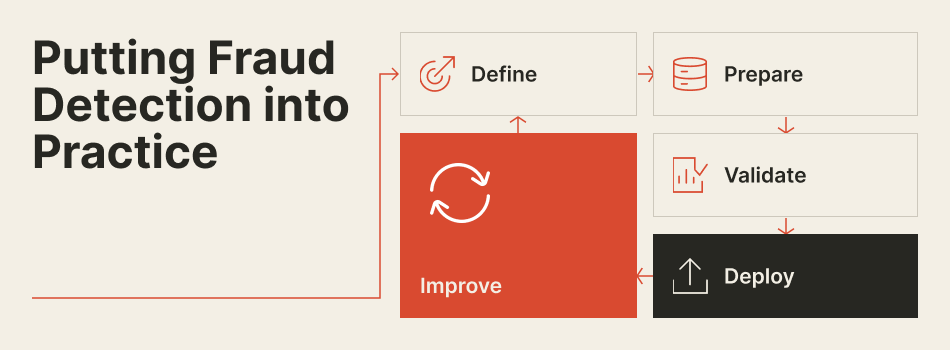
A practical implementation process could look like this:
- Identify the main fraud problem.
- Collect and understand the available data.
- Clean and prepare the historical data.
- Create useful behavioral and transaction features.
- Test suitable machine learning models.
- Evaluate the model using relevant fraud metrics.
- Integrate the model into the business workflow.
- Combine ML predictions with existing rules where required.
- Monitor the system after deployment.
- Retrain and improve the model as fraud patterns change.
This approach makes the project easier to manage and allows the organization to measure the real business impact of its fraud detection solution.
Conclusion
Machine learning is changing the way companies approach fraud detection.
Instead of relying only on predefined rules, businesses can use ML-based fraud detection systems to analyze large volumes of data, understand customer behavior, identify unusual patterns, and assign risk scores to transactions and activities.
But machine learning alone is not a complete fraud prevention strategy.
A successful system requires good-quality data, meaningful features, the right model, real-time processing, business rules, monitoring, human oversight, and continuous improvement.
As fraud becomes more sophisticated, companies will need detection systems that can adapt without creating unnecessary friction for legitimate customers. By combining machine learning with behavioral analytics, real-time data, explainability, and traditional fraud prevention methods, businesses can build a more flexible and practical approach to detecting suspicious activity.
Frequently Asked Questions
What is ML-based fraud detection?
ML-based fraud detection uses machine learning algorithms to identify suspicious transactions and behavior by learning patterns from historical and current data.
How does machine learning detect fraud?
Machine learning analyzes transaction, customer, device, location, and behavioral data to identify patterns associated with legitimate or suspicious activity. The system can then generate a risk score for new activity.
Which algorithms are used for fraud detection?
Common approaches include Logistic Regression, Random Forest, XGBoost, Gradient Boosting, Isolation Forest, Neural Networks, Autoencoders, and graph-based machine learning.
Can machine learning detect new types of fraud?
Machine learning can help identify unusual patterns that may not match existing rules. However, no model can guarantee detection of every new fraud technique, so continuous monitoring and improvement are important.
What is real-time fraud detection?
Real-time fraud detection evaluates activity as it happens. A transaction is analyzed, a risk score is generated, and the system can then approve, challenge, hold, or flag the activity.
Should companies use machine learning instead of fraud detection rules?
Not necessarily. Many businesses can benefit from a hybrid approach where machine learning works alongside traditional rules and business policies.
How often should a fraud detection model be updated?
There is no fixed schedule that works for every organization. Models should be monitored continuously and updated when performance declines, fraud patterns change, or significant data drift occurs.