Due to advances in digital banking, customers now have greater access to their banking services without having to visit physical branches. Customers can view balances, send money, pay, apply for loans and manage their accounts via mobile banking and online banking.
As digital banking has developed, customer expectations have increased. Customers expect quick, round the clock support and easy solutions to any banking issue they face. This can be very challenging for banks, as customer support teams may be receiving thousands of queries daily.
Challenges with Traditional Customer Support
Supporting customers via phone, email and in person can be difficult in meeting the current customer expectations.
Solutions with AI Chatbots
AI chatbots in banking aim to improve customer support by improving efficiency and providing answers to common queries. Using AI technology, Natural Language Processing and machine learning, AI chatbots can understand customer queries and provide relevant answers.
In this blog, we’ll look at how AI chatbots work, applications, benefits, challenges to implement, and how AI chatbots in banking are improving customer support.
What are AI Chatbots in Banking?
AI chatbots in banking allow customers to receive support via text or speech.
Unlike traditional chatbots, AI chatbots can understand natural language so that they can respond to queries appropriately.
For example, a customer can ask:
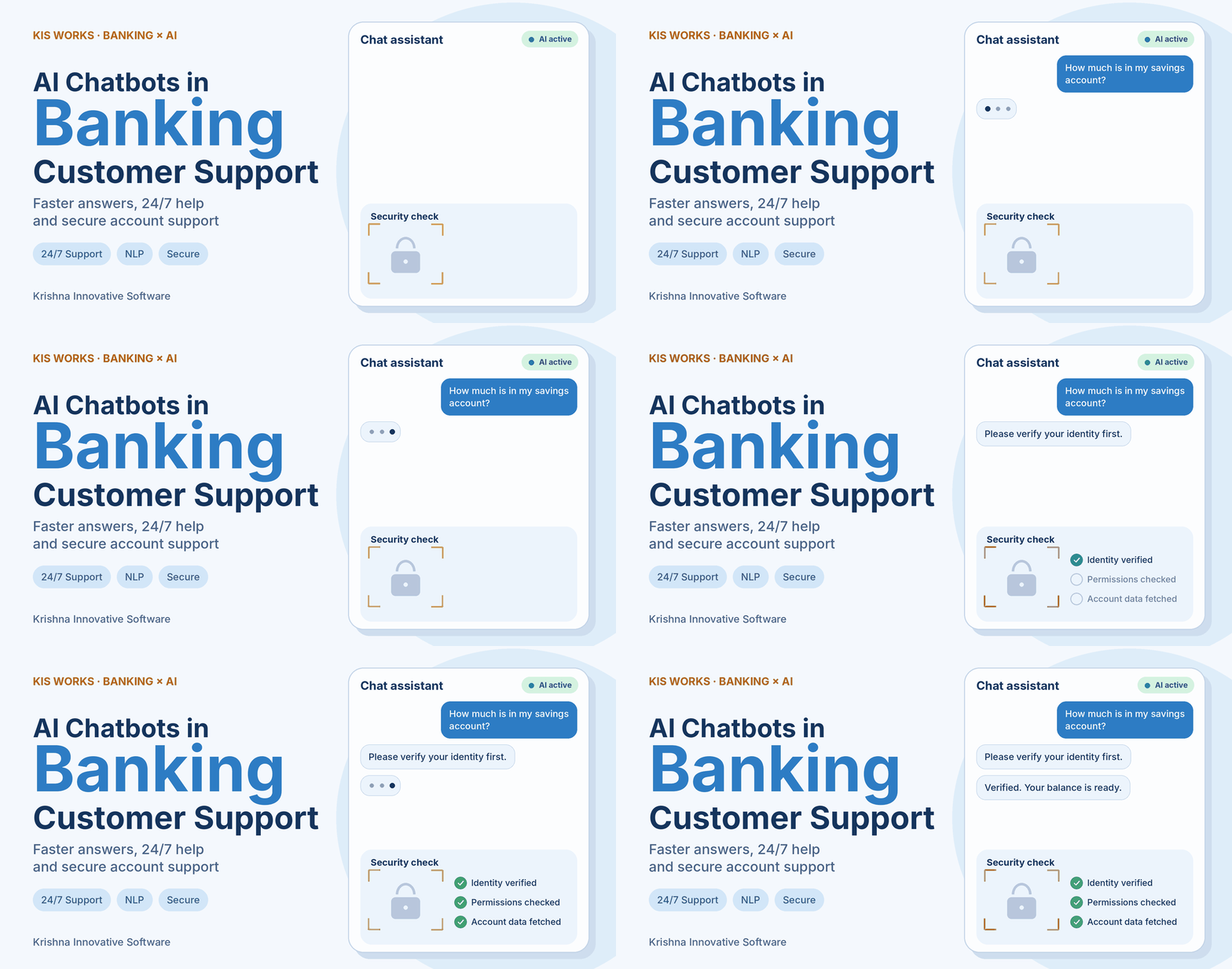
For example, a customer might ask, “How much money do I have in my savings account?”
An AI chatbot in banking can understand this query, securely connect to a relevant system in the bank, and return information on the customers’ account (once they have been appropriately authenticated).
Customers can ask questions about loan eligibility, payment status, credit card payments, bank hours and many other banking services.
AI chatbots can be implemented into various platforms in banking, including:
- Mobile banking apps
- Online banking
- Banking websites
- Messaging platforms (Such as WhatsApp)
- Customer support portals
- Voice banking
Overall, AI chatbots in banking are used to improve quick, easy and efficient support. This lessens the workload of customer service teams.
How do AI Chatbots work in Banking?
AI chatbots include a number of technologies to understand a customers’ query, process it, and form a suitable response.
Process
1. Understand Query
When a customer submits a query, the AI chatbot will process the query to understand what support the customer needs.
Using Natural Language Processing (NLP), chatbots can understand variations of similar questions.
E.g. “What is my balance?”, “Can you tell me what my balance is?”, “What is its available balance?”, “What is there in my account?”
Although phrased differently, the message is the same. By using NLP the chatbot understands the desired intentions of the customer and the context of the conversation.
2. Determine What Support is Required
Based on the query, the chatbot can determine what support is required.
If the query is about a failed payment, the customer may require information on payment status. If the query is about a personal loan, the customer may require further information on loan eligibility, interest rates and procedure.
The chatbot can determine which bank service the customer requires, and what information or support should be provided to them.
3. Connect with Bank Applications
If information relating to specific customers is required, the chatbot can integrate with certain banking applications, databases and APIs.
For example, if the customer is requesting information about their account, the chatbot can collect the appropriate information from the banking system once the customer has been appropriately authenticated and has the correct permissions.
This means that chatbots can provide more useful information.
4. Provide Response(s)
Having collected the relevant information, the chatbot provides an appropriate response.
As chatbots use AI, they can provide a natural response to the user. For example, if the customer asks about a failed payment, the chatbot can provide information on payment status and what actions should be taken.
5. Improve Using AI
Using machine learning and AI technologies, chatbots can be improved to understand customer queries better.
By analysing patterns in interactions, customer feedback and well managed conversation data, banks can identify areas in which chatbot responses can be improved. However, data privacy and security must be carefully considered when a banking chatbot processes customer information.
Common Uses
AI chatbots in banking can be used to support various functions in banking. They can be used to reduce repetitive queries from customers and provide easy access to financial services.
Below are some key uses of AI chatbots in banking.
1. Balances and Payment Information
Customers often need to know their balances and payment information. AI chatbots can provide this in an easy to interact with format.
For example, if a customer asks “Show me my last five transactions,” the chatbot can view and return this information from the banking system, once correctly authenticated. This means that customers do not need to contact customer support employees for this basic information.
2. Loan and Credit Card Information
Customers often have queries regarding personal loans, property loans, business loans and credit cards.
AI chatbots can provide information on:
- Loan eligibility
- Interest rates and repayment
- Credit card features
- Documents required
- Calculating EMI
- Application process
For example, if a customer wishes to take out a personal loan, they can ask the chatbot what the eligibility requirements are and what documents they need to complete the application. The chatbot can provide appropriate information and guide the customer.
3. Payment Support
Customers often contact customer support in relation to payments. This may be because a payment has failed, or been delayed, or there was incorrect information on the transaction. AI chatbots can help inform customers on the status of their transactions and support customers with common payment issues.
For example, if a customer says that money has been deducted from their account but not reached the recipient, the chatbot can advise how to check the status of that payment and how to raise a complaint. If further investigation is required, the chatbot can escalate the conversation to a human support representative.
4. Credit Card Support
Customers with credit cards may require assistance with knowing when payments are due, what balance they have, credit card limits, and other credit card services. AI chatbots can provide relevant information to help customers with these.
This can include:
- What outstanding balance they have
- When payments are due
- Reporting a lost or stolen card
- Understanding charges
- Information on credit card limits
- Understanding the features available on their credit cards
Depending on integration and permissions, chatbots can also assist customers with starting certain requests in relation to their credit card.
5. Reporting Fraud
Sometimes customers may see unusual activity, or suspect something is wrong in their account. They may also be concerned that they have fallen victim to a phishing attack.
AI chatbots can support customers in understanding how to report these issues in their account and can connect them to the correct security team.
For example, if a customer sees an unusual transaction in their account, the chatbot can inform them on how to report this in line with their banking process. It can also provide information on how to secure their account. However, if a security issue is urgent, a clear escalation process should be provided to ensure customers are supported quickly.
6. Onboarding New Customers
Opening a new bank account involves customers understanding account options, providing documents, and completing verification. AI chatbots can support customers with this process.
Chatbots can explain the account options available, information on required documents, and answer common questions. They can also direct customers to the correct application form. This makes onboarding new customers easier, and reduces repetitive queries from employees.
7. Round the Clock Customer Support
A key benefit of AI chatbots is that they can provide support to customers at any time.
Traditional customer support is often limited to operating within certain hours. As such, customers may find it difficult to get support outside of these hours. However, AI chatbots can provide common information, and support customers with basic processes 24/7. This means that customer support is more available, without requiring human support for every customer.
Technologies in AI Chatbots
The following technologies are used in AI chatbots within banking.
Natural Language Processing (NLP)
NLP allows chatbots to understand natural language. This means that banking chatbots can understand customer intentions, understand a variety of sentence structures, and understand queries written in natural language.
This means that if customers ask about interest rates on loans in multiple different ways, the chatbot will understand that these are related to the same banking service.
Machine Learning
Machine learning enables AI chatbots to understand patterns in customer interactions. This helps chatbots understand a variety of queries.
Chatbots can identify frequently asked questions, understand what customers require support for, and provide more relevant answers. Banks can use machine learning models to improve chatbot performance based on well managed interaction data, and customer feedback.
Large Language Models (LLMs)
Large Language Models allow chatbots to understand complex queries and provide natural responses. Unlike basic rule-based chatbots, LLM based AI assistants within banking can support a larger variety of queries and understand context within a conversation. For example, if a customer asks about eligibility for a property loan, and then asks about interest rates, and repayment periods, an LLM based chatbot will understand that these are related. Therefore, it can provide relevant information. However, within banking applications, chatbots must be provided with reliable information sources, appropriate permissions, and measures to ensure that incorrect financial information is not provided.
APIs
APIs allow AI chatbots to integrate with various bank applications. This can include customer management, making payments, loan management applications, and account databases. This means that chatbots can retrieve relevant information, and complete permitted actions in connected systems.
Voice Recognition
Voice recognition allows customers to interact with a chatbot in a banking environment using voice. Customers can ask questions about services, payment information and processes using voice. This can make banking services more accessible for customers, particularly for people who would prefer to use voice rather than typing.
Benefits of AI Chatbots for Banks and Customers
Implementing AI chatbots can provide many benefits to banks, and improve the experience for customers.
Quick Support
Customers may ask simple questions that can be easily answered. AI chatbots can provide quick responses to these questions.
Therefore, response times can be improved, making support more convenient for customers.
Reduces Workload for Customer Support Teams
Customers frequently ask repetitive questions. These can be related to account information, payment status, loan details and processes. AI chatbots can be used to answer these questions.
This means that support staff can focus on complex issues which may require human support.
Available 24/7
AI chatbots can provide 24/7 customer support. Customers can get information and answers to common questions at any time. This increases availability of support, and reduces reliance on traditional customer support hours.
Improved Customer Experience
Customers expect quick and easy support from banks. AI chatbots mean that customers can get information from chatbots, without needing to navigate many pages or wait on the phone. The chatbots can keep context within a conversation, meaning that follow-up questions can be made easier.
Cost Efficient
To employ and manage large customer support teams can be a large cost. However, AI chatbots can be used to answer repetitive questions. This can reduce the amount of queries that need to be manually answered. In turn, banks can provide high volumes of customer support in a more efficient manner.
Improved Personalised Support
With customer permission and security, AI chatbots can be used to provide more personalised support. For example, chatbots can support customers with understanding their credit card statement, explain available services and provide information on an active loan application. Providing personalisation in responses can make interactions with customers more relevant and useful.
Support in Multiple Languages
Banks support customers in many different languages. AI chatbots can support multiple languages, allowing customers to interact in their preferred language. This can be very useful in making digital banking services easier to use for people from different regions.
Challenges of Implementing AI Chatbots in Banking
Despite the benefits offered by AI chatbots, there are a number of challenges which should be considered.
Data Security
AI chatbots in banking may contain sensitive customer data, including account information, payment information and personal information. It is important that this data is secured. Encryption, secure permissions, secure authentication and proper data management must all be implemented to protect customers.
Integration with Banking Systems
Many financial institutions have many different systems. These can include account management, making payments, customer support and managing loans. Integrating AI chatbots with these systems can present technical challenges. To ensure that chatbots can gain the right information, without disrupting normal banking operations, secure APIs must be put in place.
Incorrect AI Responses
Sometimes AI chatbots may give incorrect or misunderstood responses. In banking this can be very problematic. If incorrect information is given to customers regarding loan information, payments, account balances or banking services, this can create issues. Chatbots should be connected to verified sources of information. Responses should be monitored, and clear escalation processes should be provided for sensitive queries.
Customer Trust
Some customers may prefer to be supported by humans rather than AI. To encourage customers to interact with chatbots, interactions should be simple, clear and useful. If an issue can’t be resolved by AI support, customers should be able to be put in touch with a human.
Compliance
Banks have strict compliance requirements. AI chatbots must be compliant with relevant regulations, regarding customer information, data protection, authentication and communicating financial information with customers. Financial institutions must also ensure that interactions with chatbots are appropriately documented, and that AI systems are only operating under approved permissions.
Future of AI Chatbots in Banking
As AI technologies develop, AI chatbots in banking will become more advanced. In the future chatbots will be able to support more complex interactions with customers.
Key developments include:
Generative AI Chatbots in Banking
Using generative AI, chatbots within banking will be able to understand complex queries and provide natural responses. Customers may be able to ask for information on multiple banking services in one conversation. For example, a customer may ask about eligibility for the loan, repayment options and documents required in one conversation.
Agentic AI in Banking
Agentic AI systems can complete multiple linked tasks based on given instructions and permissions. In banking this may be used to manage processes such as gathering information for applications, checking the status of requests, and preparing requests. However, sensitive financial actions will still require appropriate authentication, permissions and human support if required.
Increased Personalisation
Chatbots may increasingly be able to provide personalisation based on customer preferences and available banking information. For example, chatbots may be able to help customers understand summary information of spending, upcoming payment dates and relevant services.
Voice AI Chatbots in Banking
Voice based AI assistants may make interacting with banking systems easier. Customers may be able to use voice commands to ask questions, gain account information and navigate banking services.
Improved collaboration between AI and Humans
Although AI chatbots may increase automation within banking customer support, complex issues, concerns and personal support may still be best provided by humans. Common queries can be provided by AI, whilst more complex customer complaints, concerns and personal support can be provided by human support. Combining automated support from AI with human support can provide a more balanced customer service.
How AI Development Companies can Help Create Custom AI Chatbots in Banking
Creating AI chatbots in banking involves several considerations. It is important that the chatbots have secure architecture, accurate data sources, reliable API connections and appropriate authentication. Experienced AI development companies can create chatbots in banking to suit the specific requirements of the organisation.
Key services include:
Custom AI Chatbot Development
Development of AI chatbots that can understand customer queries and give appropriate responses depending on banking requirements.
API Integration in Banking
Connection of chatbots to banking applications, customer management systems and other systems using secure APIs.
AI Model Integration
Correct AI models and Natural Language Processing can be integrated to improve chatbot capabilities in understanding customer queries, and keeping context in a conversation.
Automation of Processes
Automation of repetitive customer support processes. This includes managing queries and requests.
Secure Architecture
Creation of scalable chatbots with appropriate authentication, data protection, permissions and monitoring.
Maintenance and Improvements
Monitoring chatbots, improving responses, improving connections, and adapting to changing business requirements.
At Krishna Innovative Software (KIS Works) we help businesses implement AI based software. We provide AI integration, intelligent automation and custom software development. Our development services can help financial organisations create custom AI chatbots and intelligent software solutions. This can improve customer interactions and streamline business processes.
Conclusion
AI chatbots in banking are improving the way banks interact with customers and provide support. As digital banking develops, customers expect quick support, easy access to information and support at any time. AI chatbots can support banks to meet these expectations by providing quick support to frequent queries, supporting account related requests, providing information on loans and guiding customers through different banking services. Technologies such as NLP, machine learning, Large Language Models and API integration allow chatbots to be created with more intelligence. However, secure data, accurate information, reliable integration and appropriate human support must be considered to successfully implement chatbots. As AI developments continue, chatbots in banking will be more capable of managing complex customer interactions. If implemented strategically, banks can improve customer support, reduce repetitive tasks and provide more convenient digital banking for customers.