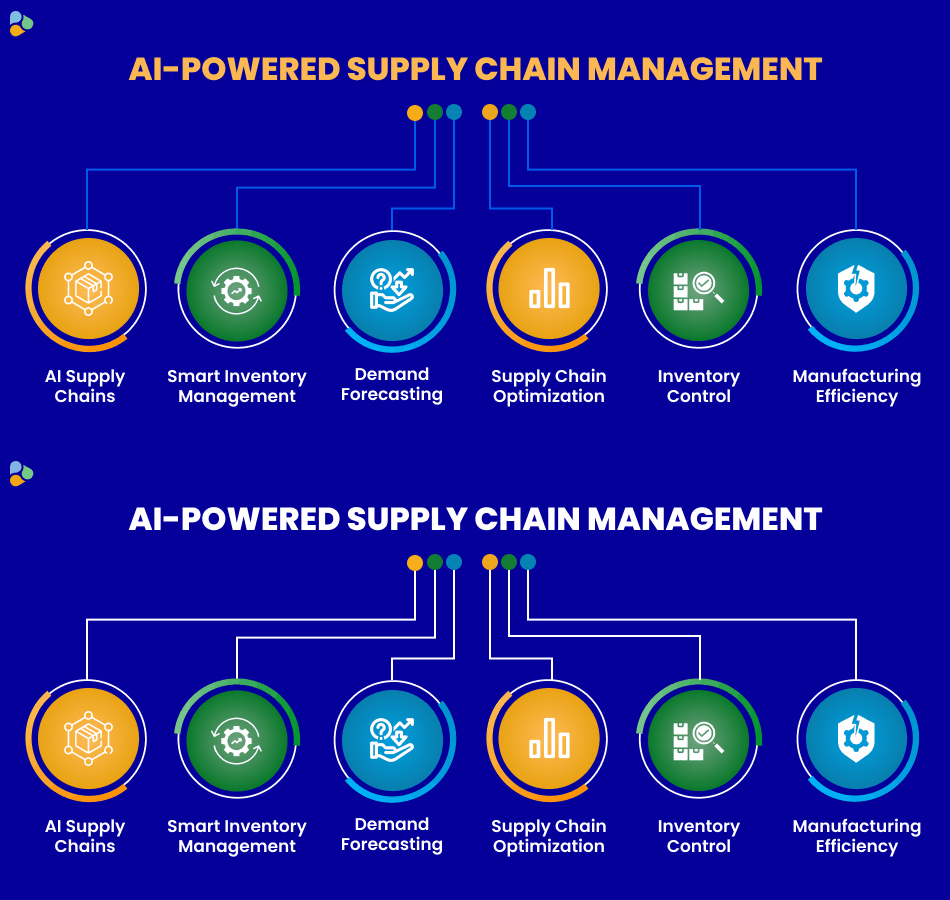
This is where artificial intelligence (AI) can make a difference. AI helps manufacturers analyze large amounts of data, forecast future demand, monitor inventory levels, and identify potential supply chain problems before they affect production.
By using AI for inventory management and demand forecasting, manufacturers can make better purchasing decisions, reduce waste, improve production planning, and build more reliable supply chains.
In this blog, we will explore how AI is transforming manufacturing supply chains, its key applications, major benefits, and the challenges businesses should consider before adopting it.
What Is AI in Manufacturing Supply Chains?
AI in manufacturing supply chains refers to the use of artificial intelligence, machine learning, and data analytics to improve the movement of materials, products, and information across the supply chain.
These technologies help manufacturers understand patterns in historical sales, supplier performance, production schedules, inventory records, and market demand. Instead of depending entirely on manual analysis, businesses can use AI systems to generate forecasts, identify risks, and recommend appropriate actions.
For example, an AI-powered system can analyze previous orders, seasonal demand, current inventory, and supplier delivery times to estimate how much raw material a factory will need next month.
If the system detects that a critical component may run out before the next delivery arrives, it can alert the purchasing team in advance. This gives the manufacturer more time to respond and reduces the risk of production delays.
AI does not replace every supply chain decision. Instead, it provides manufacturers with better information so that teams can make faster and more informed decisions.
Why Do Manufacturing Supply Chains Need AI?
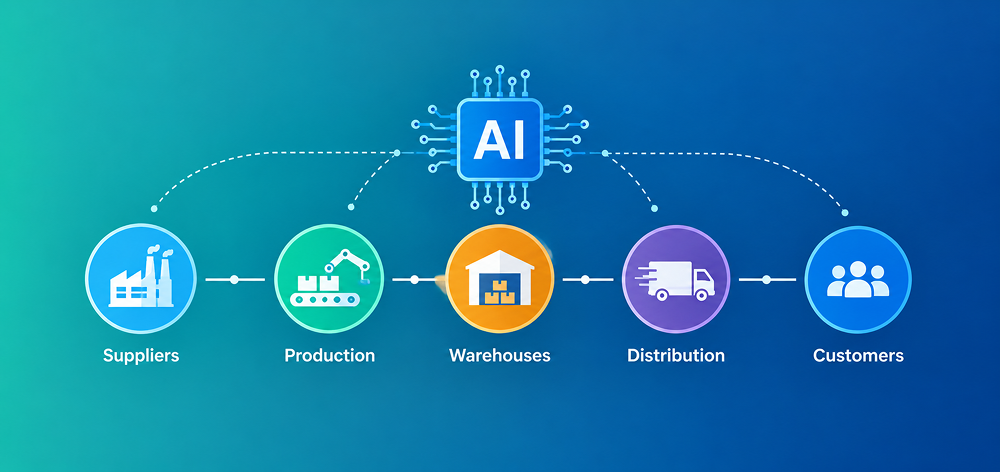
Manufacturing supply chains involve multiple connected activities, including procurement, inventory management, production planning, warehousing, transportation, and distribution.
A problem in one area can affect the entire operation. For example, if a supplier delivers raw materials late, production may slow down. This can delay customer orders, increase operating costs, and affect customer satisfaction.
Some common supply chain challenges include:
- Unpredictable demand: Customer orders can change because of seasonal trends, market conditions, or changing preferences.
- Excess inventory: Purchasing more materials than necessary ties up working capital and increases storage costs.
- Material shortages: Insufficient stock can interrupt production and delay deliveries.
- Supplier delays: Unexpected delivery times make procurement and production planning difficult.
- Limited visibility: Separate systems and disconnected spreadsheets make it harder to understand inventory across locations.
- Manual forecasting: Traditional forecasting methods may not respond quickly enough to changing business conditions.
AI helps address these challenges by analyzing data continuously, recognizing patterns, and providing forecasts that can be updated as new information becomes available.
How AI Improves Inventory Management in Manufacturing
Inventory management is one of the most important applications of AI in manufacturing. Companies need enough raw materials, components, and finished goods to meet demand without holding unnecessary stock.
AI can help manufacturers find a better balance between product availability and inventory costs.
1. Predicting Inventory Requirements
AI models analyze historical consumption, sales orders, production schedules, and current stock levels to estimate future inventory requirements.
For example, a manufacturer producing electrical equipment may experience higher demand for specific components during certain periods. AI can identify these recurring patterns and recommend suitable inventory levels.
This helps purchasing teams plan ahead instead of waiting until stock becomes critically low.
2. Reducing Overstocking and Stockouts
Overstocking increases storage expenses and ties up money that could be used elsewhere in the business. Stockouts, on the other hand, can interrupt production and delay customer deliveries.
AI systems can evaluate demand forecasts, supplier lead times, existing stock, and upcoming production requirements to recommend when and how much to reorder.
These recommendations help manufacturers maintain more appropriate inventory levels while reducing the risk of shortages and excess stock.
3. Automating Reorder Alerts
AI-powered inventory systems can monitor stock movements and notify purchasing teams when materials approach their required reorder levels.
More advanced systems can consider supplier reliability, expected demand, and delivery schedules when calculating when an order should be placed.
For instance, if a factory uses a particular raw material every day and its supplier usually takes two weeks to deliver, the system can help determine when replenishment should begin.
Automated alerts reduce the need for repeated manual checks and help teams respond before inventory problems affect production.
4. Improving Inventory Visibility
Manufacturers often store materials across multiple warehouses, factories, and distribution centers. Tracking inventory across these locations can become difficult when systems do not share information effectively.
AI can work with data from enterprise resource planning (ERP) platforms, warehouse management systems, and other business applications to provide a clearer picture of stock availability.
This visibility helps managers identify surplus inventory in one location that may be useful at another facility, reducing unnecessary purchases and improving resource utilization.
How AI Improves Demand Forecasting
Demand forecasting involves estimating how much of a product customers will need in the future. Accurate forecasts help manufacturers decide what to produce, when to produce it, and how much material to purchase.
Traditional forecasting often relies heavily on historical sales data and fixed assumptions. AI can analyze more variables and identify complex relationships that may be difficult to detect manually.
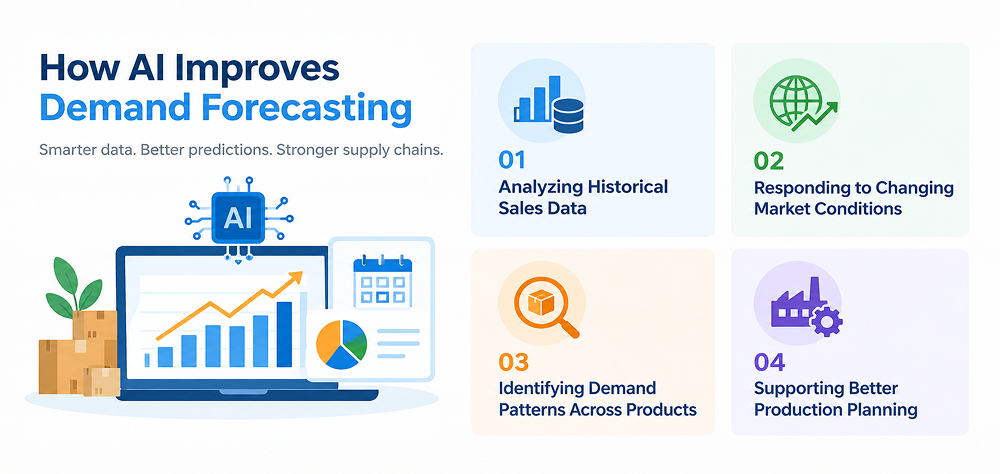
1. Analyzing Historical Sales Data
Machine learning models can study past sales, customer orders, product demand, and seasonal trends to identify recurring patterns.
For example, a manufacturer of air conditioning equipment may experience higher demand before summer. By analyzing previous sales and order patterns, an AI model can help estimate future demand during similar periods.
These forecasts allow manufacturers to prepare raw materials and production capacity in advance.
2. Responding to Changing Market Conditions
Demand does not always follow historical patterns. Economic changes, competitor activity, new product launches, and customer behavior can influence purchasing decisions.
AI models can incorporate relevant and available external data alongside internal business records to improve demand estimates.
When new information becomes available, forecasts can be updated to reflect changing conditions. This gives manufacturers a more flexible planning process than relying on fixed forecasts alone.
3. Identifying Demand Patterns Across Products
Manufacturers may produce hundreds or thousands of products, each with different demand patterns.
AI can analyze individual product categories, customer segments, locations, and order histories to identify which products are likely to experience increasing or decreasing demand.
 For example, a manufacturer may discover that certain product variants sell consistently while others experience unpredictable demand. These insights can help businesses prioritize inventory investments and adjust production plans.
4. Supporting Better Production Planning
Demand forecasts are most useful when they influence production decisions.
AI can connect demand predictions with available inventory, machine capacity, workforce availability, and supplier lead times. This helps production planners decide which products to manufacture and when to schedule production runs.
As a result, manufacturers can reduce unnecessary production, manage workloads more effectively, and improve their ability to fulfill customer orders on time.
Real-World Applications of AI in Manufacturing Supply Chains
AI can support several supply chain activities beyond inventory management and demand forecasting.
1. Supplier Risk Analysis
AI can analyze historical supplier delivery performance, order records, and available risk indicators to identify suppliers that may create supply disruptions.
Manufacturers can use these insights to review supplier relationships, evaluate alternatives, and prepare contingency plans for critical materials.
2. Warehouse and Distribution Optimization
AI can help improve warehouse operations by identifying stock movement patterns, supporting picking and replenishment decisions, and recommending efficient inventory placement.
When combined with route optimization tools, AI can also help businesses plan more efficient product deliveries.
3. Supply Chain Scenario Planning
Manufacturers can use AI-supported forecasting and analytics to evaluate possible situations, such as a sudden increase in demand, a delayed shipment, or a shortage of raw materials.
These insights help teams compare possible responses before a disruption occurs.
4. Predictive Maintenance and Material Planning
Machine failures can disrupt production schedules and change material requirements. Predictive maintenance systems analyze equipment data to identify potential maintenance needs before a failure occurs.
When maintenance insights are connected with production and inventory planning, manufacturers can better coordinate spare parts, maintenance schedules, and production commitments.
Key Benefits of AI in Manufacturing Supply Chains
Adopting AI can provide manufacturers with several operational and business advantages.
- Better inventory control: AI helps estimate stock requirements more accurately and reduces unnecessary inventory accumulation.
- Improved demand forecasting: Machine learning can identify trends and relationships that support more informed purchasing and production decisions.
- Lower operating costs: Better planning can reduce excess storage, emergency purchases, avoidable waste, and certain logistics expenses.
- Fewer production disruptions: Early warnings about material shortages and supplier delays give teams more time to respond.
- Faster decision-making: Automated analysis and alerts help managers identify problems without manually reviewing every report.
- Improved customer satisfaction: Better demand planning and inventory availability can help manufacturers fulfill orders more reliably.
- Greater supply chain visibility: Connected data provides a clearer understanding of inventory, demand, and potential risks across business operations.
The actual results depend on data quality, the chosen AI solution, existing systems, and how effectively employees use the insights.
Challenges of Implementing AI in Manufacturing Supply Chains
Although AI offers significant opportunities, implementing it successfully requires careful planning.
Data Quality and Availability
AI systems depend on reliable data. Missing inventory records, inaccurate sales information, and inconsistent supplier details can reduce forecast quality.
Manufacturers should review their existing data, correct inconsistencies, and establish processes for keeping information up to date.
1. Integration With Existing Systems
Many manufacturers already use ERP software, warehouse management systems, and production planning applications. Connecting AI solutions with these systems can require technical work and process changes.
A phased implementation can help businesses integrate AI without disrupting daily operations.
2. Initial Investment and Maintenance
AI implementation may involve software costs, infrastructure, integration, training, and ongoing maintenance. Businesses should identify a specific problem and estimate the potential value before committing to a large-scale project.
3. Employee Training and Adoption
AI-generated forecasts and recommendations are most effective when employees understand how to interpret and apply them.
Training purchasing teams, inventory managers, and production planners can improve adoption and help employees recognize when human judgment is necessary.
4. Forecast Accuracy and Uncertainty
AI cannot predict every market change or supply disruption. Unexpected events, incomplete data, and unusual customer behavior can affect forecast accuracy.
Manufacturers should monitor model performance, update forecasting systems regularly, and maintain contingency plans for critical operations.
How to Implement AI for Inventory and Demand Forecasting
Manufacturers do not need to automate their entire supply chain at once. A focused approach can make implementation more manageable.
- Step 1: Identify the main problem. Determine whether the business is experiencing frequent stockouts, excess inventory, inaccurate forecasts, or supplier delays.
- Step 2: Collect relevant data. Gather historical sales, inventory movements, supplier lead times, purchase orders, and production schedules.
- Step 3: Evaluate existing systems. Review whether current ERP and inventory applications can provide the data needed for AI analysis.
- Step 4: Start with a pilot project. Select a product category, warehouse, or production line where better forecasting could provide measurable value.
- Step 5: Integrate AI into business workflows. Connect forecasts and alerts with inventory planning, purchasing, and production scheduling processes where appropriate.
- Step 6: Measure performance. Track forecast accuracy, stockout frequency, inventory turnover, excess stock, and order fulfillment rates.
- Step 7: Improve continuously. Use new data and operational feedback to refine forecasting models and expand successful applications to other parts of the supply chain.
This step-by-step approach allows manufacturers to learn from real operational results before investing in broader automation.
The Future of AI in Manufacturing Supply Chains
The future of manufacturing supply chains will increasingly depend on connected systems, real-time data, and intelligent decision support.
As AI technologies develop, manufacturers can expect greater use of automated replenishment recommendations, more responsive demand forecasting, and improved visibility across suppliers, warehouses, and production facilities.
AI agents may also help coordinate routine activities, such as checking inventory exceptions, summarizing supplier delays, and preparing purchasing recommendations. Human approval will remain important for high-value purchases, unusual situations, and decisions with significant business consequences.
Digital twins and simulation tools can further support supply chain planning by allowing manufacturers to evaluate possible scenarios before changing real-world operations.
However, successful adoption will depend on more than technology alone. Reliable data, effective system integration, cybersecurity, employee training, and clear business objectives will remain essential.
Manufacturers that introduce AI strategically can build more adaptable supply chains and respond more effectively to changing customer and market needs.
Conclusion
AI is changing how manufacturers manage inventory, forecast demand, and coordinate supply chain operations. By analyzing historical data, identifying emerging patterns, and generating timely recommendations, AI helps businesses make more informed decisions about purchasing, production, and stock management.
From reducing overstocking to improving supplier risk analysis, AI can support a more efficient and responsive manufacturing operation. However, businesses need reliable data, suitable technology, and a clear implementation plan to achieve meaningful results.
For manufacturers exploring digital transformation, starting with a focused inventory or demand forecasting project can be a practical first step toward building a smarter supply chain.
At Krishna Innovative Software (KIS Works), businesses can explore software development and AI integration approaches that align with their operational needs. The right technology strategy can help manufacturers connect business systems, improve data visibility, and make better use of intelligent automation.
As manufacturing becomes increasingly data-driven, AI-powered supply chain planning will play an important role in helping businesses improve efficiency, manage uncertainty, and support long-term growth.