This is where smart manufacturing and artificial intelligence (AI) are making a difference.
Smart manufacturing combines AI, machine learning, industrial Internet of Things (IIoT), robotics, automation, and real-time data analytics to create more connected and intelligent production environments. These technologies help manufacturers monitor operations, identify potential problems, optimize workflows, and make better decisions.
Unlike traditional manufacturing systems, intelligent factories can analyze information from machines and production lines to respond to changing conditions. This helps businesses improve efficiency while giving employees better information to manage daily operations.
In this blog, we will explore what smart manufacturing is, how AI powers intelligent factories, its major applications, key benefits, implementation challenges, and what the future holds for the manufacturing industry.
What Is Smart Manufacturing?
Smart manufacturing is a modern approach to production that uses connected machines, digital systems, automation, and data analytics to improve manufacturing processes.
In a traditional factory, machines often operate independently, and employees manually collect production information. Identifying a problem may require checking individual machines, reviewing reports, or inspecting products after manufacturing.
In a smart factory, connected equipment continuously generates operational data. AI systems analyze this information to identify unusual patterns, predict equipment issues, improve production schedules, and support quality control.
For example, imagine a factory producing automotive components. Sensors installed on production equipment monitor temperature, vibration, pressure, and operating speed. An AI system analyzes these readings and detects a pattern that could indicate equipment wear.
Instead of waiting for the machine to fail, the maintenance team receives an alert and can schedule an inspection before the problem disrupts production.
This is one example of how smart manufacturing helps businesses move from reactive operations toward proactive and data-driven production.
How Does AI Work in Smart Manufacturing?
AI acts as an intelligence layer within a connected manufacturing environment. It analyzes data collected from machines, production systems, sensors, cameras, and enterprise software to identify patterns and recommend or trigger appropriate actions.
The exact process depends on the application, but most AI-powered manufacturing systems follow several stages.
1. Data Collection From Machines and Sensors
The first step is collecting reliable data from manufacturing operations.
Industrial sensors and connected devices can capture information such as:
- Machine temperature and vibration
- Production speed and output
- Energy consumption
- Equipment operating hours
- Product dimensions and measurements
- Environmental conditions
- Machine errors and downtime
This information gives manufacturers visibility into what is happening across their production lines.
For example, sensors attached to an industrial motor can continuously monitor vibration and temperature. These readings provide useful information about the motor’s operating condition.
2. Data Processing and Analysis
Once the data is collected, AI and machine learning models analyze it to identify patterns, relationships, and unusual behavior.
AI can compare current machine performance with historical operating data to identify conditions that may indicate a developing problem.
For instance, if a machine’s temperature gradually increases while production speed remains unchanged, the system can flag the pattern for investigation.
Data processing is important because raw sensor readings do not always provide meaningful insights on their own. Manufacturers need systems that can turn this information into practical recommendations.
3. Intelligent Decision-Making
After analyzing the data, the AI system generates insights that help employees make informed decisions.
Depending on the application, the system may:
- Predict potential equipment failures
- Recommend changes to production schedules
- Identify defective products
- Highlight unusual energy consumption
- Forecast material requirements
- Suggest process adjustments
Some systems only provide recommendations, while others can automatically adjust approved settings within predefined safety limits.
Human supervision remains important, especially when a decision affects equipment safety, product specifications, or critical production operations.
4. Automated Actions and Continuous Improvement
The final stage involves using AI insights to improve manufacturing operations.
An AI system may send maintenance alerts, notify quality teams, update a production dashboard, or recommend changes to machine settings. When properly integrated with industrial control systems, it may also trigger specific automated actions.
Over time, machine learning models can be updated with new operational data to improve their performance. However, manufacturers must monitor model accuracy and validate changes before applying them to critical production processes.
The result is a manufacturing environment where data supports continuous improvement rather than remaining unused in separate systems.
Key Technologies Behind Intelligent Factories
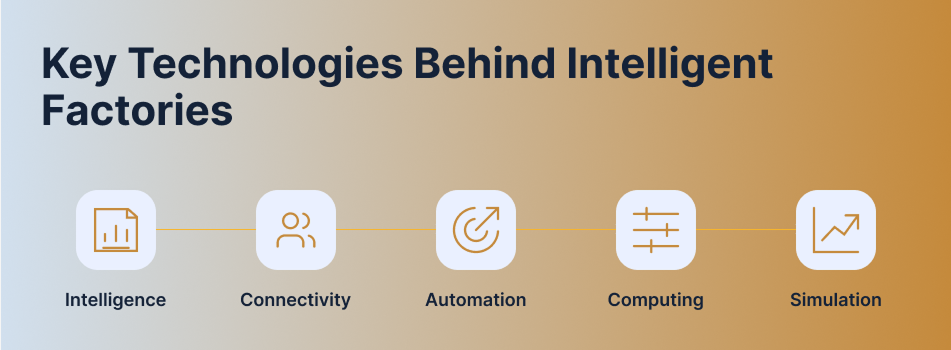
Smart manufacturing does not depend on AI alone. It combines several technologies that work together to connect physical equipment with digital intelligence.
1. Artificial Intelligence and Machine Learning
AI and machine learning help manufacturers analyze large amounts of production data and identify patterns that may not be obvious through manual observation.
Common applications include predictive maintenance, production optimization, quality inspection, and demand forecasting.
Machine learning models can also help manufacturers understand the relationship between production conditions and final product quality.
2. Industrial Internet of Things (IIoT)
The Industrial Internet of Things connects machines, sensors, controllers, and other industrial devices to collect and exchange operational information.
IIoT provides the data infrastructure needed for many AI applications. Without reliable and timely data, even advanced AI models may produce inaccurate or incomplete results.
3. Robotics and Intelligent Automation
Robots perform repetitive, physically demanding, or highly precise manufacturing tasks. When combined with AI and computer vision, they can identify objects, adapt to certain changes, and assist with inspection or material handling.
Examples include robotic assembly, automated packaging, component sorting, and warehouse movement.
4. Cloud Computing and Edge Computing
Cloud computing allows manufacturers to store and analyze data across multiple facilities, while edge computing processes information close to the machines that generate it.
Edge computing is particularly useful when applications require quick responses or cannot depend entirely on an internet connection.
A factory may use edge computing for rapid defect detection and cloud infrastructure for long-term production analysis.
5. Digital Twins
A digital twin is a digital representation of a physical machine, production line, or manufacturing system. It can use operational data to help engineers understand performance and test possible changes.
For example, manufacturers can simulate adjustments to a production line before making physical changes. When combined with AI, digital twins can support scenario analysis, process optimization, and equipment performance monitoring.
How AI Is Used in Smart Manufacturing
AI supports several important manufacturing activities. The most valuable applications depend on the factory’s production goals, available data, and existing infrastructure.
1. Predictive Maintenance
Unexpected equipment failures can interrupt production, delay customer orders, and increase maintenance expenses.
Traditional maintenance often follows fixed schedules or begins after equipment breaks down. Predictive maintenance uses AI to analyze machine data and identify signs of possible failure.
The system can monitor vibration, temperature, pressure, and other indicators to detect abnormal behavior. Maintenance teams can then investigate the issue and plan repairs before a major breakdown occurs.
For example, an AI model monitoring an industrial pump may detect unusual vibration patterns that indicate bearing wear. The maintenance team can inspect the pump before the issue causes an extended production stoppage.
This approach helps manufacturers make maintenance decisions based on equipment condition rather than relying only on fixed schedules.
2. AI-Powered Quality Control
Product quality is one of the most important parts of manufacturing. Manual inspections can be time-consuming, and small defects may be difficult to identify consistently at high production speeds.
AI-powered quality control uses computer vision, cameras, and machine learning models to inspect products and detect visible defects.
These systems can identify scratches, cracks, missing components, surface irregularities, and other quality issues, depending on the product and inspection setup.
For example, a camera positioned along an assembly line can capture images of manufactured components. The AI model analyzes each image and flags products that may not meet the required specifications.
This helps quality teams identify problems earlier and investigate the production conditions that caused them.
For a deeper explanation, read our related guide on AI in Quality Control: Defect Detection.
3. Intelligent Production Planning
Production planning involves deciding what to manufacture, when to manufacture it, and which machines and resources to use.
Unexpected orders, machine downtime, material shortages, and changing customer demand can make production schedules difficult to manage.
AI can analyze order information, available inventory, machine capacity, labor availability, and historical production data to recommend better schedules.
For example, if one production machine is unavailable, an AI-powered planning system may identify alternative equipment or suggest rearranging jobs to reduce disruption.
Manufacturers can use these insights to improve resource utilization, reduce bottlenecks, and respond more effectively to changing production requirements.
4. Smart Inventory and Material Management
Manufacturing depends on having the right materials available at the right time. Excess inventory increases storage costs, while insufficient inventory can delay production.
AI can analyze historical consumption, current inventory, supplier lead times, and demand forecasts to help businesses plan material requirements.
When inventory approaches a predefined threshold, the system can generate a notification or recommend replenishment.
For example, an automotive parts manufacturer can use AI-based forecasting to estimate the quantity of components required for upcoming production orders.
When integrated with inventory and enterprise resource planning systems, these insights can help purchasing and production teams coordinate their activities more effectively.
5. Energy Optimization
Energy consumption is a significant operational consideration for many manufacturing facilities.
AI can analyze energy usage across machines, production lines, and operating periods to identify inefficient patterns.
For instance, a system may detect that certain equipment consumes unusually high energy during idle periods. It can alert the operations team or recommend changes to operating schedules.
AI can also help manufacturers evaluate how production speed, equipment settings, and environmental conditions affect energy usage.
These insights support better energy management and may help reduce avoidable operating expenses.
6. AI-Powered Robotics and Automation
Industrial robots already perform tasks such as welding, painting, assembly, and packaging. AI can enhance these systems by helping them interpret visual information and respond to specific changes in their environment.
For example, a computer vision system can help a robot identify components in different positions before performing a pick-and-place task.
AI-enabled automation can also support material sorting, automated inspection, and repetitive handling operations.
However, not every robot requires AI. Many manufacturing tasks are handled effectively by conventional automation, particularly when the process is repetitive and the environment is predictable.
The goal is to apply AI where adaptability, perception, or data-driven decisions provide a meaningful advantage.
Smart Manufacturing vs. Traditional Manufacturing
Traditional manufacturing and smart manufacturing can both produce high-quality products. The main difference is how they collect information, respond to problems, and optimize production.
| Feature | Traditional Manufacturing | Smart Manufacturing |
| Data collection | Often manual or system-specific | Connected sensors and digital systems |
| Maintenance | Fixed schedules or reactive repairs | Predictive insights and condition monitoring |
| Quality inspection | Primarily manual or rule-based systems | AI-assisted visual inspection and analytics |
| Production planning | Fixed schedules and manual adjustments | Data-driven scheduling and recommendations |
| Decision-making | Relies heavily on reports and experience | Combines human expertise with real-time insights |
| Process improvement | Periodic reviews | Continuous monitoring and optimization |
Smart manufacturing does not mean replacing every traditional machine. Existing equipment can often be upgraded with sensors, connectivity, analytics, and software integrations.
This allows manufacturers to modernize operations gradually instead of rebuilding their entire production infrastructure.
Benefits of AI in Smart Manufacturing
When implemented with clear objectives and reliable data, AI-powered manufacturing systems can deliver several operational benefits.
Improved Productivity
AI helps manufacturers identify bottlenecks, reduce avoidable interruptions, and improve the use of production resources. Employees can spend less time gathering information manually and more time resolving important operational issues.
Reduced Equipment Downtime
Predictive maintenance helps maintenance teams identify warning signs before equipment failures occur. Although predictions are not always accurate, effective monitoring can improve maintenance planning and reduce certain unexpected interruptions.
Better Product Quality
AI-powered inspection can identify defects consistently at high production speeds. It can also help manufacturers investigate recurring quality issues and identify process conditions associated with defects.
Lower Operating Costs
Manufacturers can use AI insights to manage maintenance, energy consumption, material usage, and production schedules more efficiently.
The actual savings depend on the equipment, process, implementation costs, and the quality of available data.
Faster Decision-Making
Real-time dashboards and AI-generated alerts give managers and operators faster access to important production information.
Instead of waiting for periodic reports, teams can investigate developing problems and respond when necessary.
Greater Production Flexibility
Smart manufacturing systems can help businesses adapt to changing orders, production requirements, and equipment availability.
This flexibility is valuable for manufacturers that manage multiple products or need to respond quickly to customer demand.
Challenges of Implementing AI in Smart Factories
Despite its potential, smart manufacturing requires careful planning. Businesses should understand the following challenges before investing in AI.
1. High Initial Investment
Installing sensors, upgrading equipment, integrating software, and developing AI models can require significant investment.
Manufacturers can manage this challenge by starting with one production line or a specific problem where improvements can be measured clearly.
2. Integration With Existing Equipment
Many factories use older machines that were not designed to exchange data with modern digital systems.
Connecting these machines may require additional sensors, industrial gateways, middleware, or custom software integrations.
A technical assessment can help determine which upgrades are necessary and which existing systems can be retained.
3. Data Quality and Availability
AI systems depend on accurate, relevant, and sufficiently representative data.
Missing sensor readings, inconsistent formats, and incomplete maintenance records can reduce model performance.
Manufacturers should establish reliable data collection and validation processes before deploying AI at scale.
4. Cybersecurity Risks
Connected manufacturing equipment creates additional points that organizations must protect.
Unauthorized access to industrial systems can disrupt production or expose sensitive operational information.
Businesses should implement appropriate access controls, network segmentation, software updates, monitoring, and incident response procedures.
5. Skills and Workforce Training
Employees may need training to understand AI-generated recommendations, operate new software, and respond to system alerts.
Manufacturers should involve operators, engineers, and maintenance teams during implementation. Their practical experience is essential for identifying useful applications and ensuring that new systems fit real production requirements.
How to Implement AI in Smart Manufacturing
Manufacturers do not need to transform their entire factory at once. A phased approach can make implementation more manageable.
Step 1: Identify a Specific Business Problem
Start by identifying a measurable issue, such as frequent machine downtime, recurring defects, excessive material waste, or inefficient production scheduling.
Choose a problem that has a clear business impact and can be evaluated using available data.
Step 2: Assess Existing Systems and Data
Review the current machinery, sensors, production software, maintenance records, and data collection methods.
Determine whether the available information is reliable enough for the selected AI application.
Step 3: Choose the Right Technology
Select technologies based on the use case. Predictive maintenance may require sensor analytics and machine learning, while visual inspection may need industrial cameras and computer vision.
Consider integration requirements, scalability, security, and the technical capabilities of the existing infrastructure.
Step 4: Run a Pilot Project
Test the solution on a single machine, production line, or manufacturing process.
Establish baseline measurements before deployment so that the results can be compared objectively.
Step 5: Measure Performance
Evaluate the pilot using relevant metrics, such as downtime, defect rates, production output, inspection accuracy, energy consumption, or maintenance costs.
Compare the results with the original baseline and identify areas that require improvement.
Step 6: Expand Gradually
If the pilot delivers measurable value, expand the solution to other machines or facilities.
Continue monitoring model performance, employee feedback, system reliability, and security as the implementation grows.
What Is the Future of Smart Manufacturing?
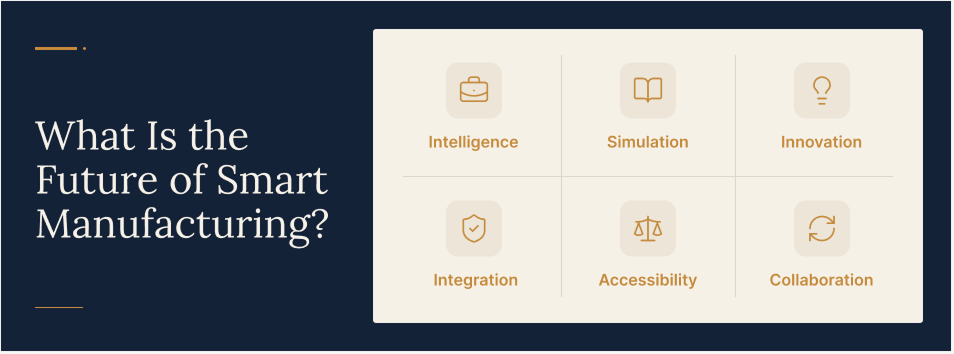
The future of smart manufacturing will involve deeper integration between AI, connected equipment, robotics, and enterprise software.
Several developments are likely to influence how intelligent factories operate.
AI Agents for Manufacturing Operations
AI agents can be designed to work with approved software tools and business systems to complete multi-step tasks.
In manufacturing, they may help analyze production alerts, retrieve maintenance records, summarize operational reports, or coordinate workflows between departments.
For example, an AI agent could review a machine alert, retrieve the relevant maintenance history, and prepare a work order for approval. Critical actions should still follow defined permissions and safety procedures.
More Advanced Digital Twins
Digital twins will continue to support the simulation and analysis of production systems.
When connected to reliable operational data, these models can help engineers test production scenarios, evaluate process changes, and understand the possible effects of equipment adjustments before implementing them.
Greater Human and AI Collaboration
Intelligent factories will continue to rely on the combination of human expertise and machine intelligence.
AI can analyze large datasets and identify patterns, while experienced employees contribute practical knowledge, judgment, and accountability.
This collaboration can improve decision-making without requiring manufacturers to automate every task.
More Connected Supply Chains
AI systems will increasingly connect production planning with inventory, procurement, logistics, and demand forecasting.
Better information sharing can help manufacturers respond to material shortages, supplier delays, and changes in customer demand.
More Accessible AI for Smaller Manufacturers
Cloud-based platforms, modular software, and specialized AI applications may make smart manufacturing more accessible to small and medium-sized businesses.
Instead of investing in a complete factory transformation, smaller manufacturers can begin with targeted solutions such as visual inspection, equipment monitoring, or inventory forecasting.
Conclusion
Smart manufacturing is changing how factories collect data, manage production, monitor equipment, and maintain product quality. By combining artificial intelligence with IIoT, robotics, machine learning, and digital systems, manufacturers can gain better visibility into their operations and make more informed decisions.
From predictive maintenance and automated quality inspection to intelligent production planning and energy optimization, AI offers practical ways to address common manufacturing challenges.
However, successful implementation depends on more than choosing advanced technology. Manufacturers need reliable data, suitable infrastructure, clear business objectives, cybersecurity controls, and employees who understand how to work with intelligent systems.
The most effective approach is to begin with a specific operational challenge, test the solution, measure its results, and expand gradually.
At Krishna Innovative Software (KIS Works), businesses can explore AI development and integration solutions that align with their operational requirements. With the right strategy, intelligent manufacturing technologies can help organizations build more efficient, adaptable, and data-driven production environments.
Frequently Asked Questions (FAQs)
1. What is smart manufacturing in simple terms?
Smart manufacturing is the use of connected machines, sensors, automation, and digital technologies to improve production. AI helps analyze manufacturing data, identify problems, and support better operational decisions.
2. How is AI used in smart factories?
AI is used for predictive maintenance, automated quality inspection, production planning, inventory management, energy optimization, and robotics. These applications help manufacturers improve efficiency and monitor production performance.
3. What is the difference between smart manufacturing and Industry 4.0?
Smart manufacturing refers to the use of connected technologies and data-driven systems to improve manufacturing operations. Industry 4.0 is a broader concept describing the digital transformation of industry through technologies such as AI, IIoT, cloud computing, robotics, and cyber-physical systems.
4. Can small manufacturing companies use AI?
Yes. Small manufacturers can begin with targeted AI applications such as machine monitoring, defect detection, or demand forecasting. Starting with a focused pilot project can help them evaluate the benefits before making larger investments.
5. Does smart manufacturing replace human workers?
Not necessarily. Smart manufacturing automates selected tasks and provides employees with better information. Human workers remain important for supervision, problem-solving, maintenance, safety, and decisions that require practical judgment.
6. What technologies are required for an intelligent factory?
Common technologies include AI, machine learning, industrial sensors, IIoT connectivity, robotics, cloud or edge computing, data analytics, and manufacturing software. The required combination depends on the factory’s goals and existing infrastructure.
7. How can a manufacturer start implementing AI?
A manufacturer can start by identifying a specific operational problem, assessing available data, selecting a suitable AI application, and testing it through a pilot project. Performance should be measured before expanding the solution.
8. What are the main benefits of smart manufacturing?
The main benefits include improved productivity, better quality control, reduced unplanned downtime, more informed decisions, optimized resource utilization, and greater flexibility in responding to changing production requirements.