This is where artificial intelligence makes a difference.
By combining machine learning, predictive analytics, computer vision, and intelligent automation, manufacturers can analyze large amounts of data, identify potential problems, and improve operational decisions.
But how does AI work in manufacturing industries, and what benefits can businesses expect from adopting this technology?
Let’s explore how AI is reshaping modern manufacturing, its major applications, advantages, challenges, and future opportunities.
What Is Artificial Intelligence in Manufacturing?
Artificial intelligence in manufacturing refers to the use of intelligent software, machine learning algorithms, and automated systems to improve manufacturing operations.
AI enables machines and software applications to analyze information, recognize patterns, predict outcomes, and support decisions based on available data.
Unlike traditional automation, which generally follows predefined instructions, AI-powered systems can identify patterns and adapt certain decisions based on changing operating conditions.
For example, AI can monitor production equipment, analyze machine performance, and identify early warning signs of mechanical problems.
Similarly, AI-powered cameras can inspect products during production and identify defects that may be difficult to detect manually.
The main objective of AI in manufacturing is to improve productivity, reduce operational costs, maintain consistent product quality, and support smarter business decisions.
How Does AI Work in Manufacturing Industries?
AI works in manufacturing by collecting information from machines, sensors, cameras, and production management systems. AI algorithms then analyze this information to identify patterns, generate predictions, and recommend or automate appropriate actions.
The process generally involves five key steps.
1. Data Collection
Manufacturing facilities generate large amounts of operational data every day.
This information comes from industrial equipment, Internet of Things (IoT) sensors, production lines, quality inspection systems, and enterprise software.
Common manufacturing data includes:
- Machine temperature and vibration levels
- Production speed and output
- Equipment operating hours
- Energy consumption
- Product quality measurements
- Raw material availability
- Equipment maintenance records
For example, sensors installed on production machines can continuously collect information about operating temperature, vibration, and performance.
This data provides the foundation for AI-powered analysis.
2. Data Processing and Analysis
After collecting information, AI systems process and analyze the data using machine learning algorithms.
These algorithms identify relationships, trends, and unusual patterns that may not be immediately visible through manual monitoring.
For example, AI can compare current machine performance with historical operating data to identify abnormal behavior.
If a machine begins consuming more energy than usual or shows unusual vibration patterns, the system can flag the issue for investigation.
This helps manufacturers identify potential operational problems earlier.
3. Predictive Analytics
Predictive analytics is one of the most valuable applications of AI in manufacturing.
By analyzing historical and real-time data, AI systems can estimate future outcomes and identify potential risks.
For example, AI can help predict:
- Possible equipment failures
- Future maintenance requirements
- Changes in product demand
- Potential production delays
- Inventory requirements
- Quality-related issues
These predictions allow manufacturers to take preventive action rather than waiting for problems to occur.
4. Intelligent Automation
AI can work alongside industrial automation systems to support repetitive and complex manufacturing activities.
AI-powered robots, computer vision systems, and automated software can assist with product inspection, assembly, sorting, packaging, and production monitoring.
For example, an AI-enabled robotic system can identify different products moving along a conveyor belt and help sort them based on their size, shape, or quality.
This improves consistency and reduces the need for manual intervention in suitable processes.
5. Continuous Improvement
Machine learning systems can be improved over time using new, reliable manufacturing data.
As production requirements change, manufacturers can evaluate and retrain AI models to maintain their effectiveness.
For example, a quality inspection system can be updated with additional examples of product defects to improve its detection capabilities.
With proper monitoring and maintenance, AI systems can support continuous improvements in manufacturing operations.
Top Applications of AI in Manufacturing Industries
Artificial intelligence has numerous applications across manufacturing operations. Businesses can use AI to improve equipment reliability, production quality, inventory planning, and operational efficiency.
1. Predictive Maintenance
Unexpected machine breakdowns can cause production delays, increased repair expenses, and missed delivery deadlines.
AI-powered predictive maintenance helps manufacturers identify potential equipment problems before major failures occur.
By analyzing machine temperature, vibration, operating hours, and maintenance history, AI systems can detect unusual patterns associated with equipment wear or malfunction.
Key benefits include:
- Reduced unexpected equipment downtime
- Better maintenance scheduling
- Improved machine reliability
- Lower risk of expensive repairs
- More efficient maintenance operations
For example, an automotive manufacturing facility can use AI to monitor assembly-line equipment and identify early signs of mechanical wear.
This allows maintenance teams to inspect equipment before problems significantly affect production.
2. AI-Powered Quality Control
Maintaining consistent product quality is essential for manufacturing businesses.
Traditional quality inspection processes often depend on manual checks, which can become challenging when production volumes increase.
AI-powered computer vision systems can inspect products using cameras and image recognition algorithms.
These systems can help identify:
- Surface scratches
- Product cracks
- Incorrect dimensions
- Missing components
- Packaging defects
- Assembly errors
For example, electronics manufacturers can use AI-powered visual inspection systems to identify defects in circuit boards.
Early defect detection can help reduce product waste, improve quality consistency, and minimize rework.
3. Smart Robotics and Automation
AI-powered robotics is helping manufacturers automate repetitive, physically demanding, and precision-based activities.
Industrial robots can assist with assembly, welding, packaging, sorting, and material handling.
When combined with computer vision and AI algorithms, robotic systems can identify objects and adjust certain actions based on their surroundings.
For example, an AI-powered robotic arm can recognize differently shaped components and determine suitable positions for picking and placing them.
This can improve production consistency, reduce repetitive manual tasks, and support safer operations when appropriate safeguards are in place.
4. Supply Chain and Inventory Management
Managing inventory and supply chain operations is a major responsibility for manufacturing businesses.
AI can analyze historical demand, inventory levels, supplier performance, and production schedules to support better planning.
AI-powered inventory management systems can help manufacturers:
- Forecast product demand
- Estimate raw material requirements
- Identify potential inventory shortages
- Reduce unnecessary stock
- Improve purchasing decisions
- Support production scheduling
For example, a manufacturing company can use AI to forecast demand for a particular product and adjust raw material purchasing accordingly.
This helps businesses make better use of available resources.
5. Production Planning and Optimization
Manufacturing facilities must coordinate machines, employees, materials, and production schedules to operate efficiently.
AI can analyze production data to identify bottlenecks, inefficient workflows, and opportunities for improvement.
AI-based optimization systems can recommend changes to production schedules based on equipment availability, material requirements, and order priorities.
For example, a factory operating multiple production lines can use AI to identify underutilized equipment and improve resource allocation.
This supports more efficient production planning and better operational performance.
6. Energy Management
Energy consumption is a significant operating expense for many manufacturing facilities.
AI-powered energy management systems can monitor electricity usage, identify inefficient operating patterns, and recommend improvements.
For example, AI can analyze energy consumption across different machines and production shifts to identify opportunities for reducing unnecessary usage.
This can help manufacturers control energy expenses and support sustainability initiatives.
7. Workplace Safety Monitoring
Workplace safety is an important consideration in industrial environments.
AI-powered monitoring systems can use cameras and sensors to identify certain safety risks, such as restricted-area entry, missing protective equipment, or unusual operating conditions.
For example, an AI-enabled camera system may notify supervisors when someone enters a designated hazardous area.
These systems can support workplace safety procedures, although they should not replace required safety controls, employee training, or human supervision.
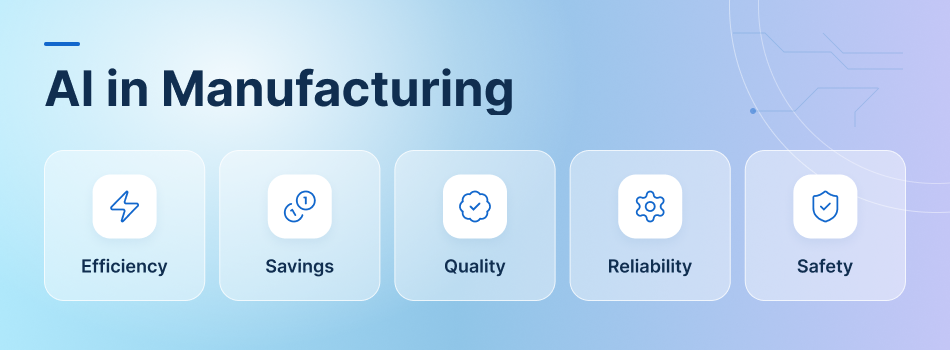
Benefits of AI in Manufacturing Industries
Implementing artificial intelligence can provide several business advantages when solutions are selected and deployed appropriately.
Increased Production Efficiency
AI helps manufacturers analyze production workflows, identify inefficiencies, and automate suitable repetitive tasks.
This can improve productivity and make better use of manufacturing resources.
Reduced Operational Costs
AI can help businesses reduce unnecessary expenses by improving maintenance planning, minimizing material waste, and optimizing energy consumption.
Improved Product Quality
AI-powered quality inspection systems can identify product defects earlier and support consistent manufacturing standards.
Reduced Equipment Downtime
Predictive maintenance systems help manufacturers recognize potential equipment issues and plan maintenance before unexpected failures occur.
Better Decision-Making
AI provides valuable insights from manufacturing data, helping managers make more informed decisions about production, inventory, equipment, and resource allocation.
Improved Workplace Safety
AI-assisted monitoring and robotics can help reduce employee exposure to certain hazardous and repetitive activities.
Greater Operational Flexibility
AI-powered planning systems can help manufacturers respond more effectively to changing production requirements, customer demand, and supply chain conditions.
Real-World Uses of AI Across Manufacturing Sectors
AI technology is being adopted across different manufacturing industries to address sector-specific challenges.
Automotive Manufacturing
AI supports vehicle assembly, robotic automation, component inspection, and predictive equipment maintenance.
Electronics Manufacturing
AI-powered computer vision systems help identify component defects, circuit board issues, and assembly errors.
Food and Beverage Manufacturing
AI can assist with food sorting, packaging inspection, production forecasting, and quality monitoring.
Pharmaceutical Manufacturing
AI can support process monitoring, production planning, quality analysis, and equipment maintenance, subject to applicable regulatory and validation requirements.
Textile Manufacturing
AI-powered inspection systems can help identify fabric defects, monitor product quality, and improve material utilization.
These applications demonstrate how AI can address different operational requirements across manufacturing sectors.
Challenges of Implementing AI in Manufacturing
Although artificial intelligence offers valuable opportunities, successful implementation requires careful planning.
High Initial Investment:
AI implementation may require spending on software, sensors, infrastructure, integration, and employee training.
Data Quality:
AI systems need accurate, reliable, and relevant data to generate useful insights.
Integration with Existing Systems:
Older manufacturing equipment and legacy software may require additional technical work to support AI integration.
Workforce Training:
Employees may need training to operate, monitor, and maintain AI-powered systems.
Cybersecurity:
Connected manufacturing systems require strong security measures to protect sensitive business and operational data.
Ongoing Maintenance:
AI models need monitoring, evaluation, and updates to maintain performance as operating conditions change.
Manufacturers should evaluate these challenges before selecting and implementing AI solutions.
How Can Manufacturing Businesses Get Started with AI?
Manufacturing companies do not need to transform their entire production facility at once.
A gradual, business-focused approach can help reduce implementation risks and improve the chances of achieving measurable results.
Step 1: Identify Business Challenges
Start by identifying operational problems such as frequent equipment breakdowns, production delays, quality defects, or inefficient inventory management.
Step 2: Evaluate Available Data
Review the information collected from manufacturing machines, sensors, ERP systems, and other business applications.
Step 3: Choose the Right AI Solution
Select an AI application that directly addresses the identified business challenge.
Step 4: Start with a Pilot Project
Test the solution on a limited production line, equipment group, or business process before expanding it.
Step 5: Measure Results
Track relevant performance indicators such as equipment downtime, defect rates, production output, operating costs, and return on investment.
Step 6: Expand Successful Solutions
Once the pilot demonstrates measurable value, consider implementing the solution across additional manufacturing operations.
The Future of AI in Manufacturing Industries
Artificial intelligence is expected to play an increasingly important role in the development of smart factories and connected industrial systems.
Several emerging technologies are shaping the future of manufacturing.
Smart Factories
Smart factories combine AI, IoT sensors, industrial automation, and connected software to improve operational visibility and decision-making.
Digital Twins
Digital twins create virtual representations of physical equipment or production processes.
Manufacturers can use these models to simulate operating conditions, evaluate potential changes, and identify opportunities for improvement.
Generative AI
Generative AI can assist manufacturing teams with technical documentation, knowledge management, engineering support, and troubleshooting.
Edge AI
Edge AI allows certain artificial intelligence models to run directly on industrial devices rather than relying entirely on cloud-based processing.
This can support faster local analysis for suitable manufacturing applications.
Human-Robot Collaboration
Advances in robotics and AI are creating opportunities for more flexible collaboration between human workers and appropriately safeguarded industrial robots.
As these technologies develop, manufacturers will have additional opportunities to improve efficiency, flexibility, and competitiveness.
How KIS Works Can Help Manufacturing Businesses Implement AI
Implementing AI successfully requires the right combination of technology, business understanding, and software development expertise.
At Krishna Innovative Software (KIS Works), we help businesses explore and develop intelligent software solutions that address their operational challenges.
Our AI development and software engineering capabilities can support manufacturing companies looking to improve efficiency, automate workflows, and make better use of business data.
Our AI Development Services
Custom AI Development
We develop AI-powered software solutions tailored to specific business requirements, including data analysis, intelligent automation, and decision-support applications.
AI Workflow Automation
Our AI workflow automation solutions help businesses streamline repetitive processes, reduce manual work, and improve operational workflows.
Predictive Analytics Solutions
We can help businesses explore predictive analytics applications for equipment monitoring, demand forecasting, and operational planning.
AI Integration with Existing Software
We develop integration solutions that help businesses connect AI capabilities with existing software applications, APIs, and enterprise systems.
AI Consulting
Our team helps businesses evaluate AI opportunities, identify technical requirements, and plan practical implementation strategies.
Why Choose KIS Works?
With over 16 years of software development experience, KIS Works combines technical knowledge with a practical approach to business technology.
Our capabilities include custom software development, AI-powered applications, workflow automation, enterprise software solutions, and system integration.
We focus on understanding business requirements and developing solutions that support long-term operational goals.
Whether your manufacturing business is exploring AI for the first time or planning to introduce intelligent features into existing software, our team can help you evaluate the next steps.

Conclusion
Artificial intelligence is changing how manufacturing industries manage production, equipment, quality control, and business operations.
From predictive maintenance and smart robotics to inventory forecasting and automated inspection, AI provides opportunities to improve efficiency, reduce operational challenges, and support better decision-making.
Understanding how AI works in manufacturing industries helps businesses identify where intelligent technologies can deliver practical value.
However, successful AI adoption requires reliable data, suitable infrastructure, clear objectives, and the right implementation strategy.
By starting with specific business challenges and gradually expanding successful applications, manufacturers can move toward smarter and more efficient operations.
Ready to Explore AI Solutions for Your Manufacturing Business?
At KIS Works, we help businesses turn technology ideas into practical software solutions.
Whether you need custom AI development, intelligent workflow automation, or AI integration with existing business systems, our team is ready to discuss your requirements.
Explore our AI Development Services or Contact KIS Works to get started.
Frequently Asked Questions (FAQs)
1. How does AI work in manufacturing industries?
AI works in manufacturing by collecting and analyzing data from machines, sensors, cameras, and production systems. Machine learning algorithms identify patterns, predict potential problems, and support automated processes or operational decisions.
2. What are the main applications of AI in manufacturing?
The major applications include predictive maintenance, quality inspection, smart robotics, production optimization, inventory forecasting, energy management, and workplace safety monitoring.
3. How does AI improve manufacturing efficiency?
AI helps improve manufacturing efficiency by identifying production bottlenecks, reducing unexpected downtime, automating repetitive tasks, and supporting better resource allocation.
4. Can small manufacturing businesses use AI?
Yes. Small manufacturing businesses can begin with targeted AI solutions such as inventory forecasting, quality inspection, or equipment monitoring. Starting with a pilot project helps evaluate costs and potential benefits.
5. How does AI reduce manufacturing costs?
AI can help reduce costs by improving maintenance planning, minimizing material waste, optimizing energy consumption, and improving production efficiency. Actual savings depend on the manufacturing environment and implementation.
6. What is the difference between AI and traditional manufacturing automation?
Traditional automation generally follows predefined instructions. AI-powered systems can analyze data, identify patterns, and support decisions or adjustments based on changing operating conditions.
7. What is the future of AI in manufacturing?
The future of AI in manufacturing includes smart factories, digital twins, intelligent robotics, generative AI, edge computing, and increasingly connected industrial systems.
8. How can KIS Works help manufacturing companies with AI?
KIS Works provides AI development, software engineering, workflow automation, and system integration services. Manufacturing businesses can work with KIS Works to explore custom AI solutions based on their operational requirements.