Traditional quality control methods often depend on manual inspections, sampling, and predefined testing procedures. Although these methods remain useful, they can become challenging when manufacturers need to inspect thousands of products within a short period. Human inspectors may also overlook minor defects, particularly during repetitive tasks or high speed production.
This is where Artificial Intelligence (AI) is making a difference.
AI in quality control helps manufacturers analyze product images, identify unusual patterns, monitor production processes, and detect defects more consistently. By combining machine learning, computer vision, cameras, and sensor data, manufacturers can identify potential problems earlier and make better quality related decisions.
In our previous blog, How AI Works in Manufacturing, we discussed the broader role of artificial intelligence in manufacturing operations. This article explores one specific application: how AI powered quality control helps manufacturers detect product defects faster and improve production quality.
What Is AI in Quality Control?
AI in quality control refers to the use of artificial intelligence technologies to inspect products, analyze manufacturing data, identify defects, and support quality assurance decisions.
Instead of relying entirely on manual inspection or fixed inspection rules, AI systems learn patterns from data and use those patterns to recognize acceptable products and potential defects.
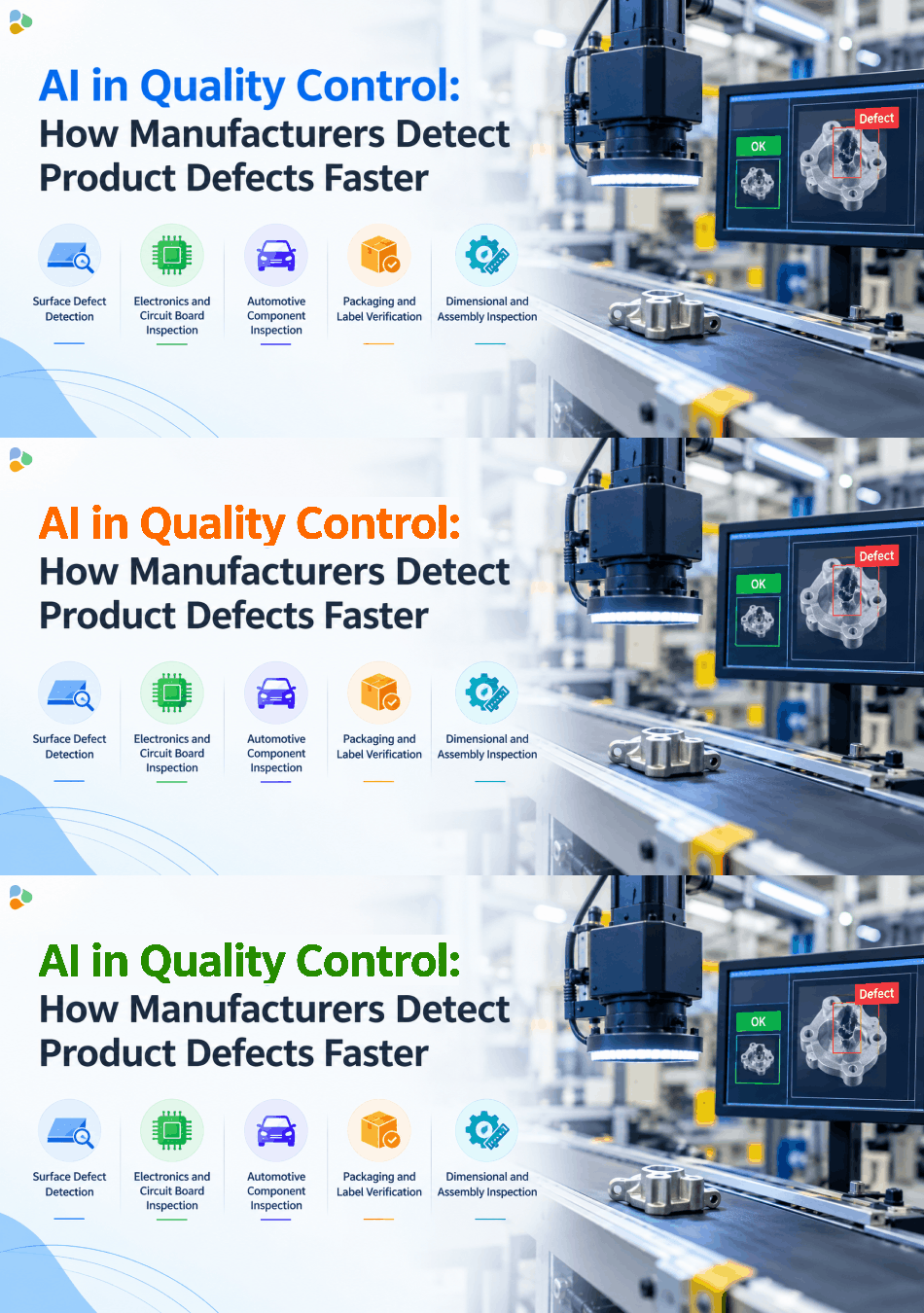
For example, a manufacturer producing metal components may use an AI based vision system to examine every component moving along a production line. The system can identify scratches, cracks, surface irregularities, or dimensional differences and flag products that require further inspection.
Depending on the application, an AI quality control system can inspect products during production, after assembly, or before packaging and shipment.
The goal is not simply to identify defective products. It is also to understand why defects occur and help manufacturers prevent similar problems in the future.
How Does AI Detect Product Defects in Manufacturing?
AI based defect detection combines cameras, sensors, machine learning models, and manufacturing software to analyze products and production conditions.
Here is how the process typically works.
1. Collecting Product and Production Data
The first step is collecting relevant data from the manufacturing process. This may include product images, sensor readings, machine temperatures, pressure measurements, dimensions, and historical quality inspection records.
Industrial cameras capture images of products as they move through the production line. Sensors collect additional information about operating conditions.
The quality and consistency of this data are important because the AI system depends on it to identify meaningful patterns.
2. Training the AI Model
The collected data is used to train an AI model to recognize normal product characteristics and identify defects.
For supervised learning, the training dataset may contain images labeled as acceptable or defective. Defects can also be categorized into groups, such as scratches, dents, cracks, missing components, and incorrect assembly.
Some anomaly detection systems can learn the characteristics of acceptable products and identify unusual variations without requiring large numbers of examples for every defect type.
The right approach depends on the product, available data, defect types, and inspection requirements.
3. Inspecting Products in Real Time
Once deployed, the AI model analyzes product images or sensor data as manufacturing operations continue.
It can compare the observed characteristics with learned patterns and predefined quality requirements. If it identifies a possible defect, the system can flag the product for further review.
When integrated with suitable production equipment, the system may also trigger an alert, route the product for additional inspection, or send a rejection signal to automated machinery.
This allows manufacturers to inspect products at production speed rather than relying exclusively on slower, manual inspection processes.
4. Classifying and Recording Defects
After detecting a potential defect, the system can classify its type and record the inspection result.
For example, an electronics manufacturer may identify a missing component on a circuit board, while an automotive manufacturer may detect a surface defect on a metal part.
Recorded results can help quality teams identify recurring problems, compare defect rates across production batches, and investigate the manufacturing stages responsible for quality issues.
5. Improving Quality Through Feedback
AI based inspection can become more useful as manufacturers collect additional inspection data and validate model predictions.
Quality engineers can review incorrect classifications, confirm newly identified defects, and use verified examples to improve the model.
However, updates should be tested and monitored before deployment. Changes in product design, materials, lighting, or manufacturing conditions can affect inspection performance, so ongoing validation is essential.
Key Applications of AI in Manufacturing Quality Control
AI quality inspection can support different industries and production environments. The following are some of its most useful applications.
1. Surface Defect Detection
Surface defects can affect both the appearance and functionality of manufactured products. Scratches, dents, cracks, stains, and irregular finishes may be difficult to identify consistently through manual inspection, particularly when products move quickly along a production line.
AI powered computer vision analyzes product images to identify visible abnormalities and highlight the affected areas.
Manufacturers can apply this technology to metal sheets, automotive components, plastic products, glass panels, and other materials where surface quality is important.
2. Electronics and Circuit Board Inspection
Electronics manufacturing requires accurate placement and assembly of small components. A missing component, incorrect connection, soldering issue, or misaligned part can affect the performance of the finished product.
AI powered inspection systems can examine circuit boards and electronic assemblies to identify potential manufacturing errors.
Early detection helps quality teams isolate defective units before they move to later production stages, reducing unnecessary rework and the risk of faulty products reaching customers.
3. Automotive Component Inspection
Automotive manufacturers produce components that must meet strict specifications for safety, fit, and performance.
AI can assist with inspecting welds, metal parts, painted surfaces, fasteners, and assembled components. Computer vision can identify visible defects, while sensor based models can help detect unusual manufacturing conditions associated with quality problems.
These systems support more consistent inspection across high volume production lines. Critical safety related components still require appropriate testing, validation, and compliance procedures.
4. Packaging and Label Verification
Incorrect labels, damaged packaging, missing seals, and unreadable barcodes can create problems for manufacturers and customers.
AI powered inspection can examine packaging to verify the presence and position of labels, identify visible damage, and detect packaging inconsistencies.
Optical character recognition can also help read printed text, batch numbers, expiry dates, and other product information.
These capabilities are especially useful in food processing, pharmaceutical packaging, consumer goods, and other industries where packaging accuracy and traceability matter.
5. Dimensional and Assembly Inspection
Some manufacturing defects involve incorrect dimensions or assembly errors rather than visible surface damage.
AI can work with machine vision, measurement systems, and sensor data to identify dimensional deviations, missing parts, incorrect orientation, and alignment problems.
For example, a manufacturer assembling mechanical components may use an inspection system to check whether all required parts are present and positioned correctly.
Accurate measurement still depends on suitable cameras, calibrated equipment, and clearly defined tolerance requirements.
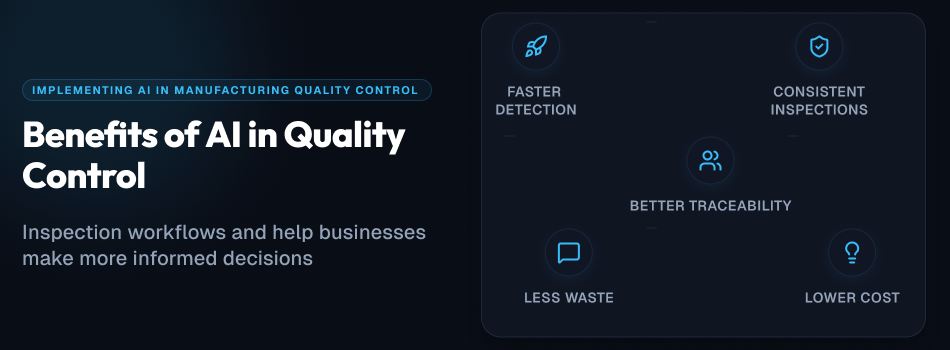
Benefits of AI in Quality Control
Implementing AI in manufacturing quality control can improve inspection workflows and help businesses make more informed decisions.
Faster Defect Detection
AI systems can analyze images and sensor readings rapidly, allowing manufacturers to identify potential defects while production is underway.
When inspection is performed directly on the production line, problems can be detected before large quantities of defective products are manufactured.
More Consistent Inspections
Manual inspections can vary according to an inspector’s experience, fatigue, and working conditions.
AI systems apply the same trained model and inspection criteria repeatedly. This can improve consistency, although performance still depends on the quality of the model and the conditions in which it operates.
Reduced Waste and Rework
Identifying defects early helps manufacturers avoid spending additional time, materials, and labor on products that do not meet quality requirements.
For example, detecting an incorrect component during assembly may prevent the manufacturer from completing an entire batch of defective products.
Over time, inspection data can also reveal recurring production issues that require corrective action.
Lower Quality Inspection Costs
Automating repetitive inspection tasks can reduce the amount of manual effort required for routine checks.
Quality teams can focus more on complex defects, root cause analysis, process improvements, and final verification instead of examining every product manually.
The overall cost benefit depends on implementation expenses, inspection volume, defect frequency, and the accuracy of the system.
Better Product Traceability
AI inspection systems can record images, defect classifications, timestamps, and inspection outcomes.
When connected to manufacturing execution systems or quality management software, this information can help businesses trace quality issues to specific production batches, machines, or process stages.
Better traceability supports investigations, reporting, and continuous improvement.
Improved Customer Satisfaction
Consistent product quality helps manufacturers reduce complaints, returns, and avoidable product failures.
By identifying defects before products leave the facility, AI supported quality control can contribute to better customer experiences and help protect brand reputation.
AI Quality Control vs. Traditional Quality Inspection
Traditional quality inspection remains important in manufacturing. However, AI based inspection offers additional capabilities for analyzing large amounts of data and identifying complex patterns.
| Factor | Traditional Quality Control | AI Based Quality Control |
| Inspection method | Manual checks and predefined rules | Machine learning, computer vision, and sensor analysis |
| Inspection speed | Depends on the task and inspection method | Can support rapid, automated inspection |
| Consistency | May vary between inspectors | Applies a trained model consistently |
| Defect identification | Relies on human observation or fixed criteria | Can recognize learned defect patterns and anomalies |
| Data analysis | Often requires manual review | Can analyze inspection results at scale |
| Process improvement | Uses inspection reports and investigations | Can reveal patterns and support root cause analysis |
| Initial requirements | Inspection procedures, equipment, and trained staff | Suitable data, model validation, integration, and monitoring |
AI does not make traditional inspection unnecessary. In many manufacturing environments, the most effective approach combines automated AI inspection with human expertise, established testing procedures, and final quality verification.
Challenges of Implementing AI in Quality Control
Although AI offers significant opportunities, manufacturers should understand the challenges before introducing it into production.
Data Quality and Availability
AI models need relevant, reliable data to perform effectively. Some manufacturers may have limited examples of defective products, especially when defects occur infrequently.
Businesses can address this challenge by collecting inspection images, maintaining accurate defect records, and working with quality engineers to validate training data.
Integration With Existing Systems
Manufacturing facilities may use older machinery, production control systems, and quality management software.
Integrating AI inspection with these systems requires careful planning, compatible interfaces, and testing to ensure that inspection results reach the right equipment or personnel.
Initial Investment
AI implementation may require industrial cameras, lighting systems, computing hardware, software development, integration, and employee training.
Manufacturers should begin with a clearly defined problem and estimate the expected return on investment before expanding the solution.
False Positives and Missed Defects
An AI system may incorrectly flag an acceptable product or fail to identify a real defect. Both outcomes can create costs and operational risks.
Manufacturers should evaluate precision, recall, false rejection rates, and missed defect rates under realistic production conditions. Human review and established quality checks remain important, particularly for safety critical products.
Ongoing Monitoring and Maintenance
Manufacturing conditions change over time. New materials, product designs, lighting conditions, and machine settings may affect model performance.
Regular testing, performance monitoring, controlled model updates, and clear responsibility for reviewing inspection results help maintain reliability.
How Manufacturers Can Implement AI in Quality Control
A structured implementation approach can help manufacturers adopt AI without disrupting existing production operations.
Step 1: Identify a Specific Quality Problem
Start with a recurring issue, such as surface scratches, incorrect assembly, missing components, or packaging defects. Define what needs to be detected and how success will be measured.
Step 2: Evaluate Available Data
Review existing inspection records, product images, sensor readings, and defect reports. Determine whether enough representative data is available to develop and test the solution.
Step 3: Select the Right AI Technology
Choose an approach based on the inspection task. Computer vision may be suitable for visible defects, anomaly detection for unusual product variations, and sensor based machine learning for identifying process patterns associated with poor quality.
Step 4: Run a Pilot Project
Test the system on a limited production line or a specific product category. Compare AI predictions with verified inspection results to understand its actual performance.
Step 5: Integrate With Production Workflows
Connect validated inspection results to relevant manufacturing systems, dashboards, or alerts. Establish clear procedures for handling rejected products and uncertain predictions.
Step 6: Monitor and Improve Performance
Track defect detection rates, false alarms, inspection speed, rework, and operational costs. Use verified feedback to improve the system and determine whether it is ready for wider deployment.
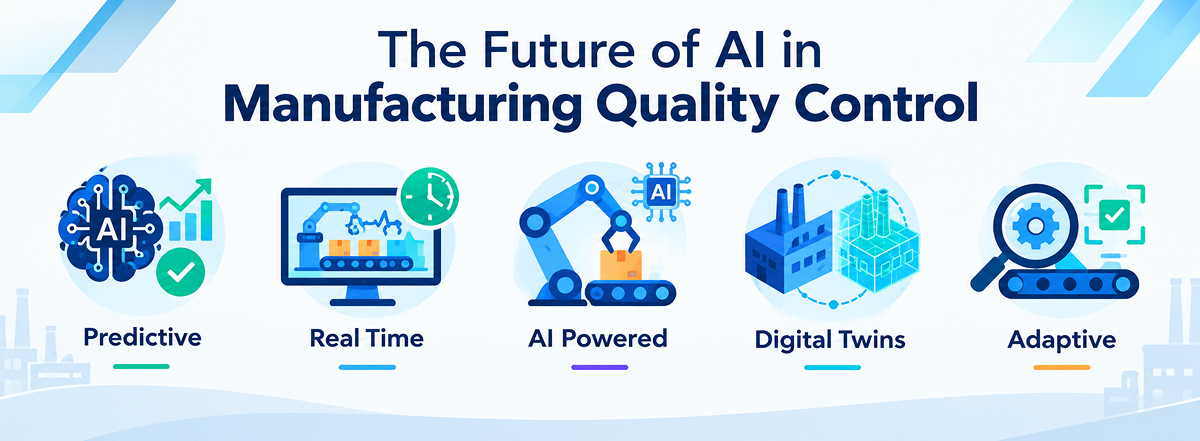
The Future of AI in Manufacturing Quality Control
AI quality inspection is moving beyond identifying visible defects after they occur. Advances in machine learning, computer vision, sensor analytics, and manufacturing connectivity are creating opportunities for more proactive quality management.
Predictive Quality Assurance
AI models can analyze production parameters and historical quality records to identify conditions associated with defects.
Instead of waiting for a finished product to fail inspection, manufacturers may be able to identify unusual process conditions earlier and investigate potential causes.
Real Time Process Monitoring
AI systems can combine camera images with machine data to monitor production continuously. This can help quality teams recognize developing problems and take corrective action before defects spread across a batch.
AI Powered Robotics
Robotic systems equipped with computer vision can assist with product inspection, component positioning, and automated handling of rejected items.
This can help manufacturers build more connected production lines where inspection results inform subsequent manufacturing actions.
Digital Twins and Connected Manufacturing
Digital twins create virtual representations of physical products, equipment, or manufacturing processes. When combined with suitable operational data and AI models, they can help engineers study process variations, evaluate possible changes, and investigate quality problems.
More Adaptive Inspection Systems
Future inspection systems may become better at handling new product variations and previously unseen defects. However, reliable adaptation requires validated data, controlled updates, and ongoing performance checks rather than assuming that every model improves automatically.
These developments are part of the broader movement toward smart manufacturing, where connected technologies support better visibility, efficiency, and quality across production operations.
Conclusion
AI in quality control is helping manufacturers improve how they detect, classify, and investigate product defects. By combining computer vision, machine learning, sensor data, and manufacturing software, businesses can inspect products more consistently, identify potential problems earlier, and reduce avoidable rework.
Successful implementation requires more than selecting an AI tool. Manufacturers need reliable data, appropriate inspection equipment, well defined quality standards, careful integration, and continuous performance monitoring.
For manufacturers exploring digital transformation, AI based quality inspection can be a practical starting point for building smarter and more data driven production operations.
At Krishna Innovative Software (KIS Works), businesses can explore software development, AI integration, and data driven solutions to support their digital transformation goals. The right approach begins with understanding the manufacturing challenge and developing a solution around measurable business needs.
Looking to explore AI solutions for your manufacturing business? Connect with the KIS Works team to discuss how AI integration and custom software solutions can support your operational goals.
Frequently Asked Questions
1. What is AI in quality control?
AI in quality control uses artificial intelligence technologies, including machine learning and computer vision, to inspect products, identify defects, analyze quality data, and support manufacturing decisions.
2. How does AI detect defects in manufacturing?
AI systems analyze product images, sensor readings, or production data to identify unusual patterns and classify potential defects. Depending on the setup, they can flag products for review or trigger automated inspection responses.
3. Which manufacturing defects can AI detect?
AI can help detect scratches, cracks, dents, missing components, assembly errors, labeling issues, surface irregularities, and certain dimensional deviations when suitable inspection equipment and models are available.
4. Can AI replace manual quality inspection?
AI can automate many repetitive inspection tasks, but it does not eliminate the need for human expertise. Quality engineers remain important for validating results, investigating complex defects, and handling safety critical decisions.
5. What are the main benefits of AI in quality control?
The main benefits include faster defect detection, more consistent inspections, reduced rework, improved traceability, better analysis of recurring quality problems, and potentially lower inspection costs.
6. Is AI quality control suitable for small and medium sized manufacturers?
Yes. Small and medium sized manufacturers can begin with a focused inspection task and expand after evaluating the results. The appropriate solution depends on production volume, defect types, available data, and budget.
7. What is the difference between AI inspection and traditional machine vision?
Traditional machine vision often relies on predefined rules and image processing techniques. AI based vision can learn patterns from data and may identify more complex variations. Both approaches can be combined to build effective inspection systems.
8. How does AI help prevent manufacturing defects?
AI can analyze production and inspection data to identify patterns associated with defects. This information helps manufacturers investigate root causes, adjust process settings, and take corrective action before similar issues recur.