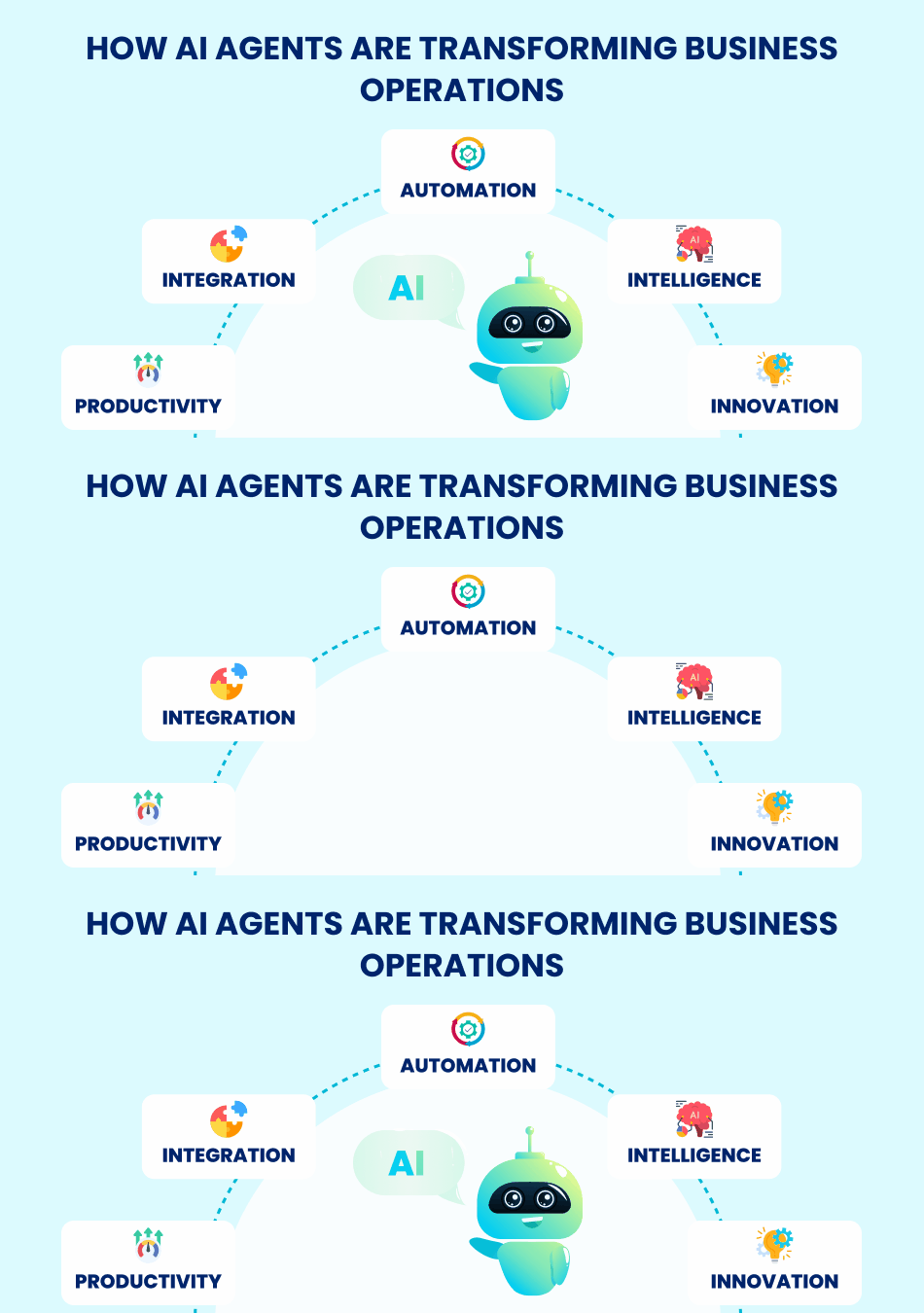
Unlike traditional automation tools that follow predefined rules, AI agents can understand context, make decisions, learn from interactions, and perform tasks with minimal human intervention. They are becoming valuable digital assistants that support employees, improve productivity, and help organizations make smarter decisions.
From handling customer inquiries to managing workflows and analyzing large volumes of business data, AI agents are changing the way companies operate across industries.
In this guide, we’ll explore what AI agents are, how they work, their benefits, real-world use cases, challenges, and why businesses are increasingly investing in AI-powered solutions.
What Are AI Agents?
An AI agent is an intelligent software system designed to perform tasks, make decisions, and interact with users or other systems without requiring constant human supervision.
Unlike basic chatbots that answer predefined questions, AI agents can:
- Understand natural language
- Analyze information from multiple sources
- Make context-aware decisions
- Complete multi-step tasks
- Learn from previous interactions
- Improve performance over time
Think of an AI agent as a highly capable virtual employee. Instead of simply responding to commands, it can plan actions, gather information, and execute tasks based on business objectives.
For example, an AI agent supporting a sales team can automatically qualify leads, schedule meetings, update CRM records, send follow-up emails, and generate performance reports all without manual intervention.
How AI Agents Work
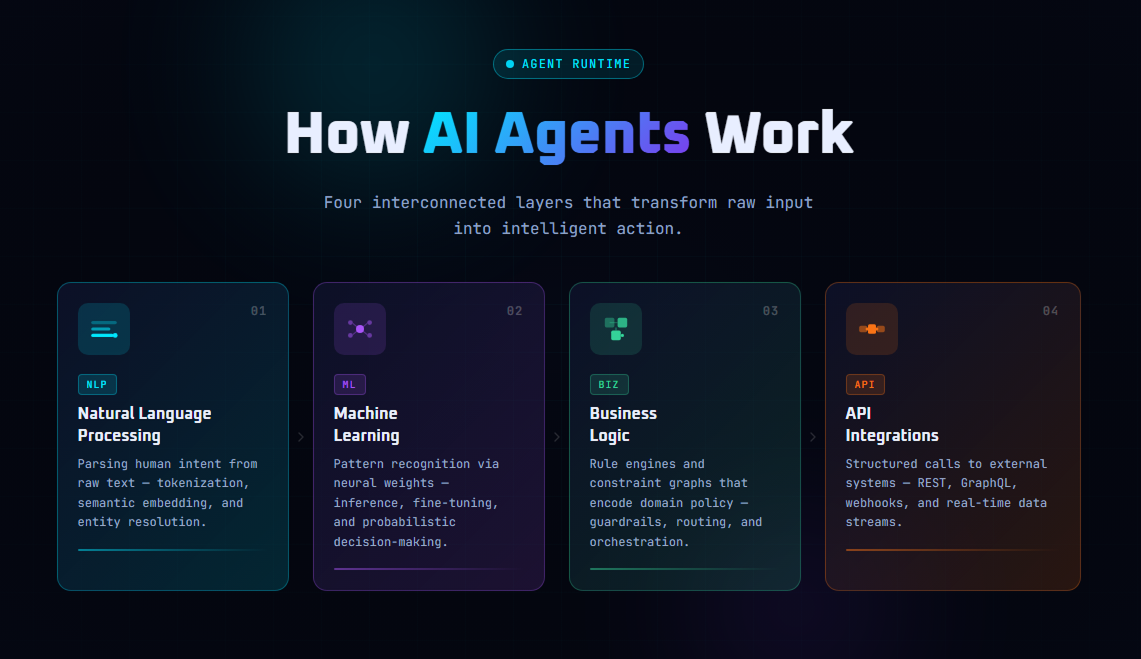
AI agents combine several technologies to perform intelligent actions.
Natural Language Processing (NLP)
NLP enables AI agents to understand human language, whether it’s written or spoken. This allows users to communicate naturally instead of using specific commands.
Machine Learning
Machine learning helps AI agents improve their responses by learning from historical data and user interactions.
Business Logic
Organizations define rules and workflows that guide how AI agents should respond in different situations while maintaining compliance with company policies.
API Integrations
Modern AI agents connect with business tools such as CRM systems, ERP software, customer support platforms, email services, and databases. This connectivity allows them to perform tasks instead of simply answering questions.
Why Businesses Are Investing in AI Agents
Companies are realizing that employees spend a significant portion of their day on repetitive administrative work rather than strategic activities.
Common examples include:
- Answering routine customer questions
- Scheduling meetings
- Updating databases
- Processing invoices
- Managing support tickets
- Preparing reports
- Collecting information from multiple systems
These repetitive tasks consume valuable time and increase the chances of human error.
AI agents help automate these responsibilities, allowing employees to focus on problem-solving, innovation, and customer relationships.
As a result, businesses experience:
- Faster response times
- Improved productivity
- Lower operational costs
- Better customer satisfaction
- Increased business efficiency
Key Benefits of AI Agents
1. Improved Productivity
AI agents work around the clock without breaks. They handle repetitive tasks consistently, allowing employees to dedicate more time to strategic work.
Example:
A software development company receives hundreds of project inquiries every month. Instead of manually reviewing every request, an AI agent collects project requirements, categorizes leads, schedules discovery calls, and sends confirmation emails automatically. The sales team only engages with qualified prospects.
Better Customer Support
Customers expect quick responses regardless of the time of day.
AI agents provide instant assistance by:
- Answering frequently asked questions
- Tracking orders
- Booking appointments
- Resolving common issues
- Escalating complex cases to human agents
Example:
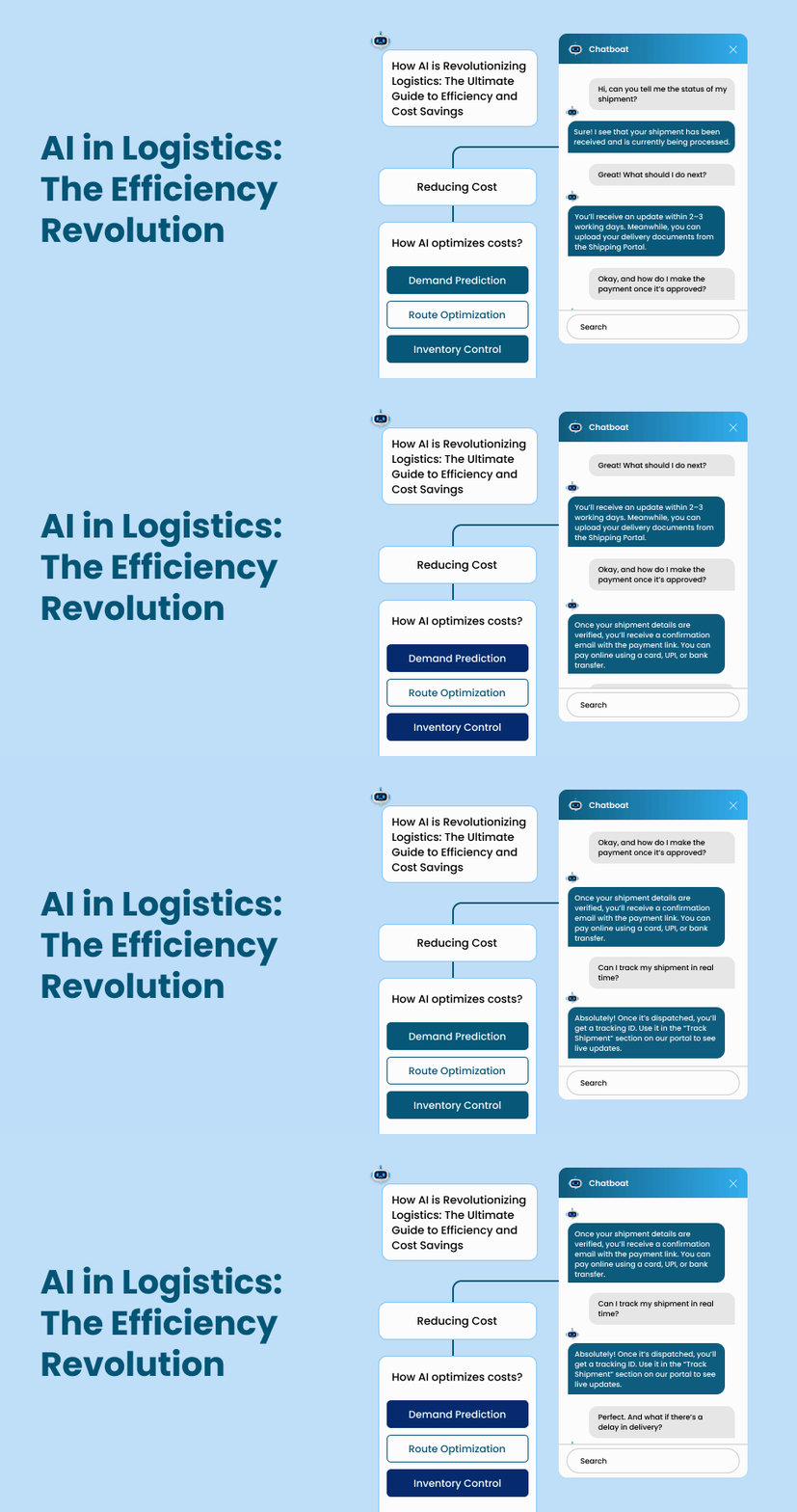
An eCommerce business uses an AI agent to help customers track shipments, process returns, and recommend products. Customers receive immediate support, while customer service representatives focus on resolving more complex issues.
Reduced Operational Costs
Hiring additional staff for repetitive tasks can significantly increase operational expenses.
AI agents reduce costs by automating routine work while maintaining accuracy and consistency.
Instead of expanding customer support teams during peak seasons, businesses can deploy AI agents to manage increased workloads efficiently.
Faster Decision-Making
AI agents analyze large amounts of data within seconds and provide actionable insights.
Business leaders can quickly identify:
- Sales trends
- Inventory shortages
- Customer behavior
- Operational bottlenecks
- Marketing performance
Rather than spending hours preparing reports, decision-makers receive real-time recommendations that support faster and more informed decisions.
Higher Accuracy
Manual processes often lead to mistakes, especially when dealing with large volumes of information.
AI agents minimize human errors by following standardized workflows and validating data before completing tasks.
For industries such as healthcare, finance, and manufacturing, this level of accuracy improves compliance and reduces operational risks.
HR, Sales, and IT Use Cases of AI Agents
AI agents are no longer limited to customer service. They are helping departments across an organization improve efficiency, reduce manual work, and make better decisions.
Human Resources
HR teams handle repetitive administrative tasks every day, from screening resumes to answering employee questions. AI agents simplify these processes and allow HR professionals to focus on employee engagement and talent development.
Common HR use cases include:
- Screening job applications
- Scheduling interviews
- Answering employee policy questions
- Managing onboarding documentation
- Tracking leave requests
- Sending reminders for training and compliance
Example
A growing IT company receives hundreds of resumes for every open position. Instead of reviewing every application manually, an AI agent shortlists candidates based on predefined criteria, schedules interviews, and sends status updates to applicants. This reduces hiring time while improving the candidate experience.
Sales
Sales teams spend a significant amount of time on administrative tasks instead of building relationships with prospects. AI agents automate many of these activities.
They can:
- Qualify leads
- Respond to initial inquiries
- Schedule meetings
- Update CRM records
- Send personalized follow-up emails
- Generate sales reports
Example
A software development company receives inquiries through its website. An AI agent interacts with visitors, asks questions about project requirements, collects contact details, and books meetings with the appropriate sales representative. This ensures that every lead receives a timely response and no opportunity is missed.
IT Support
Internal IT teams often receive repetitive requests, such as password resets, software installation requests, and troubleshooting common technical issues.
AI agents can provide instant support by:
- Resetting passwords
- Troubleshooting common problems
- Creating support tickets
- Routing complex issues to IT specialists
- Monitoring systems for potential failures
Example
An organization with hundreds of employees deploys an AI-powered IT assistant to handle routine support requests. Employees receive immediate assistance, while the IT team focuses on infrastructure improvements and cybersecurity.
Challenges of Implementing AI Agents
Although AI agents offer significant benefits, successful implementation requires careful planning.
Data Quality
AI agents rely on accurate and organized data. Poor-quality or outdated information can lead to incorrect responses and unreliable decisions.
Businesses should clean and standardize their data before deploying AI solutions.
Integration with Existing Systems
Many organizations use multiple software platforms across different departments.
Ensuring seamless integration between AI agents and existing systems such as CRM, ERP, HRMS, and accounting software is essential for maximizing value.
Security and Privacy
AI agents often process sensitive business and customer information.
Organizations should implement:
- Strong authentication
- Data encryption
- Access controls
- Compliance with regulations
- Regular security audits
Protecting business data should always remain a top priority.
Employee Adoption
Introducing AI into the workplace may raise concerns among employees.
Businesses should communicate that AI agents are designed to support employees rather than replace them. Providing proper training and involving teams in the implementation process can encourage adoption and reduce resistance.
Best Practices for Implementing AI Agents
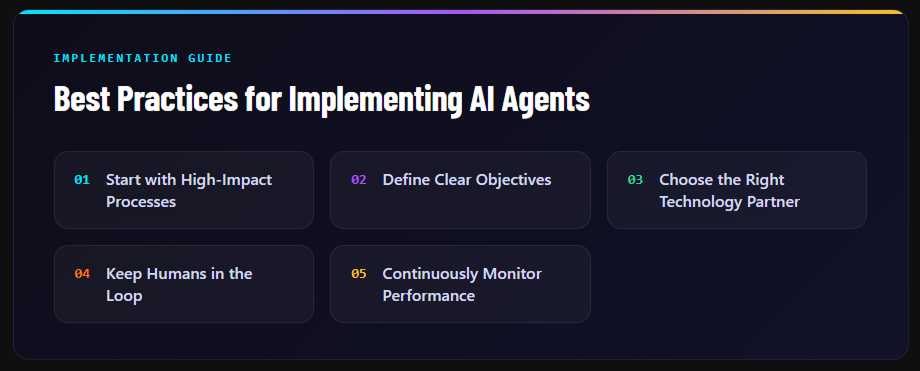
Businesses that achieve the best results follow a structured implementation strategy.
Start with High-Impact Processes
Identify repetitive tasks that consume the most time and automate them first. This allows organizations to achieve quick wins while building confidence in AI adoption.
Define Clear Objectives
Before implementing AI agents, establish measurable goals such as:
- Reducing customer response time
- Increasing lead conversion
- Lowering operational costs
- Improving employee productivity
Clear objectives help measure success and identify areas for improvement.
Choose the Right Technology Partner
Selecting an experienced AI development company is crucial for building reliable and scalable AI solutions.
A trusted technology partner can help with:
- AI strategy
- Custom AI development
- System integration
- Security implementation
- Ongoing maintenance and optimization
Keep Humans in the Loop
While AI agents can automate many tasks, human oversight remains essential for handling complex situations, reviewing critical decisions, and ensuring quality.
The most effective approach combines AI efficiency with human expertise.
Continuously Monitor Performance
Business needs evolve over time, and AI agents should evolve with them.
Regularly monitor performance metrics such as:
- Response accuracy
- Customer satisfaction
- Task completion rates
- Cost savings
- Employee productivity
Continuous improvement ensures long-term success.
The Future of AI Agents in Business
AI agents are expected to become more intelligent, collaborative, and capable of managing increasingly complex business processes.
In the coming years, businesses are likely to see AI agents that can:
- Coordinate work across multiple departments
- Analyze business performance in real time
- Generate strategic recommendations
- Automate end-to-end workflows
- Support decision-making using predictive analytics
Rather than replacing employees, AI agents will act as digital teammates that enhance productivity and allow people to focus on creative problem-solving and innovation.
Organizations that adopt AI thoughtfully today will be better prepared to compete in an increasingly digital business environment.
Frequently Asked Questions (FAQs)
1. What is an AI agent?
An AI agent is an intelligent software system that can understand information, make decisions, and perform tasks automatically with minimal human involvement.
How are AI agents different from chatbots?
Traditional chatbots mainly answer predefined questions. AI agents can understand context, connect with business systems, make decisions, and complete multi-step tasks such as scheduling meetings, updating CRM records, or processing requests.
Which industries benefit most from AI agents?
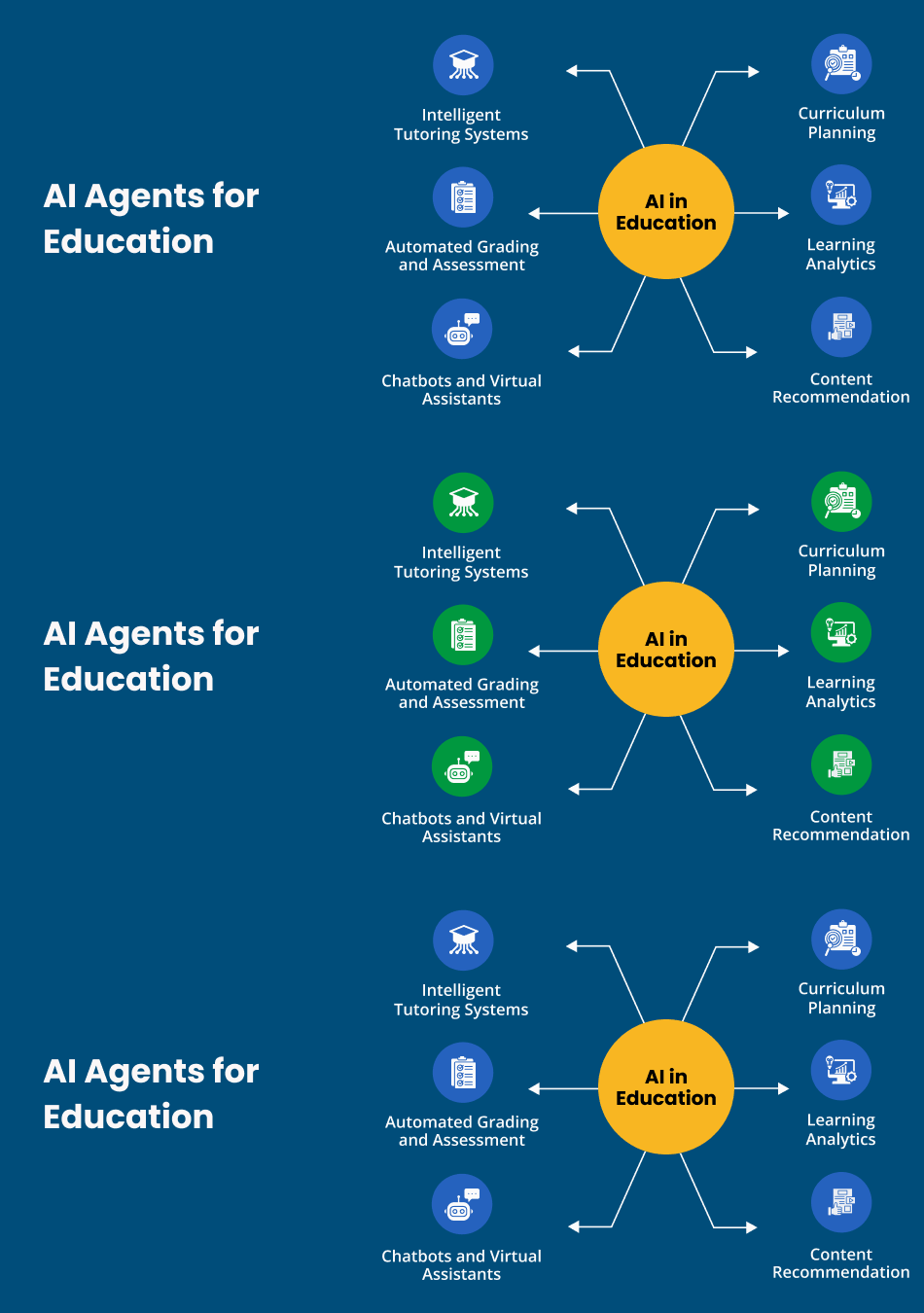
AI agents are widely used in healthcare, retail, finance, manufacturing, logistics, education, customer support, and software development. Any business with repetitive workflows can benefit from AI-powered automation.
Can small businesses use AI agents?
Yes. Small and medium-sized businesses can use AI agents to automate customer support, sales inquiries, appointment scheduling, marketing tasks, and administrative work without requiring large IT teams.
Are AI agents secure?
They can be highly secure when implemented with proper encryption, authentication, role-based access controls, and compliance with data privacy regulations. Security should always be part of the implementation strategy.
Will AI agents replace employees?
AI agents are designed to assist employees rather than replace them. They handle repetitive and time-consuming tasks, allowing people to focus on strategic work, creativity, and customer relationships.
How long does it take to implement an AI agent?
The implementation timeline depends on the complexity of the project. Simple AI agents can be deployed within a few weeks, while enterprise-grade solutions integrated with multiple systems may take several months.
What should businesses consider before implementing AI agents?
Businesses should evaluate their goals, data quality, existing software infrastructure, security requirements, and user adoption strategy. Starting with a clear roadmap increases the chances of a successful implementation.
Conclusion
AI agents are transforming the way businesses operate by automating routine tasks, improving decision-making, and delivering faster, more personalized customer experiences. From customer support and sales to HR and IT, these intelligent systems help organizations work more efficiently while reducing operational costs.
However, successful adoption requires more than simply implementing new technology. Businesses need a clear strategy, high-quality data, secure integrations, and ongoing optimization to realize the full value of AI.
As AI technology continues to evolve, organizations that embrace intelligent automation today will be better positioned to improve productivity, adapt to changing market demands, and drive long-term growth.
If you’re planning to integrate AI into your business operations, partnering with an experienced software development company can help you build secure, scalable, and customized AI solutions that align with your business goals.
Ready to streamline your business with AI-powered solutions?
Build custom AI solutions, automate workflows, and modernize your business with expert guidance from KIS Works.