Building a successful digital product takes more than a good idea. Businesses need a clear development process that helps teams understand customer needs, build the right features, test the product properly, and improve it after launch.
As software products become more complex, development teams are also using cloud platforms, automation, analytics, DevOps, and artificial intelligence to improve the way they work. However, adding more tools does not automatically make product development faster. The real improvement comes from having a clear process, strong communication, continuous feedback, and the right technology in place.
In this guide, we will explain the product development lifecycle and practical strategies businesses can use to make product development faster, more efficient, and focused on customer value.
What Is the Product Development Lifecycle?
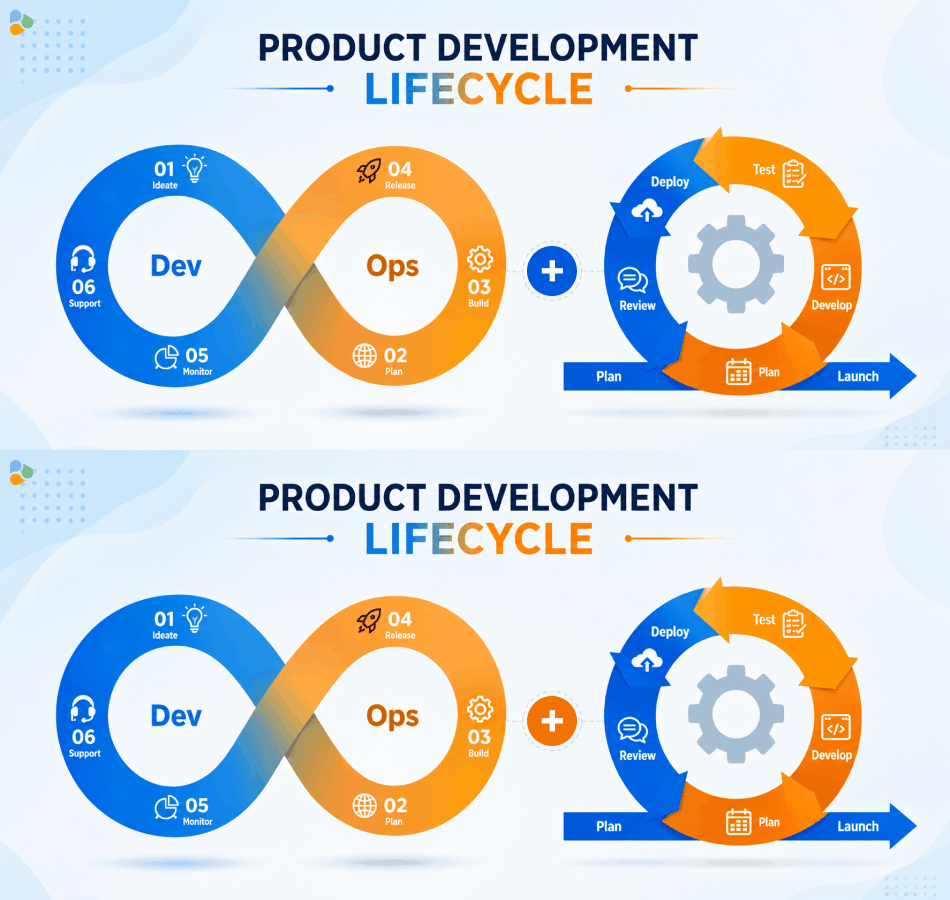
The product development lifecycle is the process of taking a product from an initial idea to development, launch, and continuous improvement.
For a software product, the lifecycle normally includes several connected stages:
- Idea and problem identification
- Market and customer research
- Product planning
- UX and UI design
- Prototyping and validation
- Development
- Testing and quality assurance
- Deployment and launch
- Product monitoring
- Continuous improvement
These stages are not always completed only once. Modern product development is usually an iterative process. Teams build, test, collect feedback, make improvements, and repeat the cycle.
This approach helps businesses avoid spending large amounts of time and money building features that customers may not actually need.
Why Should Businesses Optimize Product Development?
A slow or poorly managed development process can create problems at almost every stage. Requirements may change, communication gaps can appear, testing may happen too late, and teams may spend time fixing issues that could have been prevented earlier.
Optimizing the product development lifecycle can help businesses:
- Reduce unnecessary development work
- Improve time to market
- Control development costs
- Improve product quality
- Reduce technical risks
- Improve communication between teams
- Respond faster to customer feedback
- Make better product decisions
- Create a better user experience
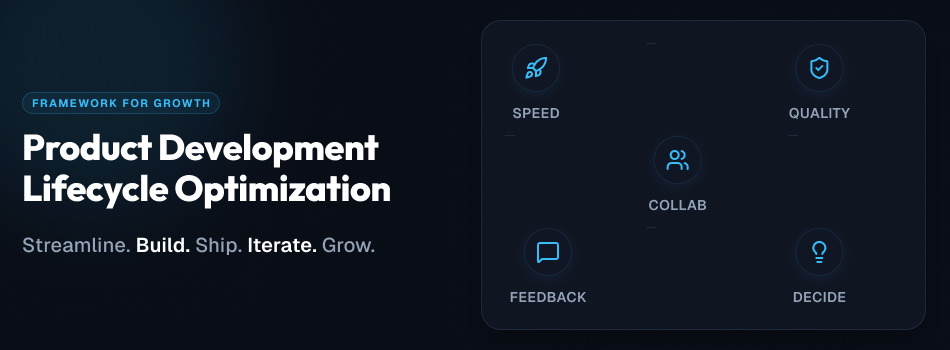
The goal is not simply to release software as quickly as possible. The goal is to deliver useful, reliable software without wasting time and resources.
Key Strategies to Optimize the Product Development Lifecycle
1. Start With a Clear Customer Problem
Before deciding what to build, understand the problem the product is expected to solve.
Talk to potential customers, review existing solutions, study competitors, and identify common pain points. Customer interviews, surveys, support conversations, and website analytics can all provide useful information.
A clear understanding of the problem gives the development team a stronger foundation. It also makes it easier to decide which features are important and which can be left for later.
2. Define Clear Product Goals
Every product needs clear goals before development begins.
Define the target users, business objectives, main product features, expected outcomes, budget, and approximate timeline. These details help product managers, designers, developers, testers, and other stakeholders work toward the same objective.
Clear goals also make it easier to measure whether the product is actually delivering the expected results after launch.
3. Build an MVP Before Expanding the Product
A Minimum Viable Product, or MVP, includes the core features needed to solve the main customer problem.
Instead of spending months developing a large product with dozens of features, businesses can start with a smaller version and test it with real users.
For example, an appointment management platform may initially focus on booking, reminders, customer information, and basic reporting. Additional features can be added after the business understands how customers use the product.
An MVP reduces unnecessary development work and provides an opportunity to learn before making larger investments.
4. Use Agile Development
Agile development allows teams to work in smaller cycles instead of waiting until the entire product is finished.
Development work can be divided into manageable sprints. Teams can review progress, test new functionality, collect feedback, and make changes regularly.
This approach is especially useful when requirements are expected to change during development.
Agile does not mean changing everything continuously. It means creating a process where teams can respond to important changes without disrupting the entire project.
5. Create Cross Functional Teams
Product development works better when different teams communicate regularly.
Product managers, developers, designers, QA specialists, marketers, business teams, and other stakeholders may all contribute to the success of a product.
Keeping these teams connected can reduce misunderstandings and help identify problems earlier.
For example, a developer may identify a technical limitation before a feature is finalized, while a designer may identify a usability issue that could affect the customer experience.
6. Use Prototypes to Validate Ideas Early
Building the complete product before testing the idea can be expensive.
Wireframes, clickable prototypes, and early design versions allow teams to test important ideas before development begins.
Users and stakeholders can review the proposed experience and provide feedback. If something does not work, it is usually easier to change a prototype than a fully developed application.
Early validation can therefore reduce rework later in the project.
7. Automate Testing
Testing should not be treated as the final step before launch.
Automated testing can help development teams check applications more frequently and identify problems earlier. Unit tests, integration tests, API tests, and other automated checks can become part of the development workflow.
Automation does not replace human testing. Instead, it handles repeatable checks while QA teams can spend more time on usability, exploratory testing, and complex scenarios.
8. Implement CI/CD
Continuous Integration and Continuous Deployment, commonly known as CI/CD, can make software delivery more consistent.
With a well-designed CI/CD pipeline, code can be automatically built, tested, checked, and prepared for deployment.
This reduces repetitive manual work and makes it easier for teams to release smaller changes more frequently.
However, automation should be supported by good testing, version control, security practices, and monitoring. Faster deployment without proper quality controls can create new problems.
9. Use AI Carefully in the Development Process
Artificial intelligence is becoming a practical part of modern software development. Teams are using AI tools for tasks such as code assistance, documentation, testing support, debugging, research, and repetitive development work.
Google Cloud’s 2025 DORA research found that AI adoption among the surveyed technology professionals had reached 90%, while more than 80% reported productivity improvements. At the same time, the research highlights that AI can amplify weaknesses in existing development systems, meaning teams still need strong processes and quality controls.
This means businesses should treat AI as a development assistant rather than a replacement for experienced developers and product teams.
AI generated code should still be reviewed, tested, secured, and validated before it becomes part of a production application.
10. Use Product Analytics
Once users start interacting with a product, businesses need to understand what is actually happening.
Product analytics can provide information about:
- Feature usage
- User journeys
- Drop off points
- Conversion rates
- Customer retention
- User engagement
- Frequently used functions
- Areas where users face problems
These insights help product teams decide what should be improved next.
Instead of relying only on assumptions, teams can use real product data to support their decisions.
11. Prioritize Features Based on Value
A product roadmap can quickly become overloaded with feature requests.
Not every requested feature needs to be developed immediately. Teams should consider customer value, business impact, development effort, technical risk, and strategic importance when deciding what to build.
Simple prioritization frameworks such as RICE or MoSCoW can help teams organize their roadmap.
The objective is to spend development time on work that creates meaningful value rather than simply increasing the number of features.
12. Build Security Into the Development Process
Security should be considered throughout the product development lifecycle instead of being treated as a final checklist.
Development teams should consider secure coding practices, access control, data protection, dependency management, authentication, authorization, and security testing during development.
For products that handle sensitive business or customer information, security requirements should be included from the planning stage.
Building security earlier can reduce the risk and cost associated with fixing major issues later.
13. Monitor Technical Debt
Technical debt is created when teams choose a quick or temporary technical solution instead of a more sustainable approach.
Some technical debt is unavoidable, especially when teams are testing an MVP or working under tight deadlines. The problem starts when technical debt continues to grow without being managed.
Regular code reviews, refactoring, documentation, dependency updates, and architecture improvements can help keep the product maintainable as it grows.
14. Create a Continuous Feedback Loop
Product development should not stop when the application goes live.
After launch, collect feedback from customers, support teams, sales teams, analytics platforms, and internal stakeholders.
This information can reveal usability problems, missing features, performance issues, and new customer requirements.
A continuous feedback loop allows businesses to improve the product based on real-world usage instead of relying only on assumptions made during the initial planning stage.
Common Challenges in Product Development
Even with a structured process, product teams can face several challenges.
Common problems include:
- Unclear product requirements
- Frequent changes in scope
- Poor communication
- Unrealistic deadlines
- Limited development resources
- Delayed testing
- Technical debt
- Lack of customer feedback
- Poor documentation
- Integration problems
- Security risks
- Difficulty managing legacy systems
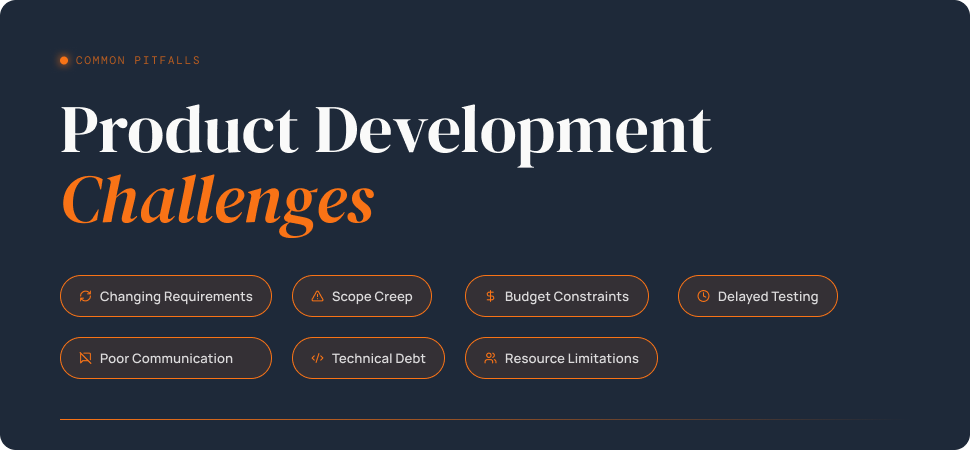
Most of these problems become easier to manage when teams have clear ownership, realistic planning, regular communication, and continuous monitoring.
Important Metrics to Track
Businesses need measurable indicators to understand whether their product development process is improving.
Some useful metrics include:
Time to Market: How long it takes to move from an approved idea to a usable product or feature.
Lead Time for Changes: How quickly development work can move from code changes to production.
Deployment Frequency: How often teams successfully release changes.
Change Failure Rate: How frequently deployments cause problems that require remediation.
Defect Rate: The number and severity of issues identified during development or after release.
Feature Adoption: How many users actually use newly released features.
Customer Retention: Whether users continue using the product over time.
Customer Satisfaction: How users perceive the product and overall experience.
These metrics should be reviewed together rather than used in isolation. Increasing release frequency, for example, is not necessarily useful if product quality and stability decline.
How AI and Automation Are Changing Product Development
AI and automation are changing how teams approach software development.
AI can assist with coding, testing, documentation, research, data analysis, and other repetitive tasks. Automation can also connect development, testing, deployment, monitoring, and reporting workflows.
However, faster work does not automatically mean better product development.
DORA’s 2025 research found that AI adoption was associated with higher software delivery throughput, while also reporting continued challenges around delivery stability. The research emphasizes the importance of strong version control, healthy data, small batches, user focus, and quality internal platforms when adopting AI.
For businesses, the practical lesson is simple: improve the development system first, then use AI and automation to make that system more efficient.
Tools That Can Support Product Development
The right tools depend on the product, team size, technology stack, and business requirements.
Common categories include:
- Project management: Jira, ClickUp, Trello
- UI and UX design: Figma
- Version control: GitHub, GitLab
- Communication: Slack, Microsoft Teams
- CI/CD and DevOps: Azure DevOps, GitHub Actions, GitLab CI/CD
- Analytics: Google Analytics and product analytics platforms
- Cloud infrastructure: AWS, Microsoft Azure, Google Cloud
- AI development: LLM APIs, AI coding assistants, and custom AI platforms
Tools should support the workflow rather than create unnecessary complexity. A smaller set of well-integrated tools is often easier to manage than a large collection of disconnected platforms.
Best Practices for a More Efficient Product Development Process
A strong product development process does not need to be complicated. Businesses can start with a few practical principles:
- Understand the customer problem before building
- Define measurable product goals
- Start with an MVP when appropriate
- Keep teams aligned through regular communication
- Validate designs before full development
- Automate repeatable testing and deployment tasks
- Use analytics to understand product usage
- Prioritize work based on customer and business value
- Address security and technical debt early
- Use AI with proper human review
- Release improvements in manageable batches
- Collect feedback continuously
- Measure both delivery performance and product outcomes
Conclusion
Optimizing the product development lifecycle is not simply about making developers work faster. It is about creating a development process where teams can move from an idea to a reliable product with less waste, better communication, and stronger customer feedback.
Customer research, Agile development, MVPs, automated testing, CI/CD, analytics, security, and AI can all contribute to a more efficient product development process when they are used in the right way.
The most effective approach is to treat product development as a continuous cycle. Build, test, measure, learn, and improve. This helps businesses respond to changing customer needs while maintaining product quality and controlling development costs.
For companies building new software products or modernizing existing applications, a structured product development approach can provide a stronger foundation for long term digital growth.