In today’s competitive market, users expect applications to work flawlessly across devices, browsers, and operating systems. A single bug can lead to customer frustration, negative reviews, lost revenue, and damage to a company’s reputation.
This is why software testing has become an essential part of the development lifecycle.
When businesses start planning their QA strategy, one question often arises:
Should we choose manual testing or automated testing?
Many assume automation is always the better choice because it is faster. Others believe manual testing is sufficient because it costs less initially.
The truth lies somewhere in the middle.
Leading software testing companies recommend using both methods strategically. Each serves a unique purpose, and understanding their strengths can help businesses improve software quality while optimizing costs.
In this guide, we’ll explore the differences between manual and automated testing and help you determine which approach is right for your project.
What is Manual Testing?
Manual testing is the process of evaluating software by manually executing test cases without the use of automation tools.
QA engineers interact with the application just like real users, checking functionality, usability, navigation, and overall user experience.
For example, if you’re launching a food delivery app, a manual tester might:
- Create an account
- Browse restaurants
- Add items to the cart
- Complete payment
- Track an order
During this process, they may identify usability concerns or unexpected behavior that automated scripts cannot detect.
Common Types of Manual Testing
- Exploratory Testing
- User Acceptance Testing (UAT)
- Ad-Hoc Testing
- Usability Testing
- Interface Testing
What is Automated Testing?
Automated testing uses tools, frameworks, and scripts to execute test cases automatically.
Instead of repeatedly performing the same tasks manually, automated tests validate application behavior within seconds.
For example, an eCommerce platform may have hundreds of checkout scenarios. Automation allows these scenarios to be tested after every code update without requiring manual effort.
Common Types of Automated Testing
- Regression Testing
- Smoke Testing
- API Testing
- Performance Testing
- Load Testing
- Security Testing
Manual Testing vs Automated Testing: Key Differences
| Feature | Manual Testing | Automated Testing |
| Human Involvement | High | Minimal |
| Speed | Slower | Faster |
| Initial Investment | Lower | Higher |
| Scalability | Limited | Excellent |
| Test Coverage | Moderate | Extensive |
| User Experience Validation | Excellent | Limited |
| Repetitive Tasks | Inefficient | Highly Efficient |
| Maintenance | Low | Moderate |
Advantages of Manual Testing

Better User Experience Evaluation
Humans can identify confusing workflows, poor navigation, and design inconsistencies.
Flexibility
Manual testing adapts quickly to changing requirements.
Ideal for Exploratory Testing
Testers can investigate unexpected behaviors beyond predefined scenarios.
Lower Initial Costs
No automation framework setup is required.
Advantages of Automated Testing
Faster Execution
Hundreds of test cases can run simultaneously.
Greater Accuracy
Automation eliminates many human errors.
Better Test Coverage
Applications can be tested across multiple devices and browsers.
Supports Continuous Delivery
Automated tests integrate seamlessly into DevOps and CI/CD pipelines.
Long-Term Cost Savings
Although setup costs are higher, automation significantly reduces repetitive testing expenses.
Challenges of Manual Testing
Manual testing remains valuable but has limitations.
Time-Consuming
Large applications require significant testing effort.
Human Errors
Repeated tasks increase the possibility of mistakes.
Difficult to Scale
Frequent releases make manual-only testing inefficient.
Limited Coverage
Testing every possible scenario manually is nearly impossible.
Challenges of Automated Testing
Automation is powerful but not perfect.
High Initial Investment
Automation tools, frameworks, and skilled engineers require investment.
Maintenance Requirements
Scripts must be updated as applications evolve.
Limited Human Insight
Automation cannot evaluate emotions, usability, or visual appeal.
Not Suitable for Every Test Case
Some scenarios still require manual validation.
When Should You Choose Manual Testing?
Manual testing is recommended when:
- New features are under development
- User experience is critical
- Requirements change frequently
- Exploratory testing is required
- Budget constraints limit automation investment
Example
A startup launching an MVP may initially rely more on manual testing because features change rapidly.
When Should You Choose Automated Testing?
Automation becomes essential when:
- Releases occur frequently
- Applications are large and complex
- Regression testing consumes excessive time
- CI/CD pipelines are implemented
- Multiple environments require testing
Example
A SaaS platform releasing updates every week benefits significantly from automated regression testing.
Why Modern QA Teams Use Both
The most successful testing strategies combine manual and automated testing.
Manual Testing Handles:
- User experience validation
- Exploratory testing
- Visual checks
- Ad-hoc testing
Automation Handles:
- Regression testing
- Repetitive tasks
- Performance testing
- API testing
- Cross-browser testing
This hybrid approach balances speed, accuracy, and user-centric quality assurance.
Real-World Testing Scenarios
E-Commerce Website
Manual Testing:
- Checkout experience
- Product navigation
- User journey evaluation
Automated Testing:
- Payment validation
- Cart functionality
- Regression testing
Healthcare Application
Manual Testing:
- Workflow validation
- Compliance reviews
Automated Testing:
- Security testing
- API testing
- Performance testing
SaaS Platform
Manual Testing:
- Feature usability
Automated Testing:
- Continuous regression testing
- Integration testing
Future Trends in Software Testing
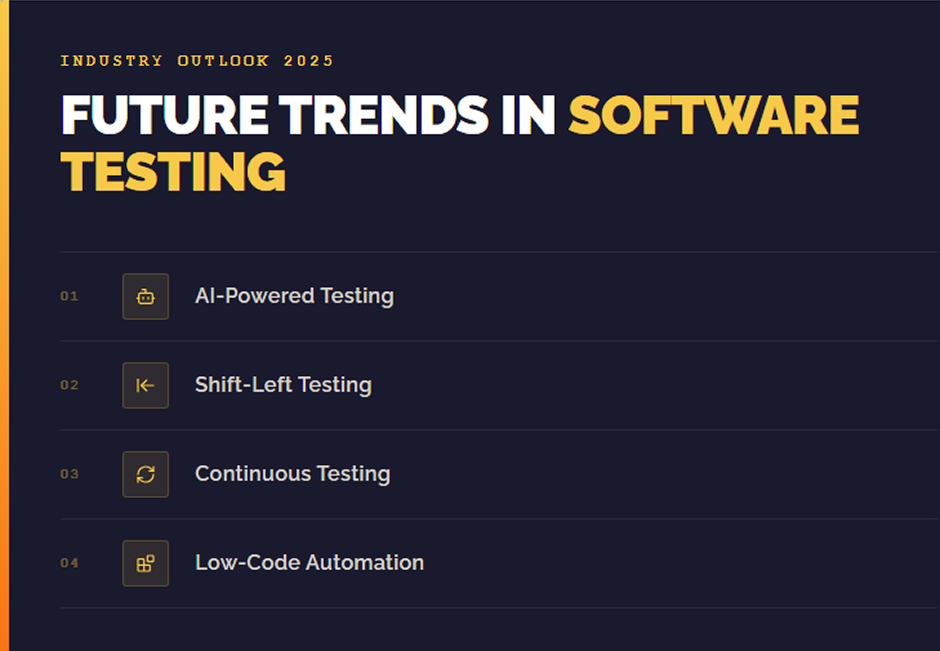
The future of software testing is being shaped by:
AI-Powered Testing
Artificial intelligence can generate test cases and identify defects faster.
Shift-Left Testing
Testing begins earlier in the development cycle.
Continuous Testing
Organizations increasingly test throughout the software lifecycle.
Low-Code Automation
Modern tools make automation more accessible to non-technical users.
Frequently Asked Questions
Which is better: manual testing or automated testing?
Neither is universally better. The right choice depends on project requirements. Most businesses benefit from a combination of both.
Can automation completely replace manual testing?
No. Automation cannot fully replicate human judgment, creativity, or usability evaluation.
Is automated testing expensive?
It requires a higher upfront investment, but it often reduces long-term testing costs.
When should a startup invest in automation?
Startups should consider automation once their product becomes stable and frequent regression testing is required.
What testing approach do software testing companies recommend?
Most professional QA teams recommend a hybrid testing strategy that combines manual and automated testing.
Which testing method is best for Agile development?
Agile teams typically use both methods. Manual testing validates new features, while automation supports rapid release cycles.
Key Takeaways
✔ Manual testing provides human insight and usability evaluation.
✔ Automated testing delivers speed, consistency, and scalability.
✔ Neither approach should be viewed as a complete replacement for the other.
✔ A hybrid testing strategy offers the best balance between quality and efficiency.
✔ Modern software testing companies increasingly combine automation, manual expertise, and AI-powered tools.
Final Thoughts
The debate between manual and automated testing is no longer about choosing one over the other.
Today’s successful software teams understand that both approaches play a critical role in quality assurance.
Manual testing helps businesses understand how real users experience their software, while automated testing ensures stability, speed, and consistency across releases.
By combining the strengths of both methods, organizations can reduce defects, improve customer satisfaction, accelerate product delivery, and achieve long-term software success.
If you’re planning your next software project, the smartest approach is not manual versus automated testing, it’s understanding how to use both effectively.