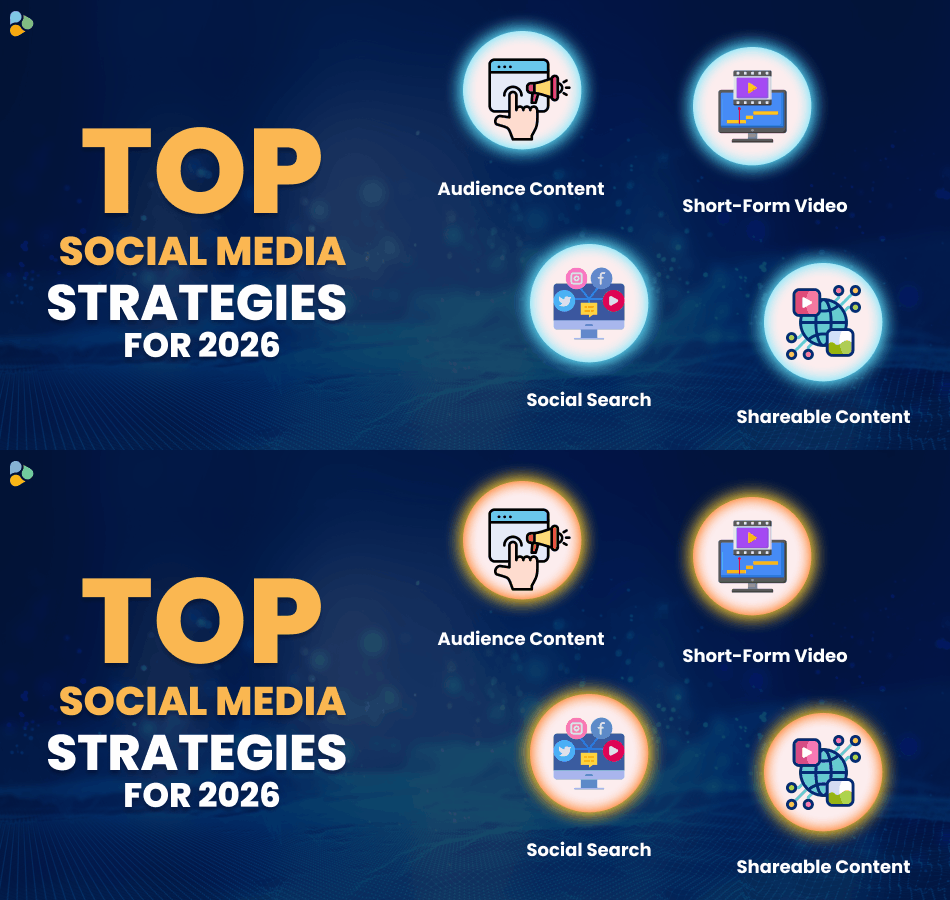
However, simply posting every day does not guarantee better reach. Social platforms are becoming more competitive, and algorithms are increasingly focused on content quality, relevance, engagement, and user behavior.
If you want your brand to reach more people in 2026, you need a clear strategy—not just more posts.
In this guide, we’ll discuss 10 practical social media marketing strategies that can help businesses increase reach, attract the right audience, and build a stronger online presence.
Why Social Media Reach Matters in 2026
Reach is the number of unique people who see your content. The larger your relevant reach, the more opportunities you have to generate engagement, website visits, leads, and sales.
But there is an important difference between getting more reach and getting the right reach.
A post reaching 100,000 random users may bring less value than a post reaching 10,000 people who actually need your product or service.
That is why your goal should be:
More relevant reach + better engagement + stronger relationships.
1. Create Content Around Your Audience’s Problems
One of the simplest ways to increase social media reach is to stop creating content only about your business.
Instead, create content around the problems, questions, interests, and goals of your target audience.
For example, instead of posting:
“We provide AI development services.”
Create content such as:
“5 Business Processes You Can Automate With AI”
The second topic gives people a reason to stop scrolling and learn something.
Before creating content, ask:
- What problems does my audience have?
- What questions do they frequently ask?
- What mistakes are they making?
- What information can help them?
- What trends are affecting their industry?
When your content solves real problems, people are more likely to watch, save, share, and comment on it.
2. Focus More on Short-Form Video
Short-form video continues to be one of the most effective formats for reaching new audiences.
Platforms such as Instagram, YouTube, Facebook, and TikTok give businesses opportunities to reach people beyond their existing followers.
But creating a video is not enough.
Your first few seconds need to give people a reason to continue watching.
For example:
Weak opening:
“Today we are going to discuss social media marketing.”
Stronger opening:
“Posting every day but still getting zero reach? Here’s what you may be doing wrong.”
Use short videos for:
- Quick tips
- How-to content
- Industry insights
- Behind-the-scenes content
- Customer questions
- Product demonstrations
- Case studies
- Common mistakes
- Myth-busting content
Keep the message simple and make every second useful.
3. Build Content Series Instead of Random Posts
A content series can make your social media strategy more consistent and recognizable.
Instead of creating completely different posts every day, choose a topic and turn it into multiple pieces of content.
For example:
Series: “AI for Small Businesses”
- Day 1: 5 tasks AI can automate
- Day 2: AI tools for customer support
- Day 3: AI for marketing
- Day 4: AI for sales
- Day 5: Common AI mistakes
- Day 6: AI implementation costs
- Day 7: AI case study
This approach gives your audience a reason to return for the next post.
It also makes content planning easier because one core topic can generate multiple posts.
4. Use Social Search Optimization
People are increasingly using social platforms to discover information, products, brands, and solutions.
This means your social content should not only be created for algorithms—it should also be created for search.
Use relevant keywords naturally in:
- Post captions
- Video titles
- On-screen text
- Descriptions
- Hashtags
- Profile information
For example, if you are targeting people searching for AI development services, don’t rely only on broad hashtags such as #AI.
Create content around specific topics such as:
“How Much Does AI Application Development Cost?”
This can help your content appear when people actively search for that subject.
5. Make Shareable Content
If you want to increase reach, create content people want to share with others.
Shares can help your content reach audiences beyond your existing followers.
Some formats that naturally encourage sharing include:
- Useful checklists
- Industry statistics
- Practical tips
- Mistakes to avoid
- Step-by-step guides
- Simple frameworks
- Templates
- “Do this, not that” posts
- Educational carousels
Think about this before publishing:
“Would someone send this post to a colleague, friend, or business owner?”
If the answer is yes, you have a stronger chance of earning organic distribution.
6. Use Carousels for Educational Content
Carousels are useful when you need to explain a topic that cannot fit into one image or short sentence.
A good carousel should have a simple flow.
For example:
Slide 1:
“7 Social Media Mistakes Killing Your Reach”
Slide 2:
“Mistake #1: Creating Content for Everyone”
Slide 3:
“Why It Doesn’t Work”
Slide 4:
“What You Should Do Instead”
Slide 5:
“Mistake #2: Ignoring Your First 3 Seconds”
And so on.
The final slide can include a simple CTA such as:
“Save this for your next content planning session.”
The goal is not to fill every slide with information. Make each slide easy to understand and encourage people to continue to the next one.
7. Turn Comments Into Conversations
Social media should be social.
Instead of treating comments as a simple number, use them as an opportunity to start conversations.
When someone asks a question, provide a useful answer.
You can also ask questions in your captions:
- “Which one are you struggling with?”
- “Would you try this strategy?”
- “What is your biggest social media challenge?”
- “Which platform works best for your business?”
But avoid forcing engagement with irrelevant questions.
The best engagement comes from genuine conversations around useful content.
8. Collaborate With Creators and Industry Experts
You don’t always need to build your entire audience from zero.
Collaborating with relevant creators, experts, brands, and industry professionals can introduce your business to new audiences.
Collaboration ideas include:
- Expert interviews
- Joint live sessions
- Podcast-style videos
- Industry discussions
- Guest content
- Co-created reels
- Case studies
- Expert roundups
The key is relevance.
A collaboration with an audience that actually matches your target market can be much more valuable than working with someone who simply has a large follower count.
9. Repurpose One Idea Into Multiple Content Formats
Creating fresh content every day can become difficult.
Instead, create one strong piece of content and repurpose it.
For example, one detailed blog about AI automation for businesses could become:
- 3 short videos
- 1 LinkedIn post
- 1 Instagram carousel
- 5 social media tips
- 1 infographic
- 1 email
- 1 discussion post
This doesn’t mean copying and pasting the same content everywhere.
Adapt the idea to each platform.
A LinkedIn post can be more detailed, while an Instagram Reel can focus on one strong point from the same topic.
This approach saves time while keeping your brand consistently visible.
10. Track What Actually Drives Reach
Don’t guess what is working.
Use your social media analytics to understand which content gets the strongest response.
Look beyond likes and track metrics such as:
- Reach
- Watch time
- Average video retention
- Shares
- Saves
- Comments
- Profile visits
- Website clicks
- Leads
- Follower growth
For example, if educational videos consistently receive more shares and watch time than promotional videos, create more educational videos.
Your analytics should influence your next content plan.
The goal is not to repeat what you posted. It’s to repeat what worked.
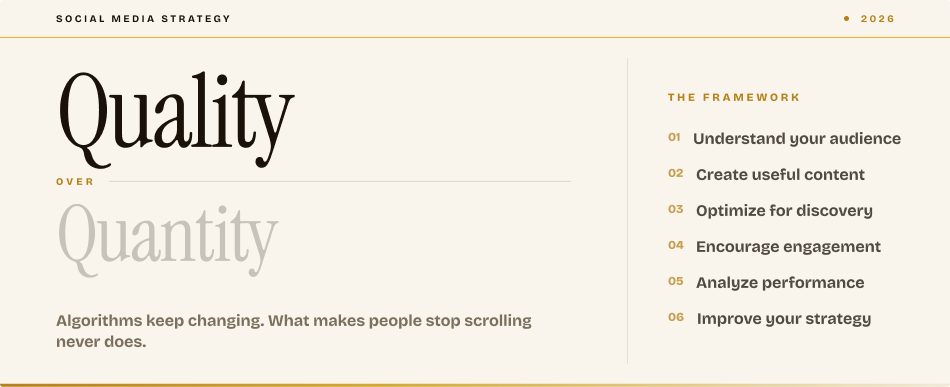
Social Media Strategy in 2026: Quality Over Quantity
Posting more content does not automatically mean getting more reach.
A better approach is to create useful, original, relevant, and easy-to-consume content consistently.
A strong social media strategy can follow this simple framework:
Understand your audience → Create useful content → Optimize for discovery → Encourage meaningful engagement → Analyze performance → Improve your strategy.
Social media algorithms will continue to change, but one thing will remain important: people engage with content that gives them a reason to stop, watch, learn, save, or share.
Final Thoughts
Increasing social media reach in 2026 is less about chasing every algorithm update and more about understanding your audience.
Focus on solving real problems, creating strong short-form videos, building content series, optimizing for social search, encouraging genuine conversations, collaborating with relevant people, and using analytics to improve your strategy.
Most importantly, don’t measure success only by follower count.
The right audience is more valuable than a large audience.
If your content consistently helps the people you want to reach, your social presence can become more than a place to post updates; it can become a powerful channel for brand awareness, trust, leads, and business growth.