Search is changing. For many years, businesses focused on getting their websites to the top of Google search results. They researched keywords, improved website pages, built backlinks, fixed technical SEO issues, and created content to attract organic traffic.
Those things are still important, but the way people search for information is changing.
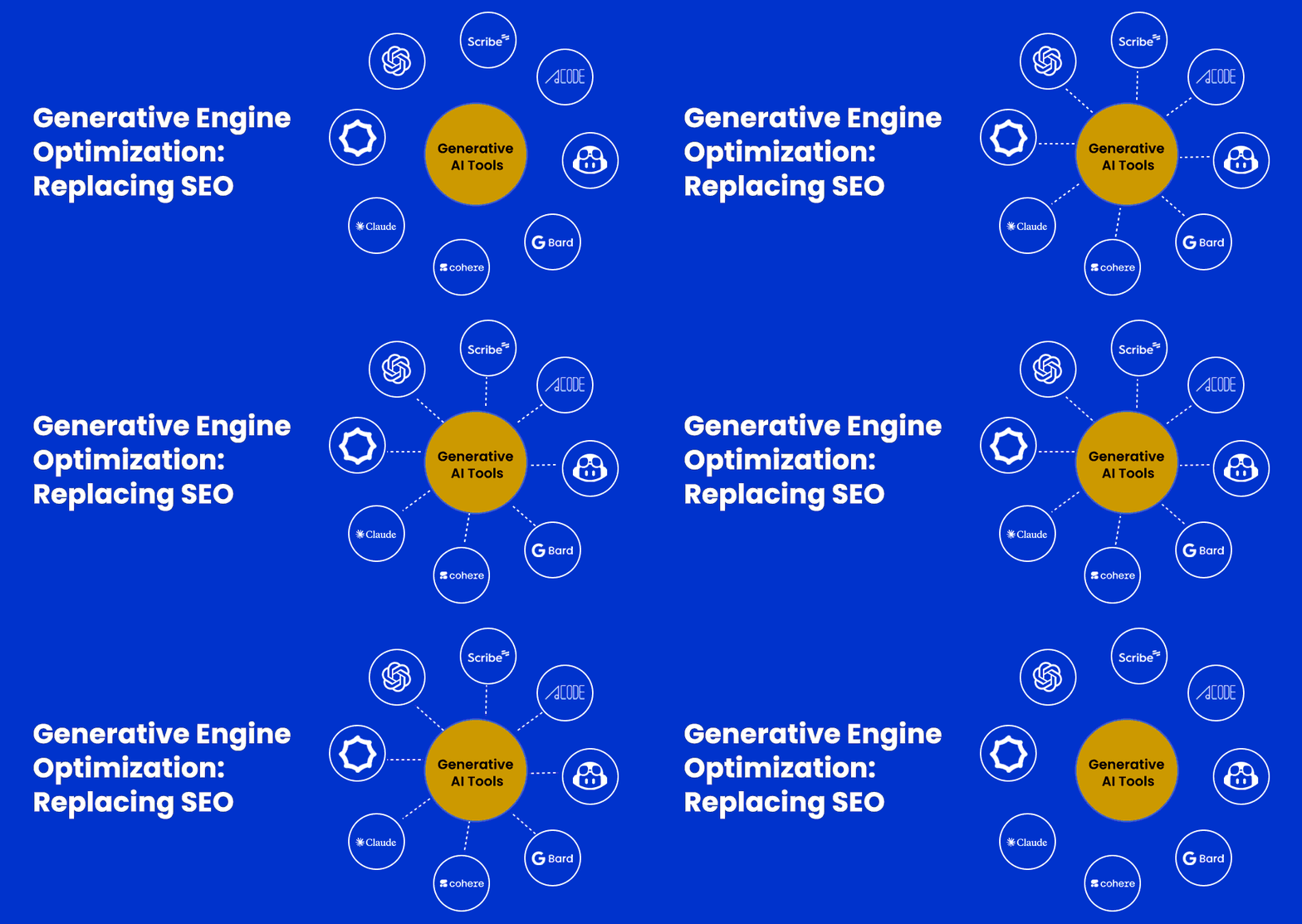
Today, users can ask complete questions through AI-powered tools and search experiences instead of simply typing a few keywords into Google. They may use platforms such as ChatGPT, Google Gemini, Microsoft Copilot, or Perplexity to get a direct answer instead of opening several websites and comparing the information themselves.
This change has introduced a new area of digital marketing called Generative Engine Optimization (GEO).
GEO focuses on making information easier for AI-powered systems to understand and potentially use when generating answers. It does not mean that traditional SEO is no longer useful. Instead, businesses need to think about how their content can perform across both traditional search and newer AI-driven search experiences.
In this article, we will explain what GEO is, how it differs from SEO, how the two approaches work together, and what businesses can do to prepare their websites for the changing search landscape.
What Is Generative Engine Optimization (GEO)?
Generative Engine Optimization, commonly called GEO, is the practice of creating and organizing content so that AI-powered search and answer systems can better understand the information and potentially use it when generating responses.
Traditional search usually presents users with a list of web pages. AI-powered search can take information from different sources, understand the context, and provide a more direct response.
For example, a person may search for “best CRM software for a small business” on Google and receive a list of websites. Another person may ask an AI tool, “What should a small business look for when choosing a CRM?” and receive a detailed answer covering features, pricing, integrations, ease of use, and other factors.
This difference changes how businesses should think about content.
Instead of focusing only on ranking for individual keywords, businesses should also create useful information that clearly answers questions, explains topics in depth, demonstrates expertise, and provides reliable information.
What Is SEO?
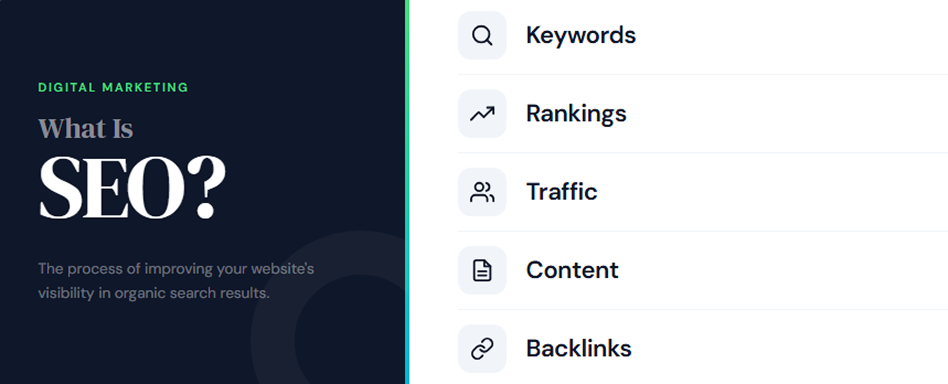
SEO stands for Search Engine Optimization. It is the process of improving a website so that search engines can understand its content and users can find it through organic search results.
SEO includes many different activities, including keyword research, on-page optimization, technical SEO, internal linking, content creation, website performance, local SEO, and earning relevant backlinks.
The main goal of SEO is to improve a website’s visibility in search engines and attract relevant organic traffic.
For example, a web development company may create a page targeting “custom web development services” and optimize the page around the needs of people searching for those services.
SEO remains an important part of digital marketing because search engines are still a major way people discover businesses, products, services, and information.
GEO vs SEO: What Is the Difference?
SEO and GEO have a similar overall purpose: helping people discover useful information. The main difference is the type of search experience they are designed to support.
SEO traditionally focuses on improving visibility in search engine results and encouraging users to visit a website. GEO focuses more on making information understandable and useful for AI-powered systems that may generate answers from multiple sources.
| SEO | GEO |
| Search Engine Optimization | Generative Engine Optimization |
| Focuses on traditional search visibility | Focuses on visibility in generative search experiences |
| Search rankings are important | Being understood and potentially referenced in AI answers is important |
| Keywords and search intent matter | Context, topic depth, and user intent matter |
| Links and website authority are important | Reliable information and authority are important |
| Organic traffic is a major goal | AI visibility and brand discovery are additional goals |
| Technical SEO is important | Clear structure and machine-readable information are useful |
However, this does not mean that SEO and GEO should be treated as completely separate strategies.
A technically strong website with useful, trustworthy, well-structured content gives you a better foundation for both traditional search and AI-driven discovery.
Why Is GEO Becoming Important?
People are becoming more comfortable using conversational interfaces to find information.
Instead of searching for something like “AI integration ERP”, a user may ask, “How can I add AI to an existing ERP system without replacing the entire system?”
The second question contains more context. It tells you what the person wants to know and what problem they are trying to solve.
AI systems are designed to understand this type of conversational input.
For businesses, this means there is an opportunity to create content around real questions and problems instead of focusing only on short keyword phrases.
This is especially useful for businesses selling complex products or services because potential customers often have several questions before they make a decision.
Does GEO Replace SEO?
No, the idea that GEO will completely replace SEO is too simple. Traditional search engines are still an important part of how people find information, products, services, local businesses, and websites.
SEO also provides many of the foundations that help content perform well in modern search environments. A website still needs to be crawlable, indexable, technically healthy, useful, and easy to understand.
GEO should therefore be viewed as an extension of your search strategy, not a complete replacement for SEO.
A better approach is to build a strong SEO foundation and then make your content useful for conversational and AI-powered search experiences as well.
How Does GEO Work?
There is no single GEO technique that guarantees that an AI system will mention your website.
Instead, GEO involves several good content and website practices that make information easier to understand.
1. Understand What Your Audience Is Asking
Start with real questions.
Talk to your sales and customer support teams. Look at questions customers ask during calls. Review Google Search Console data, keyword research, forums, social media discussions, and competitor content.
For example, if you provide ERP development services, don’t create content only around the keyword “ERP development.”
Think about questions such as:
How much does ERP development cost?
Can AI be integrated into an existing ERP system?
How long does ERP implementation take?
What are the benefits of a custom ERP system?
These questions give you a better understanding of what your audience actually wants to know.
2. Write Clear and Useful Answers
When someone visits your content, they should not have to read several paragraphs before finding the answer.
Start each section with a clear explanation and then provide more detail.
For example, if you have a section called “What is AI integration?”, explain the meaning first. After that, discuss how integration works, what systems can be connected, possible use cases, challenges, and examples.
This makes the content easier for people to read and easier for search systems to understand.
3. Focus on Topics, Not Just Keywords
One of the biggest mistakes in SEO is creating content around keywords without properly covering the topic.
Suppose your main topic is AI integration with CRM systems.
A useful article could explain AI chatbots, automated lead qualification, customer data analysis, AI recommendations, workflow automation, security considerations, implementation steps, and common challenges.
This gives readers a complete resource instead of a page that repeatedly uses the same keyword.
4. Build Topic Clusters
Topic clusters can help demonstrate that your website covers a subject in depth.
For example, a company offering .NET development could create content around .NET application development, ASP.NET, .NET modernization, .NET API development, cloud migration, AI integration with .NET, application security, and development costs.
These pages can be connected with relevant internal links.
Instead of having one article trying to rank for every variation of a topic, your website develops a collection of useful resources that support each other.
5. Demonstrate Real Experience
Generic information is easy to find.
What can make your content more valuable is your own experience.
If your company has built an AI assistant, explain what problem it solved, what technologies were used, how the system works, and what the business learned during development.
If you have worked on a CRM integration project, explain the challenges and the approach you used.
Real examples make content more useful and help establish your business as a knowledgeable source.
6. Use Clear Website Structure
Good structure helps both readers and search systems understand your content.
Use descriptive headings, short sections, relevant internal links, tables where they are useful, lists when appropriate, and clear explanations of technical terms.
Don’t make every paragraph extremely short just because you are writing for search engines. Instead, use natural paragraphs that explain one idea properly.
7. Use Structured Data Where Appropriate
Structured data gives search engines additional information about the content of a page.
Depending on the page, you may use structured data such as Article, Organization, BreadcrumbList, Product, Service, or other appropriate schema types.
Structured data does not guarantee that your content will appear in an AI-generated answer or a rich search result. It should be used to provide accurate information about the page, not as a shortcut to rankings.
8. Build a Strong Online Presence
AI visibility is not only about what you publish on your own website.
Your overall online presence also matters.
Businesses should maintain accurate information across important platforms and build a consistent presence through their website, social profiles, business listings, reviews, industry publications, case studies, and other relevant sources.
The stronger and more consistent your digital presence is, the easier it is for people to understand who your business is and what it offers.
What Is the Role of Search Intent in GEO?
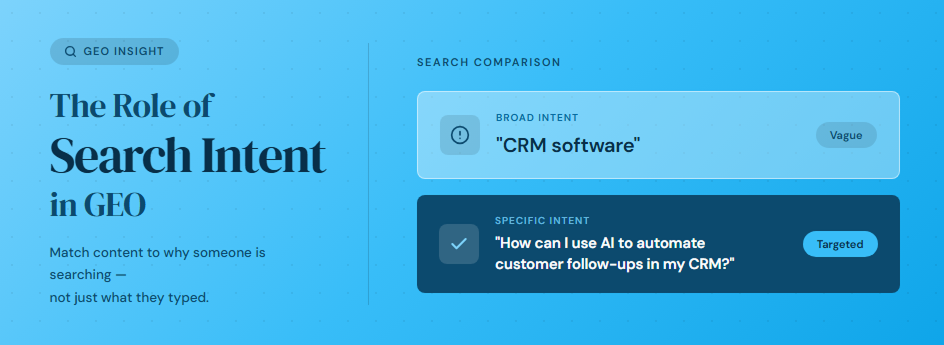
Search intent is the reason behind a search.
Consider these two searches:
“CRM software”
and
“How can I use AI to automate customer follow-ups in my CRM?”
The first search is broad. The user could be researching CRM software, comparing products, looking for pricing, or simply learning what CRM means.
The second search is much more specific. The person has a particular problem and wants to understand how AI can solve it.
Good content should match that intent.
Before creating a page, ask yourself:
What does the user actually want to know?
Once you understand that, create the content around the user’s problem rather than simply trying to include a target keyword.
GEO and Conversational Search
People often use natural language when communicating with AI systems.
Instead of searching for:
“ERP AI integration benefits”
they might ask:
“What are the benefits of adding AI to an existing ERP system?”
This means content should use natural language and answer questions in a way that sounds like a real explanation.
This does not mean every article needs to be written like a conversation.
It simply means you should avoid awkward keyword-heavy sentences and write in the same clear language your customers use when asking questions.
GEO and Zero-Click Searches
A zero-click search occurs when a user gets the information they need directly from the search experience without visiting a website.
AI-generated answers can contribute to this type of search experience.
For businesses, this creates both a challenge and an opportunity.
The challenge is that someone may receive an answer without clicking through to your website. The opportunity is that your brand or information may still become part of the user’s discovery process.
This is why businesses should not measure search performance only through clicks.
Traffic and conversions remain important, but brand visibility, mentions, impressions, and overall search presence can also provide useful information.
How Can Businesses Optimize for GEO?
There is no guaranteed formula for appearing in AI-generated answers, but businesses can take practical steps to improve the quality and usefulness of their online information.
Start by reviewing your existing website. Identify pages that are outdated, too thin, difficult to understand, or missing important information.
Next, research the questions your customers actually ask. Update important service pages and existing articles before producing large amounts of new content.
Create detailed content around your core services and build supporting articles around related questions. Connect these pages with relevant internal links.
Add original information wherever possible. Case studies, examples, expert opinions, first-hand experience, original research, and useful data can make content more valuable than generic articles.
Finally, continue working on the technical side of SEO. Make sure your website is accessible, mobile-friendly, fast, properly indexed, and easy for search engines to crawl.
Common GEO Mistakes to Avoid
Focusing Only on Keywords
Keywords are still useful, but repeating them throughout an article does not make the content better.
Focus on the topic, the user’s intent, and the questions behind the search.
Publishing Large Amounts of Generic Content
AI tools can make it easier to produce content, but publishing more content does not automatically create more visibility.
Every article should have a purpose and provide useful information.
Making Unsupported Claims
Avoid statements such as “GEO guarantees AI rankings” or “GEO will replace SEO.”
Search systems change frequently, and there is no guaranteed method for controlling how an AI system selects or presents information.
Ignoring Traditional SEO
Technical SEO, indexing, website performance, internal linking, content quality, and authority still matter.
GEO should complement your SEO strategy rather than replace it.
Writing Only for AI
Your first audience is still the person reading the content.
If an article is difficult, repetitive, or unnatural, it will not provide a good user experience.
How to Measure GEO Performance
Measuring GEO can be more difficult than measuring traditional SEO because AI platforms do not all provide the same type of reporting.
You can still monitor your traditional SEO metrics, including organic traffic, impressions, rankings, click-through rate, conversions, indexed pages, and backlinks.
You can also manually test important questions related to your business across different AI-powered search platforms.
For example, if you are a .NET development company, you could regularly test questions such as:
“What should I look for when choosing a .NET development company?”
“What are the best options for modernizing an old .NET application?”
“How can AI be integrated into a .NET application?”
Record whether your brand appears, how it is described, which competitors are mentioned, and what sources are referenced.
This gives you a practical way to monitor how your brand appears in AI-driven discovery.
SEO and GEO Should Work Together
The biggest takeaway is that you do not have to choose between SEO and GEO.
SEO helps your website become discoverable and accessible through traditional search.
GEO focuses on making your information useful and understandable in generative and conversational search experiences.
The two strategies can support each other.
A website with strong technical SEO, useful content, clear structure, real expertise, good internal linking, and a trusted online presence has a stronger foundation for both traditional and AI-powered search.
What Is the Future of Search?
Search will continue to evolve.
People will use traditional search engines, AI assistants, conversational interfaces, voice search, and other discovery methods depending on what they need.
This means businesses should avoid building their entire strategy around one platform or one ranking method.
The long-term focus should be on creating useful information, demonstrating real expertise, understanding customer questions, maintaining a technically healthy website, and building a trustworthy brand.
SEO is not disappearing, and GEO is not a magic replacement for it. Instead, search is becoming more diverse. Businesses that prepare their content for different search experiences will be in a better position to stay visible as user behavior continues to change.
Final Thoughts
Generative Engine Optimization is an important development in the way businesses think about online visibility.
However, GEO should not be treated as a shortcut or a replacement for traditional SEO.
The best approach is to build a strong SEO foundation and improve the quality, structure, depth, and usefulness of your content so that it works well for both people and modern search systems.
Instead of asking only, “How can I rank this page?”Users should also ask like this, “Does this content give a useful and trustworthy answer to the question my customer is asking?”
That shift in thinking is more valuable than chasing every new search trend. When your website provides user solution focused clear answers, useful examples, genuine expertise, and reliable information, you are building content that can remain valuable as search continues to change.