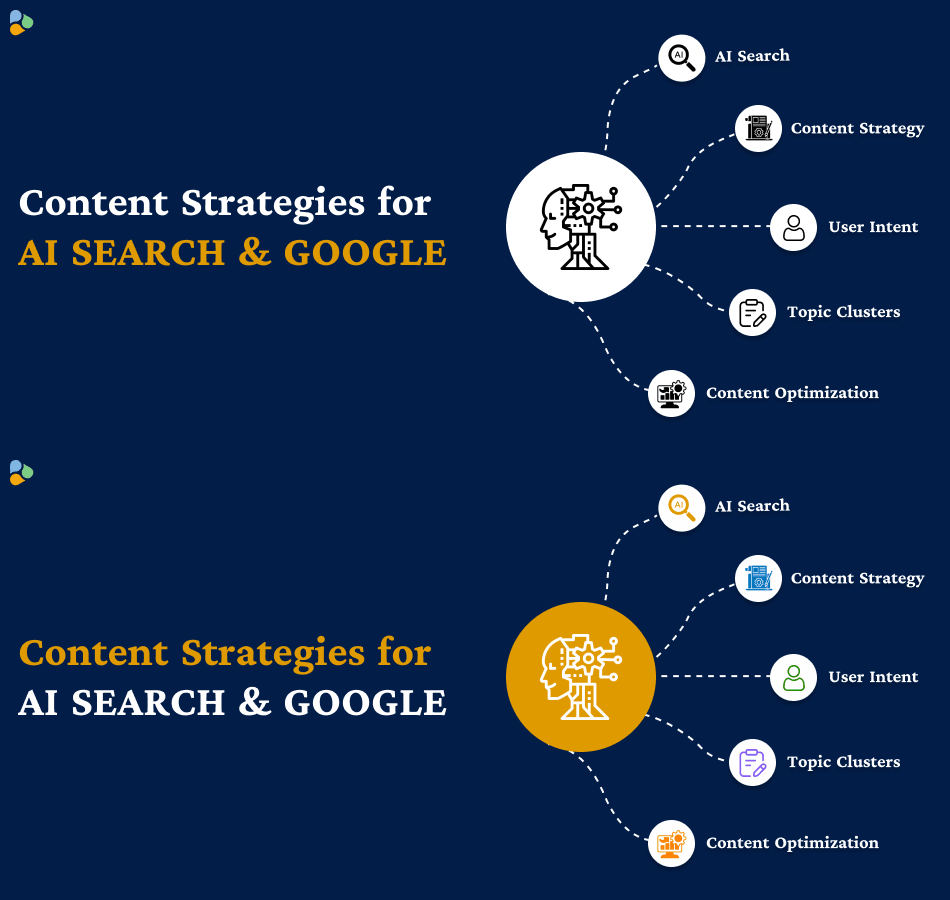
Instead of clicking through multiple links, users now expect direct, accurate, and conversational answers. This means businesses need to rethink their content strategy. Simply targeting keywords is no longer enough—you need content that is useful, trustworthy, and easy for both search engines and AI models to understand.
In this guide, you’ll learn how to build a high-performance content strategy that improves visibility across both Google Search and AI-powered search experiences.
Why Traditional SEO Alone Isn’t Enough
For years, SEO focused on ranking web pages by optimizing keywords, backlinks, and technical performance. While these factors still matter, AI search evaluates content differently.
AI models prioritize content that:
- Clearly answers user questions
- Demonstrates expertise and credibility
- Uses structured information
- Covers topics in depth
- Provides practical value instead of keyword repetition
A modern content strategy combines traditional SEO with content that AI systems can easily interpret and recommend.
Start with User Intent, Not Just Keywords
The foundation of every successful content strategy is understanding what your audience wants to know.
Instead of targeting only broad keywords like “AI development” identify the questions your potential customers are asking.
For example:
- What are AI agents?
- How much does AI software development cost?
- How can AI improve customer support?
- Is AI automation suitable for small businesses?
When your content directly answers these questions, it has a better chance of ranking in Google and being referenced by AI-powered search tools.
Build Topic Clusters Instead of Standalone Blogs
Publishing random blog posts makes it difficult for search engines to understand your expertise.
Instead, organize your content into topic clusters.
For example, if your business provides AI development services, your content structure could look like this:
Pillar Page
- AI Development Services
Supporting Blogs
- AI Agents vs AI Workflows
- Benefits of AI Automation
- AI for Healthcare
- AI in Logistics
- AI Chatbot Development Guide
- Cost of AI Software Development
- How AI Improves Business Productivity
This approach helps establish topical authority and encourages visitors to explore more of your website.
Create Content That Answers Questions Clearly
AI search tools often extract concise answers from well-structured content.
To improve your chances of being featured:
- Use descriptive headings.
- Answer the question within the first few sentences.
- Keep paragraphs short.
- Use bullet points where appropriate.
- Include real-world examples.
For example, instead of writing long introductions, answer the main question first and then provide additional details.
This improves readability for both users and AI systems.
Demonstrate Experience and Expertise
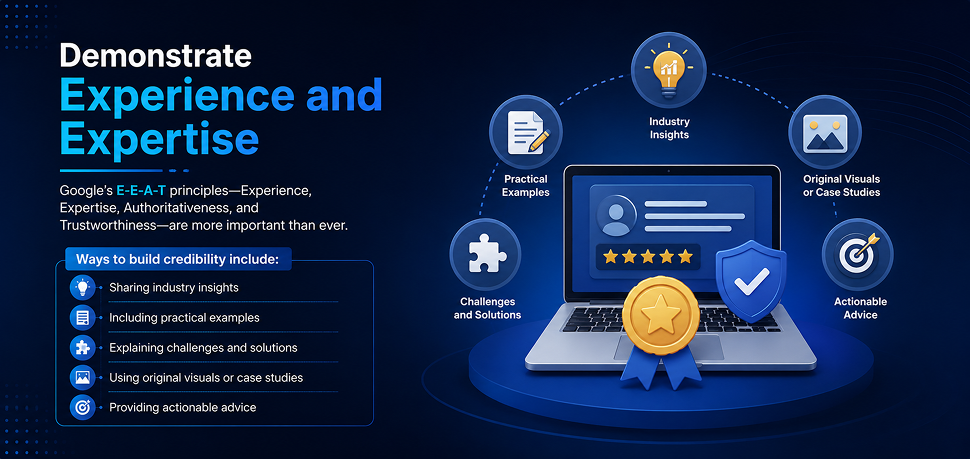
Google’s E-E-A-T principles—Experience, Expertise, Authoritativeness, and Trustworthiness—are more important than ever.
Your content should demonstrate real knowledge instead of repeating information found elsewhere.
Ways to build credibility include:
- Sharing industry insights
- Including practical examples
- Explaining challenges and solutions
- Using original visuals or case studies
- Providing actionable advice
Content based on real experience is more valuable than generic articles filled with AI-generated text.
Optimize for Conversational Search
People interact with AI differently than they use traditional search engines.
Instead of typing short keywords, they ask complete questions like:
“What’s the best AI solution for automating customer support?”
Your content should reflect this natural language.
Include question-based headings and conversational answers that mirror how people speak.
This improves your chances of appearing in AI-generated responses.
Use Structured Data
Schema markup helps search engines understand your content more effectively.
Useful schema types include:
- FAQ Schema
- Article Schema
- Organization Schema
- Breadcrumb Schema
- Service Schema
Structured data increases the likelihood of appearing in rich search results and provides additional context for AI systems.
Focus on Content Quality Over Quantity
Publishing dozens of average blog posts won’t outperform a smaller number of comprehensive, well-written articles.
Every piece of content should:
- Solve a real problem
- Be easy to understand
- Include accurate information
- Stay updated over time
- Provide unique value
Instead of asking, “How many blogs should we publish?”, ask, “Will this article genuinely help our audience?”
Keep Your Content Fresh
AI and search engines prefer updated information.
Review important pages regularly and update them with:
- New statistics
- Industry developments
- Improved examples
- Additional FAQs
- Better internal links
Refreshing existing content is often more effective than constantly creating new articles.
Strengthen Your Internal Linking Strategy
Internal links help both users and search engines navigate your website.
For example, if someone is reading about AI agents, you can naturally link to related pages such as:
- AI Workflow Automation
- AI Chatbot Development
- Custom Software Development
- Digital Transformation Services
This improves user experience while distributing authority across your website.
Don’t Ignore Technical SEO
Even exceptional content may struggle if your website has technical issues.
Regularly check that your website:
- Loads quickly
- Works well on mobile devices
- Uses HTTPS
- Has clean URLs
- Includes optimized title tags and meta descriptions
- Has no broken links
- Is easy for search engines to crawl
Technical SEO creates the foundation that allows great content to perform.
Measure What Matters
Creating content is only the first step. Measuring performance helps you improve your strategy over time.
Track metrics such as:
- Organic traffic
- Keyword rankings
- User engagement
- Time on page
- Conversion rate
- Lead generation
- Click-through rate
- Pages indexed
Regular analysis helps you identify which topics resonate with your audience and where opportunities exist.
Common Mistakes to Avoid
Many businesses invest in content but make avoidable mistakes that limit results.
Some of the most common include:
- Writing only for search engines instead of people
- Publishing thin or duplicate content
- Ignoring search intent
- Stuffing keywords unnaturally
- Neglecting content updates
- Failing to use internal links
- Overlooking technical SEO
- Creating content without a clear business goal
Avoiding these mistakes can significantly improve long-term content performance.
How KIS Works Can Help
At KIS Works, we help businesses build content strategies that perform across both traditional search engines and AI-powered platforms.
Our team combines SEO expertise with AI-driven content optimization to create content that attracts the right audience and supports business growth.
Our services include:
- AI Search Optimization
- SEO Strategy
- Content Marketing
- Technical SEO
- Website Optimization
- AI Content Consulting
- Digital Marketing Services
Whether you’re looking to increase organic traffic, improve AI search visibility, or generate more qualified leads, we can help you build a strategy that delivers measurable results.
Final Thoughts
Search is evolving, and successful businesses are evolving with it.
A high-performance content strategy is no longer about ranking for a handful of keywords. It’s about creating valuable, trustworthy content that answers real questions, demonstrates expertise, and delivers an excellent user experience.
By combining strong SEO fundamentals with AI-friendly content practices, your business can improve visibility across Google Search, AI search engines, and future search experiences.
The businesses that invest in helpful, well-structured, and user-focused content today will be better positioned to grow in the years ahead.
Frequently Asked Questions
1. What is AI Search Optimization?
AI Search Optimization is the process of creating content that can be easily understood and recommended by AI-powered search platforms like ChatGPT, Gemini, Perplexity, and Google AI Overviews.
2. Is traditional SEO still important?
Yes. Traditional SEO remains essential, but it should be combined with high-quality, user-focused content and AI-friendly formatting.
3. How often should I update my content?
Review your important pages every 3–6 months or whenever there are major industry changes to keep them accurate and relevant.
4. Why are topic clusters important?
Topic clusters help establish authority on a subject, improve internal linking, and make it easier for search engines and AI systems to understand your expertise.
5. How can KIS Works improve my content strategy?
KIS Works provides SEO, AI Search Optimization, technical SEO, and content marketing services to help businesses increase online visibility, attract qualified traffic, and generate more leads.