The hospitality and travel industry has changed significantly over the last few years. Travellers today expect more than just a comfortable hotel room or a convenient flight. They want personalised recommendations, faster bookings, quick customer support, flexible travel options, and memorable experiences.
At the same time, hotels, resorts, airlines, travel agencies, and tour operators are managing increasing customer expectations while trying to control operational costs and improve their services.
This is where Artificial Intelligence (AI) is making a difference.
AI is helping hospitality and travel businesses understand customer preferences, automate routine tasks, manage bookings, predict travel demand, and deliver personalised experiences. From AI powered chatbots that answer customer enquiries to intelligent systems that help hotels manage room availability, AI is becoming an important part of modern travel operations.
In this blog, we will explore how AI is transforming the hospitality and travel industry, its practical applications, key benefits, challenges, and what businesses can expect in the future.
What Is AI in the Hospitality and Travel Industry?
Artificial Intelligence in the hospitality and travel industry refers to the use of intelligent technologies that help businesses automate operations, analyse information, understand customer behaviour, and improve decision making.
These technologies include machine learning, natural language processing, predictive analytics, computer vision, and AI powered automation.
For example, a hotel can use AI to recommend room options based on a customer’s previous bookings and preferences. Similarly, a travel agency can use AI to create personalised travel itineraries based on a traveller’s budget, destination preferences, and available time.
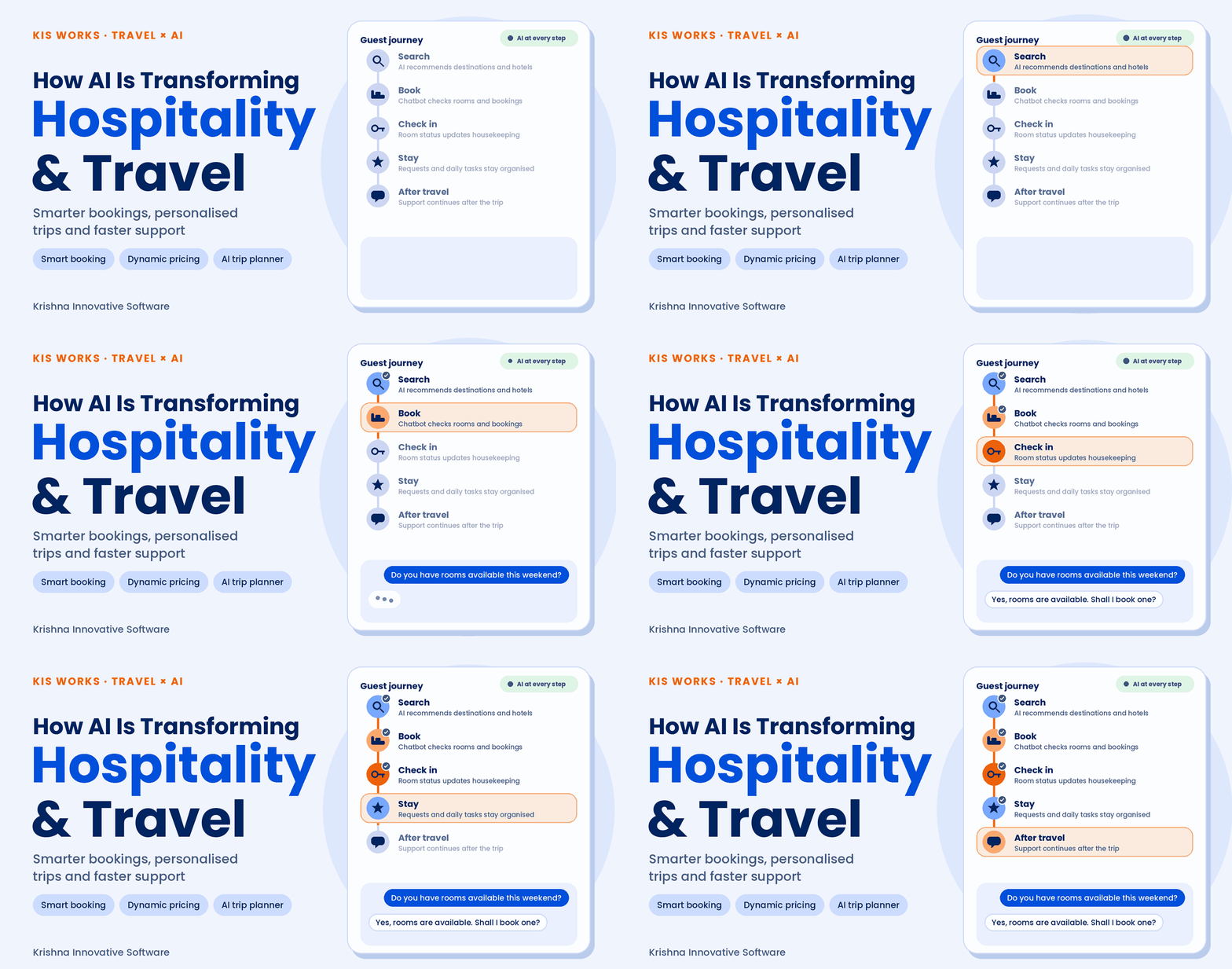
AI can support different stages of the customer journey, from searching for destinations and booking accommodation to checking in at hotels and receiving post travel assistance.
8 Ways AI Is Transforming the Hospitality and Travel Industry
AI is not limited to one particular area of the hospitality and travel business. It is helping companies improve customer experiences, simplify daily operations, and make better business decisions.
Let’s explore some important applications.
1. AI Chatbots for Customer Support and Travel Assistance
Customer support is one of the most important parts of the hospitality and travel industry. Customers often have questions about hotel bookings, room availability, flight schedules, cancellation policies, travel packages, and other services.
Handling every enquiry manually can become difficult, especially during peak travel seasons.
AI chatbots help businesses manage these customer interactions more efficiently.
These chatbots can understand customer questions and provide relevant responses using natural language processing. They can also be integrated with booking systems, hotel management software, and customer databases to provide more useful information.
For example, a customer visiting a hotel’s website might ask:
- Do you have rooms available for this weekend?
- What facilities are included in the room?
- Can I cancel my reservation?
- Do you provide airport pickup services?
An AI chatbot can respond to these questions, share relevant information, and guide customers through the booking process.
Travel companies can also use AI assistants to answer questions about flight timings, baggage policies, travel packages, and destination information.
This helps businesses provide faster customer support without requiring employees to handle every basic enquiry manually.
2. Personalised Travel Recommendations
Every traveller has different preferences. Some people prefer luxury hotels, while others look for budget friendly accommodation. Some enjoy adventure activities, while others prefer peaceful destinations and cultural experiences.
Providing the same recommendations to every customer does not always create a good experience.
AI helps travel companies understand individual customer preferences by analysing information such as previous bookings, browsing behaviour, travel history, budgets, and search patterns.
Based on this information, AI systems can recommend:
- Hotels based on customer preferences and budgets.
- Travel destinations based on previous searches.
- Restaurants and local attractions.
- Activities and sightseeing experiences.
- Travel packages based on customer interests.
For example, if a customer regularly searches for beach destinations and luxury resorts, an AI powered travel platform can recommend similar destinations and accommodation options.
This makes travel planning more relevant and helps businesses provide experiences that match individual customer expectations.
3. AI for Smart Hotel Booking and Reservation Management
Managing hotel reservations involves several activities, including checking room availability, updating booking information, handling cancellations, and managing customer requests.
When these activities are performed manually, businesses may face delays, booking errors, and communication gaps.
AI can help automate several parts of the reservation management process.
AI powered booking systems can analyse room availability, customer preferences, reservation history, and booking patterns to support better reservation management.
For example, when a customer searches for accommodation on a hotel’s website, an intelligent booking assistant can suggest suitable rooms based on the customer’s requirements.
AI can also help hotels identify booking patterns and anticipate periods of high demand.
This allows hotel management teams to prepare in advance, manage room inventory more effectively, and improve the overall booking experience.
4. AI for Dynamic Pricing and Revenue Management
Pricing is an important factor in the hospitality and travel industry. Hotel room rates, airline tickets, and travel packages can change depending on demand, availability, seasonality, and customer behaviour.
Setting prices manually can make it difficult for businesses to respond quickly to changing market conditions.
AI powered pricing systems can analyse multiple factors to help businesses make informed pricing decisions.
These factors may include:
- Current booking demand.
- Seasonal travel trends.
- Room or seat availability.
- Local events and festivals.
- Competitor pricing.
- Historical booking information.
For example, a hotel located in a popular tourist destination may experience higher booking demand during holidays and festivals.
An AI based revenue management system can analyse demand patterns and help hotel managers adjust room prices accordingly.
Similarly, airlines can use intelligent pricing systems to analyse seat availability and booking trends.
This helps businesses manage revenue opportunities while remaining responsive to market conditions.
5. AI for Predicting Travel Demand and Planning Resources
Understanding future demand is essential for hotels, airlines, travel agencies, and tour operators.
If a hotel expects more visitors during a particular season, it needs to prepare enough staff, rooms, food supplies, and other resources.
Without accurate demand forecasting, businesses may experience overbooking, staff shortages, or unnecessary operational expenses.
AI helps businesses analyse historical booking records, seasonal patterns, holidays, weather conditions, and market trends to predict future demand.
For example, an AI forecasting system used by a hotel can identify that bookings usually increase during summer holidays.
Based on these patterns, the management team can plan staffing requirements, room availability, food supplies, and other operational activities.
Airlines can also use demand forecasting to understand passenger demand on different routes and plan their operations more effectively.
By using AI for demand forecasting, businesses can make better decisions and prepare for changing customer requirements.
6. AI for Hotel Operations and Staff Management
Running a hotel requires coordination between multiple departments, including reception, housekeeping, maintenance, food services, and customer support.
Managing all these activities manually can create communication gaps and operational delays.
AI powered systems can help hotels organise daily operations and automate repetitive administrative tasks.
For example, an AI enabled hotel management system can help:
- Assign housekeeping tasks based on room status.
- Track maintenance requests.
- Manage employee schedules.
- Monitor room cleaning progress.
- Organise customer service requests.
- Generate operational reports.
Imagine a guest checking out of a hotel. Once the checkout is completed, an integrated system can update the room status and notify the housekeeping team that the room needs cleaning.
AI can also help managers analyse operational data to identify delays, recurring problems, and areas that require improvement.
This allows hotel employees to spend less time managing repetitive administrative work and more time focusing on guest experiences.
7. AI for Smart Travel Planning and Itinerary Creation
Planning a trip often requires considerable time and research. Travellers need to compare destinations, find accommodation, check transportation options, explore tourist attractions, and prepare daily schedules.
AI is making this process easier through intelligent travel planning assistants.
These tools can understand a traveller’s requirements and generate personalised travel itineraries.
For example, a traveller planning a five day trip to Dubai might provide the following requirements:
- Travel duration: Five days.
- Budget: Medium.
- Interests: Shopping, sightseeing, and adventure activities.
- Accommodation: Four star hotel.
An AI powered travel assistant can use these preferences to suggest destinations, activities, accommodation options, and a day wise travel plan.
Travellers can also ask follow up questions and modify their plans according to their preferences.
Travel agencies can use similar technology to help their customers explore travel packages and prepare customised itineraries more quickly.
8. AI for Improving Hotel Security and Guest Safety
Safety and security are essential responsibilities for hospitality businesses.
Hotels need to monitor their premises, manage access to restricted areas, and respond quickly to unusual activities.
AI powered security solutions can help businesses improve monitoring through technologies such as computer vision and intelligent video analytics.
For example, AI enabled surveillance systems can analyse video feeds to identify unusual movement patterns, unauthorised access, or potentially suspicious activities.
AI can also support access management through facial recognition and other biometric technologies, where legally permitted and appropriately implemented.
However, these systems should be designed with proper privacy protections, data security measures, and compliance with applicable regulations.
By combining AI with existing security infrastructure, hotels can strengthen their monitoring capabilities and support safer environments for guests and employees.
Real World Examples of AI in the Hospitality and Travel Industry
Several well known companies are already using AI and related technologies to improve different parts of the travel experience.
Booking.com
Booking.com uses AI powered features to help travellers discover accommodation and travel options. Its AI Trip Planner is designed to help users explore destinations, receive recommendations, and plan their trips through conversational interactions.
Marriott International
Marriott has explored AI and digital technologies across different areas of hospitality, including customer engagement, operational efficiency, and personalised guest experiences.
Expedia
Expedia has introduced AI powered travel planning experiences that help customers explore destinations, discover hotels, and organise travel plans through conversational search.
These examples demonstrate how AI is becoming an important technology for businesses that want to improve travel planning, customer engagement, and hospitality services.
Key Benefits of AI for Hospitality and Travel Businesses
Implementing AI can provide several advantages to hotels, airlines, travel agencies, and other hospitality businesses.
1. Better Customer Experience
AI helps businesses understand customer preferences and provide more relevant recommendations, faster assistance, and personalised services.
2. Improved Operational Efficiency
Automation reduces repetitive manual tasks and helps employees manage daily operations more effectively.
3. Faster Customer Support
AI chatbots and virtual assistants can handle common enquiries and provide assistance at any time.
4. Better Business Decisions
AI analyses large amounts of business data and identifies patterns that help management teams make informed decisions.
5. Improved Revenue Management
Predictive analytics and intelligent pricing systems help businesses understand demand and make better pricing decisions.
6. Reduced Operational Costs
Automating repetitive processes can reduce administrative workloads and help businesses use their resources more efficiently.
Challenges of Implementing AI in the Hospitality and Travel Industry
Although AI offers many opportunities, implementing it successfully requires proper planning and investment.
Businesses should understand the following challenges before adopting AI solutions.
Data Privacy and Security
Hotels and travel companies collect customer information such as names, contact details, payment information, booking history, and travel preferences.
Businesses must protect this information through appropriate security measures and follow applicable data protection regulations.
Integration With Existing Systems
Many hospitality businesses already use hotel management software, reservation platforms, customer relationship management systems, and accounting tools.
Integrating AI solutions with these existing systems can be technically challenging.
Implementation Costs
Developing and implementing AI solutions may require investment in software, infrastructure, data management, and technical expertise.
Small hotels and travel businesses may need to start with specific use cases instead of implementing multiple AI solutions at once.
Maintaining Human Interaction
Hospitality is a people focused industry. Customers often expect personal attention, especially when they face problems or require special assistance.
AI should support hotel employees and travel professionals rather than completely replace human interaction.
A balanced approach that combines AI automation with human customer service can deliver better results.
What Is the Future of AI in the Hospitality and Travel Industry?
The role of AI in hospitality and travel is expected to expand as intelligent technologies become more accessible and advanced.
One important development is the growth of AI agents. Unlike traditional chatbots that mainly respond to questions, AI agents can be designed to perform multi step tasks by interacting with connected systems.
For example, a travel AI agent could help a customer search for flights, compare hotel options, prepare an itinerary, and assist with reservations through connected booking platforms, subject to the customer’s approval.
Another important development is the use of generative AI for personalised travel experiences. Travellers may increasingly use AI assistants to create customised travel plans, discover local experiences, and receive recommendations based on their preferences.
Hotels may also adopt more connected systems that combine AI, Internet of Things (IoT), and automation to improve room management, energy consumption, and maintenance operations.
Predictive maintenance is another promising application. AI systems can analyse equipment performance and identify potential issues before they cause major disruptions.
As these technologies continue to develop, businesses that adopt AI strategically will have more opportunities to improve their services, streamline operations, and respond to changing customer expectations.
How Can Hospitality and Travel Businesses Get Started With AI?
Businesses do not need to transform their entire operations at once. They can begin by identifying specific problems where AI can provide measurable value.
Here are a few practical starting points:
- Automate Customer Enquiries: Introduce an AI chatbot to answer common questions about bookings, services, and travel packages.
- Improve Booking Management: Integrate intelligent systems with existing reservation platforms to simplify booking related activities.
- Analyse Customer Preferences: Use AI analytics to understand customer behaviour and provide personalised recommendations.
- Implement Demand Forecasting: Analyse historical booking information to predict customer demand and plan resources.
- Automate Daily Operations: Use AI powered solutions to manage housekeeping requests, maintenance updates, and administrative tasks.
The best approach is to start with one or two business challenges, evaluate the results, and gradually expand AI implementation.
Conclusion
Artificial Intelligence is transforming the hospitality and travel industry by changing how businesses manage operations, interact with customers, and deliver services.
From AI chatbots and personalised travel recommendations to intelligent booking systems and predictive demand forecasting, AI is helping businesses make their processes faster, smarter, and more efficient.
However, successful AI adoption is not just about introducing new technology. It is about understanding business challenges and implementing solutions that create real value for customers and employees.
Hotels, airlines, travel agencies, and hospitality businesses that combine AI capabilities with human expertise can build more efficient operations and deliver better customer experiences.
If your business is planning to adopt AI, working with an experienced AI development company can help you identify the right opportunities and build solutions that align with your operational requirements.
At Krishna Innovative Software (KIS Works), we help businesses explore AI integration, intelligent automation, AI agent development, and custom software solutions to improve their business operations.