Running a hospital can be very complex. You have doctors who have to read reports, nurses who manage patient care, receptionists who manage appointments and administrators who manage patient records, billing, staff schedules and more.
Sometimes this can become very difficult to manage as busy hospitals can have hundreds of patients coming in each day. Delays within one department can cause issues in several departments.
Due to this, healthcare organisations are beginning to look into new technologies.
Artificial Intelligence (AI) is becoming a huge part of healthcare. It can be used in hospitals and clinics to help with various general tasks, patient information, medical staff and patient communication.
For example it can help with organising medical records, asking questions that patients commonly ask and identifying strange patterns in medical reports. Although these individual tasks can seem small, when combined they can make everyday tasks easier.
Although AI cannot replace doctors and their knowledge, it can help healthcare workers and reduce some of the pressure.
Let’s look at how AI is used within healthcare and how it can help hospitals, doctors and patients.
AI in Healthcare
Artificial Intelligence (AI) within healthcare is using computer systems to understand information, recognise patterns and complete certain tasks.
These systems use various technologies such as machine learning, natural language processing, computer vision and predictive analytics.
You may have already seen some examples of AI in healthcare. Medical imaging software can help radiologists look at x-rays and scans. Chatbots can answer simple questions and systems can help organise patient records or pull useful information from large medical databases.
AI can also help with managing a hospital. Helping with appointment scheduling, billing, patient communication and resource planning.
This reduces extra admin and makes important information easier to manage, giving doctors and hospital staff more time to focus on their jobs.
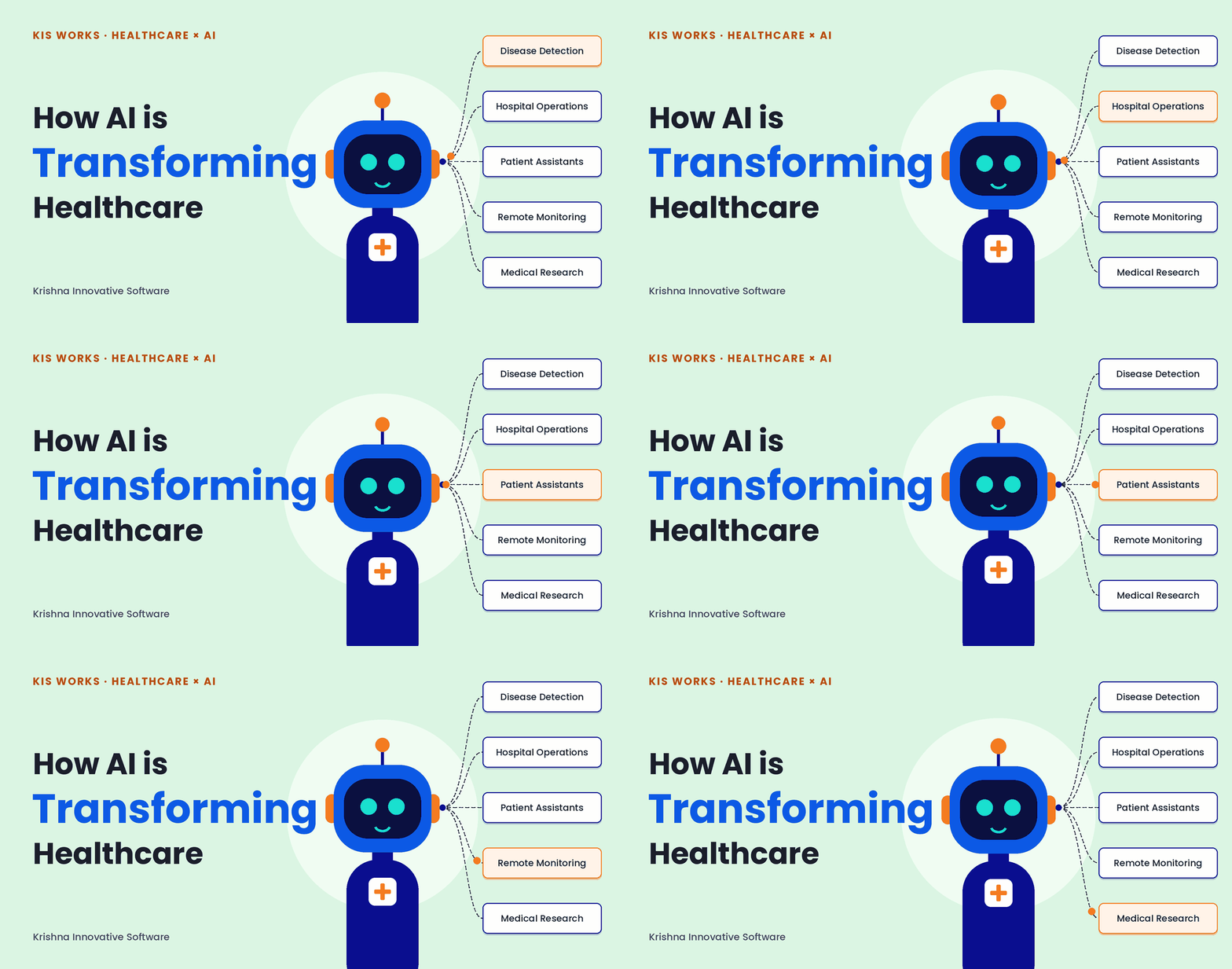
1. Helping doctors detect diseases quicker
Detecting diseases early can make a big difference however, diagnosing diseases can be difficult. Doctors may have to look through multiple reports, compare medical images and understand the patient’s medical history.
AI can help doctors with this by analysing medical information and identifying patterns.
For example, AI imaging software can help analyse x-ray, ct scans and mri scans and highlight strange areas for the radiologist to look at.
This can help doctors when they need to look at lots of medical images in a short space of time.
AI can also help analyse patterns in lab results and patient records. However, it should only be used to help and the final diagnosis should still be made by a qualified medical professional.
2. Simplifying daily hospital tasks
Hospitals can have many departments and it can be difficult to keep everything running smoothly. It can be difficult to manage admissions, beds, staff schedules, medical equipment and resources.
If everything is done manually mistakes can be made.
If your hospital doesn’t have a clear idea of how many beds they will need in the next few weeks it can be hard to schedule staff and resources.
AI systems can help analyse past hospital records and identify patterns in patient admissions.
For example, if your hospital tends to get more patients in a certain season you can use predictive analytics to help your management prepare for this increase.
Hospitals can use this information to:
- Plan staff schedules according to patient numbers.
- Keep track of beds.
- Monitor medical equipment and resources.
- Identify delays in departments.
- Improve collaboration between hospital teams.
AI isn’t going to run your whole hospital but it will give useful information to help the administrators make the best decision.
3. Reduce admin and repetitive tasks
Ask any doctor or hospital staff member and they will tell you that they spend a lot of their time doing admin.
They will need to keep track of patient forms, notes from consultations, prescriptions, billing, insurance and medical history.
Whilst this is an important task it can become very time consuming.
Using AI tools can help with some of this. Speech recognition software can help turn the doctor’s voice notes into text and natural language processing can help organise this information into structured clinical notes.
There are plenty of ways AI can help with hospital admin:
- Medical notes – AI tools can help doctors create notes from conversations. These can then be reviewed and approved by the medical professional.
- Billing – AI can help identify incomplete information and organise billing.
- Patient records – Medical documents can be categorised to make it easier for hospital staff to find the information they need.
- Insurance – AI can help extract key information and complete regular checks.
This can reduce repetitive tasks and give healthcare staff more time to focus on patients.
4. Improving patient communication with AI assistants
Often patients will want to know some information before visiting the hospital. Some may want to know when their consultation will be whilst others may have questions about departments, services, appointments and follow ups.
Most hospitals will have these questions asked by phone, website and reception. During busy times it can be difficult to answer all the questions.
AI chatbots can help answer many common questions.
For example, if someone visits your hospital website late at night they may want to know how to book an appointment. Using an AI assistant can give them the information they need.
Depending on how it is created and integrated with your hospital, an AI assistant can help with:
- Answering common questions.
- Providing information about departments and consultation times.
- Guiding patients through the appointment process.
- Sending reminders for appointments.
- General information.
- Helping visitors find the right department.
Remember that the chatbot shouldn’t be used as a replacement for doctors. Any medical emergencies or personal medical advice should be directed to a qualified healthcare professional.
5. Personalising patient care
Patients can have different medical needs. Two patients with similar symptoms may have completely different medical history, lifestyle and treatment needs.
Doctors will consider this when deciding how to manage their care.
AI can help healthcare professionals by helping them analyse information from various sources such as medical history, lab results, medication and previous consultations.
It may identify changes in their medical history worth looking at. This can help doctors understand their condition.
AI can also help with personalising patient care by:
- Analysing previous medical history.
- Highlighting possible health risks.
- Helping monitor changes in the patient’s condition.
- Assisting with treatment planning.
- Identifying patients who may need extra attention.
However, personalising treatment is still a medical task. AI can help provide useful information but doctors will need to consider the patient’s full condition when deciding on their treatment.
6. Monitoring patients remotely
Sometimes patients will need regular check ups after leaving the hospital. This can be the case for patients recovering from surgery or those with long term conditions.
However, it may not be convenient for them to visit the hospital regularly, especially if they are elderly or live far away.
Remote monitoring is helping healthcare providers.
Wearable tech and connected medical equipment can collect information about the patient’s health such as heart rate, blood pressure, oxygen levels and activity.
This information can be analysed by AI to highlight any strange changes.
For example, if a patient has had recent surgery connected equipment may help monitor certain health reading. If there are any strange patterns the healthcare team can review the information to see if they need to assess the patient further.
This can help with:
- Long term health conditions.
- Elderly patients needing regular monitoring.
- Patients recovering from surgery.
- Patients receiving treatment at home.
- Patients needing regular follow up.
Remote monitoring won’t replace visiting the hospital but gives healthcare teams another way to keep up to date with the patient’s condition.
7. Helping hospitals prepare for patient numbers
Some days will be busier in the hospital. Emergency departments may get more patients at certain times and certain seasons may bring more of a certain health condition.
If the hospital isn’t prepared this can cause extra pressure on staff and longer waiting times for patients.
AI can help with this using predictive analytics.
By analysing previous admissions, seasonal changes and operational information, AI can predict when patient numbers may increase.
For example, if your hospital has shown that patient admissions tend to increase in a certain season this can help the administrators plan staff and prepare extra resources.
This analysis can help with:
- Bed availability.
- Staff scheduling.
- Emergency department.
- Medical resources.
- Identifying potential delays.
These predictions won’t always be accurate but having useful information can help the hospital management prepare better.
8. Assisting medical research and new drug development
Creating a new medicine can be a lengthy process. Researchers will spend years researching diseases, testing various compounds, carrying out clinical trials and ensuring the treatment is safe and effective.
A large part of this process will involve analysing scientific information.
AI is helping researchers with this.
Using machine learning the system can analyse lots of scientific data, identify patterns and help researchers identify potential drugs. AI can also help analyse genetic information.
AI can also be used in clinical research. Helping to organise information, identify potential participants and analyse research.
Some uses include:
- Analysing disease patterns.
- Identifying potential drugs.
- Analysing biological/genetic data.
- Helping plan clinical trials.
- Analysing large amounts of scientific information.
AI can’t replace lab testing or clinical trials. All new medicines will need proper testing and approvals.
Benefits of AI in Healthcare
AI can be a useful tool to help with many areas of healthcare. It can help doctors, hospital administrators and patients by making healthcare easier to access.
Some key benefits include:
- Reduced admin – AI can help with documentation, billing and other repetitive tasks.
- Improved patient communication – Virtual assistants can provide basic information about the hospital and help patients understand the appointment process.
- Quick analysis of information – Healthcare professionals can use AI to analyse large amounts of medical information.
- Help with early diagnosis – AI tools can help highlight strange patterns in medical images and health information.
- Improved hospital planning – Predictive analytics can help administrators plan beds, staff and medical resources.
- Focus on patients – By making everyday tasks easier doctors and other healthcare professionals may have more time to focus on patients.
Challenges of using AI in Hospitals
Whilst AI seems like a useful tool to implement into a hospital, it needs to be carefully planned. Healthcare organisations deal with sensitive information and important medical decisions so they must ensure any new technology is suitable.
Some common challenges include:
Patient Information
Hospitals will hold sensitive information such as medical history, lab results, prescriptions and personal information.
If this information is being used within an AI system, the hospital must ensure the data is secure. Consider data security, access, encryption and relevant privacy regulations when creating the system.
Patients should also be informed how their information will be used.
Accurate results
AI tools aren’t always accurate. Sometimes information can be missed or results may need further checking.
As mistakes can have serious consequences in healthcare, any important findings from AI must be reviewed by doctors or other qualified professionals.
Integration with existing hospital software
Many healthcare organisations will have various software already in place. This can include patient records, appointments, billing and hospital management.
The new AI solution must integrate well with this. If the software isn’t able to share information this can cause more issues.
Planning and developing the AI solution is an important part of any project.
Costs of development
AI software will need planning, development, testing, infrastructure and maintenance.
For smaller clinics it may be difficult to create a completely new system. It may be better to focus on one specific issue such as appointments or patient communication. Then build up from there.
Keeping medical professionals involved
Healthcare isn’t all about data and software. Patients need to feel understood, communicated with and cared for.
AI should be used to help doctors and hospital staff. It should never be used as an excuse to remove human judgement from important medical decisions.
Future of AI in Healthcare
AI within healthcare is still evolving. Some hospitals are beginning to use intelligent systems to help with medical imaging, documentation and patient communication. Others are looking to see how they can integrate these technologies.
In the upcoming years we may see more healthcare organisations integrating various systems to make everyday tasks easier.
For example, hospital management software, electronic health records, appointment systems and AI assistants.
Remote monitoring may become more common due to improved connected medical equipment. Doctors may have better access to patient information between regular appointments.
AI can also help with medical research. Improved data analysis may help researchers understand diseases and look into new treatment options.
However, hospitals will also need to focus on keeping patient information private, ensuring systems are reliable, medical oversight and responsible use of AI.
How can Healthcare Organisations begin using AI?
Hospitals and clinics don’t need to implement every AI technology straight away. Too many changes can make it difficult to implement.
Instead focus on understanding where your current issues are.
If you’re receiving too many phone calls at your clinic an AI patient assistant may be a good place to start. If your hospital staff are spending too much time searching through documents an intelligent record management system may be more suitable.
Before beginning an AI project it’s important to:
- Identify tasks that are taking too long.
- Understand what processes can be improved with automation.
- Ensure your existing software can support AI.
- Consider patient data privacy.
- Start with a clear use case.
- Test the solution with proper human oversight.
- Review the results.
This will help organisations invest in the right technology to solve their issues.
How can KIS Works help your business explore AI solutions?
Every business will have different requirements for their operations. Healthcare organisations may need better integration between applications, automation of repetitive tasks or development of software to make information easier to manage.
At Krishna Innovative Software (KIS Works) we specialise in software development, AI integration and automation of workflows. We can help your business improve their existing processes.
We focus on understanding what your organisation needs and creating practical software solutions.
Healthcare organisations looking to digitally transform can use AI powered applications to improve patient communication, document management, automation and integration.
The right solution will depend on your organisations requirements, infrastructure and security.
Conclusion
AI is changing healthcare. Whilst it can help doctors look at medical reports it can also help with everyday tasks in the hospital. This can include appointment management, patient records, admin and hospital resource planning.
This can make it easier for patients to access information and improve communication with healthcare professionals. Doctors and hospital staff can also benefit by reducing some of the repetitive tasks.
Every hospital will have different requirements. Large healthcare organisations may require an advanced patient management system whilst a small clinic may only need appointment automation or a chatbot.
It is important to understand where you need improvements.
At Krishna Innovative Software (KIS Works) we believe technology should solve real business problems. We can help your organisation explore practical ways to improve their operations using AI integration, application development and automation.
AI will continue to develop, however healthcare will always need experienced medical professionals. The best results will be achieved when technology is used to support them and provide better care for patients.