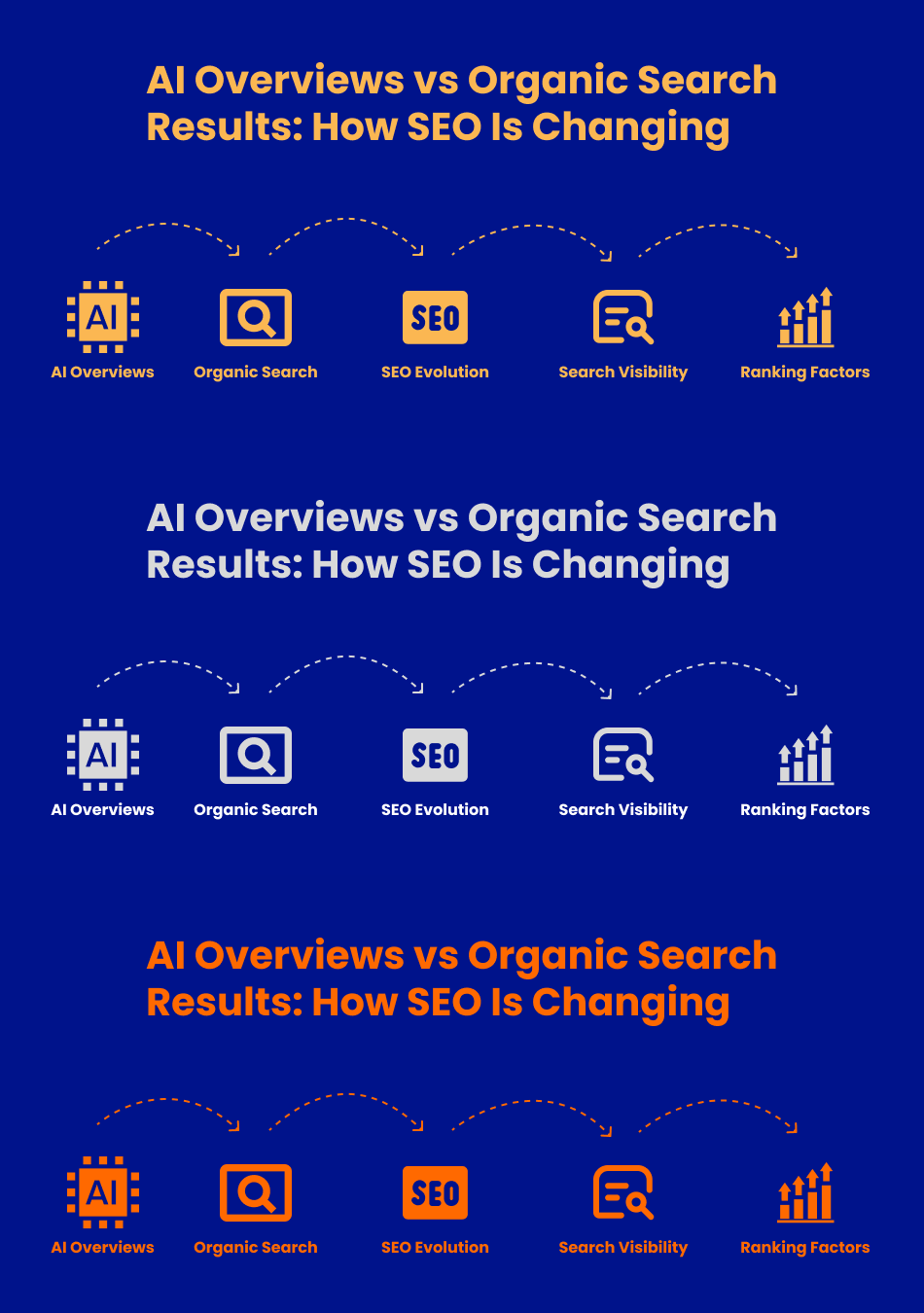
Today, however, the search landscape is undergoing one of its biggest transformations.
With the introduction of Google’s AI Overviews, users can often find complete answers directly within search results without visiting a website. Instead of clicking through multiple pages, searchers receive AI-generated summaries that combine information from various sources into a single response.
This shift is changing how people discover information, interact with brands, and consume online content.
The question businesses must ask is no longer:
“How do we rank higher on Google?”
The more important question is:
“How do we become a trusted source that both Google and AI systems choose to reference?”
In this article, we’ll explore the differences between AI Overviews and traditional organic search results, how they are impacting website traffic and visibility, and what businesses must do to stay competitive in the evolving world of search.
Understanding Organic Search Results
Organic search results are the traditional listings that appear beneath paid advertisements on search engine results pages. These rankings are determined by Google’s algorithms, which evaluate hundreds of factors to decide which pages best satisfy a user’s search intent.
Key Factors Influencing Organic Rankings
Google considers numerous signals when ranking webpages, including:
- Content quality and relevance
- Website authority and trustworthiness
- Backlink profile
- User experience metrics
- Page speed and mobile friendliness
- Technical SEO implementation
- Search intent alignment
For years, businesses relied on organic rankings as one of their most valuable sources of traffic because they could attract visitors without paying for every click.
Example
If a user searches:
“Best CRM software for small businesses”
Google traditionally displays a list of websites containing reviews, comparisons, buying guides, and software recommendations. Users click through these pages to research available options before making a decision.
Historically, websites appearing in the top positions received the majority of search traffic.
What Are Google AI Overviews?
AI Overviews are AI-generated summaries that appear at the top of certain Google search results.
Instead of presenting only a list of webpages, Google’s AI analyzes information from multiple trusted sources and generates a direct answer to the user’s query.
The objective is simple: provide users with fast, comprehensive answers without requiring them to visit multiple websites.
AI Overviews Typically Include
- Direct answers to questions
- Summarized explanations
- Recommendations and insights
- Lists and comparisons
- Source citations
- Follow-up questions
Example
If someone searches:
“How does solar energy work?”
Google may display a detailed AI-generated explanation covering how solar panels convert sunlight into electricity, along with citations from various authoritative sources.
In many cases, users can obtain the information they need without clicking on a website.
AI Overviews vs Organic Search Results: Key Differences
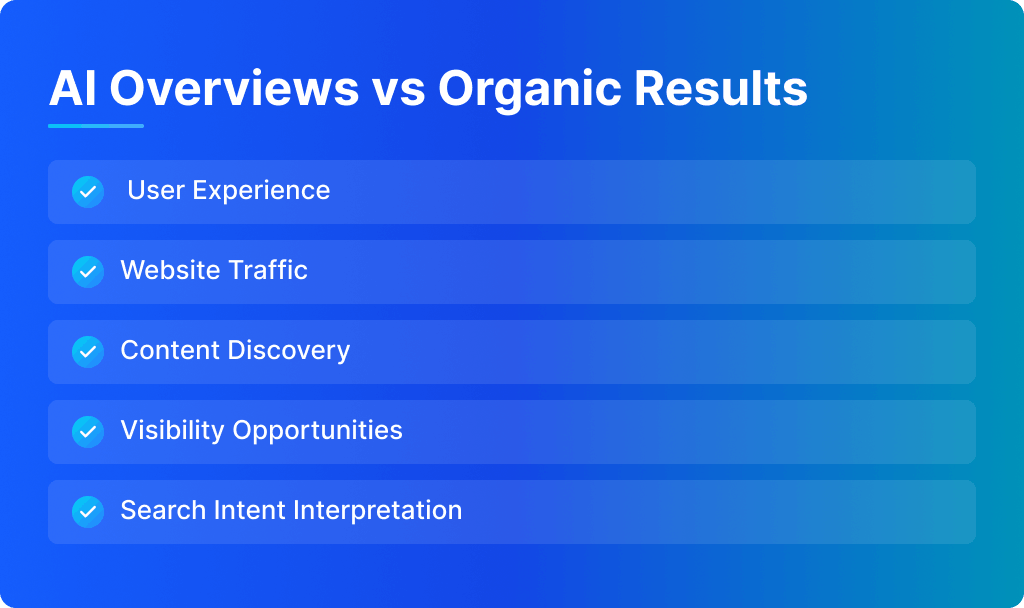
1. User Experience
Organic Search
Users browse a list of search results and choose which websites to visit.
AI Overviews
Users receive an immediate answer directly within Google.
Impact
Search becomes faster and more convenient, reducing the effort required to find information.
2. Website Traffic
Organic Search
Traffic flows directly to websites when users click search listings.
AI Overviews
Users often receive enough information without leaving Google.
Impact
Many websites are experiencing lower click-through rates even when maintaining strong rankings. This trend has contributed to the rise of what marketers call zero-click searches.
3. Content Discovery
Organic Search
Users typically consume information from one website at a time.
AI Overviews
Google combines insights from multiple sources into a single response.
Impact
Content quality becomes increasingly important because AI systems selectively choose which websites to reference.
4. Visibility Opportunities
Organic Search
Visibility depends heavily on ranking position.
AI Overviews
A website can be cited even if it is not ranked in the number-one position.
Impact
Smaller websites with highly valuable content can gain exposure alongside larger competitors.
5. Search Intent Interpretation
Organic Search
Historically focused on keyword relevance and optimization.
AI Overviews
Places greater emphasis on context, intent, and user needs.
Impact
SEO strategies must evolve beyond keywords and focus on solving user problems comprehensively.
Why AI Overviews Are Reshaping SEO
Google’s mission has always been to provide the best possible answer to every search query.
AI Overviews represent the next step in achieving that goal.
Rather than simply ranking webpages, Google now attempts to understand information, synthesize knowledge, and present complete answers.
As a result, SEO professionals must optimize not only for search algorithms but also for AI systems that evaluate content quality, expertise, and usefulness.
How SEO Is Changing in the AI Era
Topical Authority Matters More Than Ever
Publishing isolated articles targeting individual keywords is no longer enough.
Google increasingly rewards websites that demonstrate comprehensive expertise across an entire subject area.
For example, a website focused on SEO should cover:
- Technical SEO
- Local SEO
- AI SEO
- Link Building
- Content Marketing
- Keyword Research
- Search Analytics
- Core Web Vitals
This depth signals expertise and increases the likelihood of being cited within AI-generated responses.
Content Must Provide Direct Answers
AI systems prioritize content that clearly addresses user questions.
The most successful content often includes:
- Clear definitions
- Practical explanations
- Step-by-step instructions
- Examples
- FAQs
- Actionable recommendations
Content that makes information easy to understand is more likely to be selected as a source.
E-E-A-T Has Become Critical
Google continues to emphasize its E-E-A-T framework:
Experience
Demonstrating real-world involvement and firsthand knowledge.
Expertise
Showing deep subject matter understanding.
Authoritativeness
Building recognition and credibility within an industry.
Trustworthiness
Providing accurate, transparent, and reliable information.
AI systems increasingly favor content that exhibits strong E-E-A-T signals because trustworthy sources produce better answers.
User Intent Is More Important Than Keywords
Keyword stuffing stopped working years ago, and AI-powered search makes it even less effective.
Modern SEO focuses on understanding:
- Why users are searching
- What information they need
- What problem they want solved
- What action they intend to take next
The better your content satisfies user intent, the more likely it is to perform well in both traditional and AI-driven search experiences.
Structured Content Improves AI Visibility
Well-organized content is easier for both users and AI systems to understand.
Best practices include:
- Descriptive headings
- Short paragraphs
- Bullet points
- Numbered lists
- Comparison tables
- FAQ sections
- Schema markup
Proper structure improves readability while helping AI extract relevant information more efficiently.
Brand Authority Is Becoming a Competitive Advantage
As AI systems evaluate information quality, recognized and trusted brands often gain an advantage.
Businesses should invest in:
- Thought leadership content
- Industry publications
- Digital PR
- Customer reviews
- Expert interviews
- Research reports
- Case studies
A strong reputation increases the likelihood of being cited as a reliable source.
Practical Steps Businesses Should Take Today
Create Original, Experience-Based Content
AI can summarize information, but it cannot replace genuine expertise and firsthand experience.
Focus on producing:
- Case studies
- Customer success stories
- Original research
- Industry analysis
- Expert opinions
- Real-world examples
Unique content creates value that competitors and AI tools cannot easily replicate.
Optimize for Conversational Searches
Search behavior is becoming increasingly conversational.
People now search using questions such as:
- What is Local SEO?
- How does AI SEO work?
- Why is website speed important?
- Which CRM is best for small businesses?
Creating content around these questions improves visibility across both traditional search and AI-generated responses.
Strengthen Technical SEO Foundations
Technical SEO remains essential.
Key areas include:
- Fast page loading speeds
- Mobile optimization
- Crawlability
- Structured data implementation
- Secure HTTPS connections
- Core Web Vitals performance
Strong technical foundations make it easier for search engines and AI systems to access and understand your content.
Build Trust Signals Across Your Website
Trust influences rankings, citations, and user confidence.
Important trust signals include:
- Author bios
- Customer testimonials
- Industry certifications
- Accurate references
- Updated content
- Transparent contact information
Websites that demonstrate credibility are more likely to be selected as authoritative sources.
Does Organic SEO Still Matter?
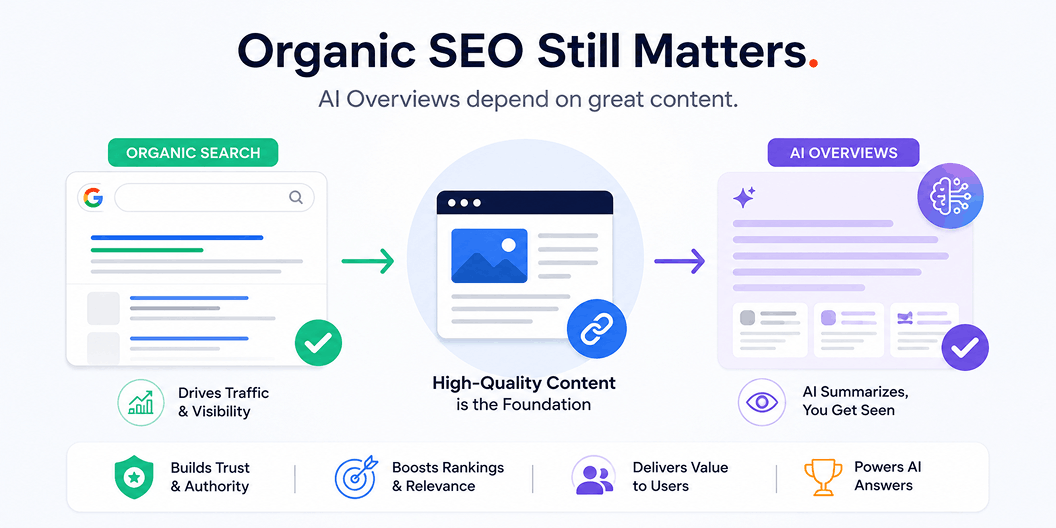
Absolutely.
Despite the growth of AI Overviews, organic search remains one of the most important sources of website traffic and brand visibility.
AI Overviews depend on high-quality webpages to generate their responses. Without valuable content from websites, AI systems would have nothing to summarize.
Businesses should view AI Overviews as an extension of SEO rather than a replacement for it.
The same qualities that drive strong organic rankings—expertise, relevance, authority, and user value—also increase the likelihood of appearing in AI-generated answers.
The Future of Search
Search engines are evolving from information directories into intelligent answer engines.
Users increasingly expect:
- Instant answers
- Personalized experiences
- Conversational interactions
- Context-aware recommendations
As AI becomes more deeply integrated into search experiences, businesses must adapt by prioritizing helpful, trustworthy, and user-focused content.
The brands that succeed will be those that consistently provide value rather than simply attempting to rank for keywords.
Conclusion
The discussion around AI Overviews versus organic search results is not about choosing one over the other. Both play an important role in modern search visibility.
Organic rankings continue to build authority, generate traffic, and establish credibility. AI Overviews, meanwhile, create new opportunities for businesses to gain exposure directly within Google’s AI-powered search experience.
Success in 2026 and beyond will belong to organizations that combine traditional SEO best practices with AI-focused content strategies.
Instead of optimizing solely for algorithms, focus on creating content that genuinely helps people solve problems, answer questions, and make informed decisions.
That’s exactly the kind of content Google—and its AI systems—are increasingly designed to reward.
Frequently Asked Questions
What is the difference between AI Overviews and organic search results?
Organic search results display webpages ranked by Google’s algorithms, while AI Overviews provide AI-generated summaries that answer queries directly within search results.
Do AI Overviews reduce website traffic?
They can. Some users find answers directly within AI-generated summaries, reducing the need to click through to websites and contributing to zero-click searches.
Can a website appear in both AI Overviews and organic search results?
Yes. High-quality, authoritative content can rank organically while also being cited within AI Overviews.
Is SEO still important in the age of AI search?
Absolutely. SEO helps search engines understand your content and improves the likelihood of ranking organically and being featured in AI-generated responses.
How can businesses improve their chances of appearing in AI Overviews?
Businesses should focus on creating authoritative content, building topical expertise, improving technical SEO, strengthening E-E-A-T signals, and providing clear, structured answers to user questions.