Because of this growing demand, businesses today want apps that work smoothly on both Android and iOS platforms. However, building separate native apps for each platform can be expensive, time-consuming, and difficult to manage.
This is where hybrid mobile app development becomes a smart and practical solution.
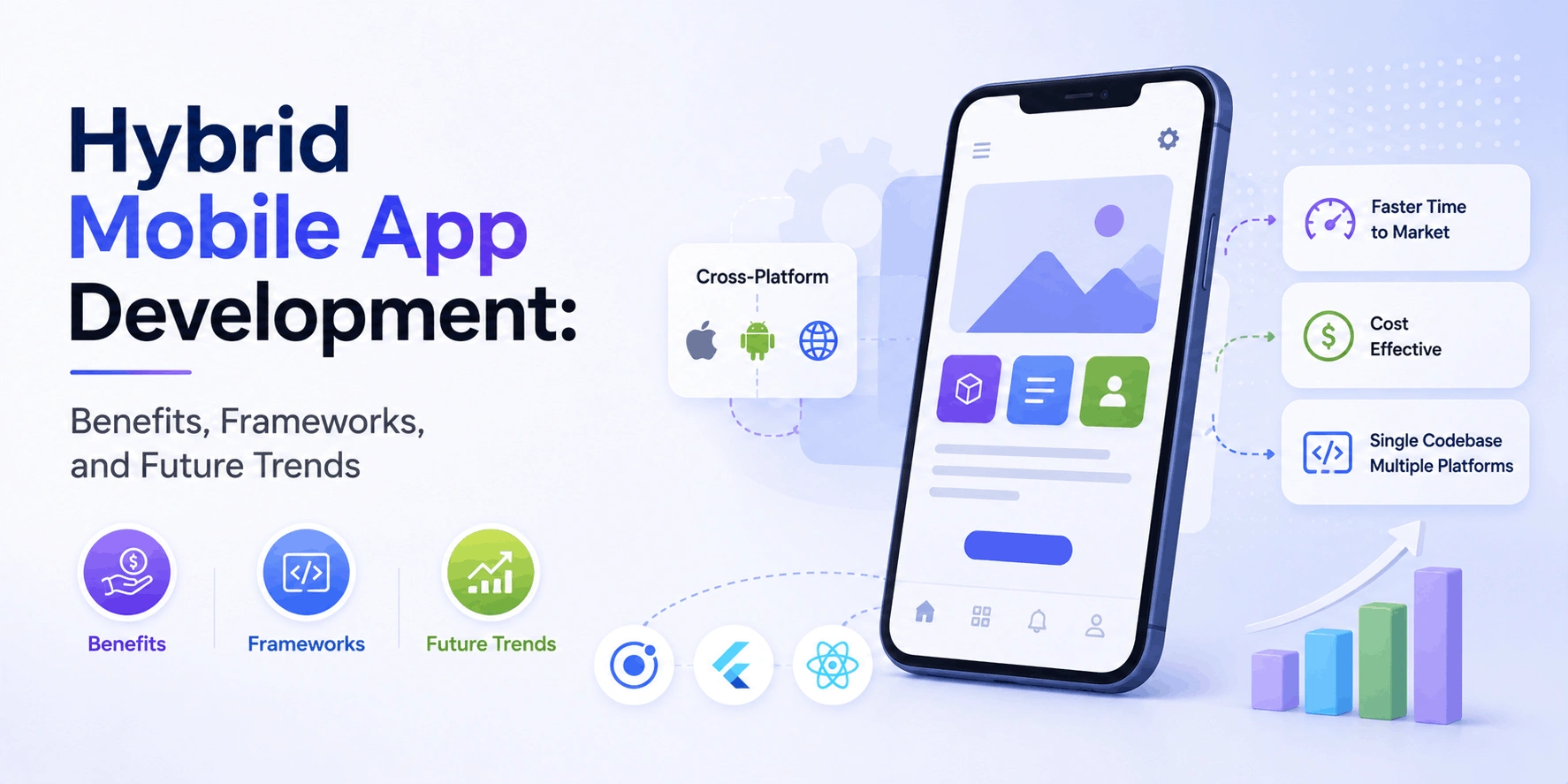
Hybrid app development allows businesses to create a single application that works across multiple platforms using one shared codebase. This approach helps companies save time, reduce development costs, and launch their apps faster without compromising user experience.
In this blog, we’ll explore hybrid mobile app development, its benefits, popular frameworks, latest trends, and why it continues to grow in popularity.
What is Hybrid Mobile App Development?
Hybrid mobile app development is the process of building applications using web technologies such as HTML, CSS, and JavaScript. These apps are then wrapped inside a native container, allowing them to run on both Android and iOS devices.
In simple words:
One codebase = Multiple platforms
Instead of developing separate apps for different operating systems, developers can build one app that works everywhere.
Hybrid apps can also access native mobile features like:
- Camera
- GPS
- Push notifications
- File storage
- Microphone
- Bluetooth
This makes hybrid apps suitable for many modern business requirements.
Why Businesses Prefer Hybrid Apps
Businesses today prefer hybrid app development because it offers a balance between performance, affordability, and speed.
Instead of spending large amounts of money on separate development teams for Android and iOS, companies can use one team and one shared codebase.
Some major reasons businesses choose hybrid apps include:
- Faster app development
- Lower development cost
- Easier maintenance
- Quick updates
- Wider audience reach
- Simplified app management
For startups and growing companies, hybrid development is often the fastest way to enter the market.
Benefits of Hybrid Mobile App Development
Faster Development Process
Hybrid apps are developed using a single codebase, which means developers don’t have to build separate applications for Android and iOS.
This significantly reduces development time and allows businesses to launch their apps more quickly.
Cost-Effective Development
One of the biggest advantages of hybrid app development is reduced cost.
Businesses save money because:
- One team can manage both platforms
- Maintenance costs are lower
- Development time is shorter
- Updates are easier to handle
This makes hybrid apps ideal for startups and businesses with limited budgets.
Easier Maintenance and Updates
Managing one application is much simpler than maintaining two separate native apps.
Whenever developers fix bugs or add new features, changes can be applied across all platforms simultaneously.
This improves efficiency and saves time.
Wider Market Reach
Hybrid apps work on both Android and iOS devices, allowing businesses to reach a larger audience with a single application.
This improves customer accessibility and business growth opportunities.
Access to Native Device Features
Modern hybrid frameworks allow apps to access important device features such as:
- Camera
- GPS
- Notifications
- Contacts
- Storage
With the help of plugins and APIs, hybrid apps can deliver experiences similar to native applications.
Improved App Performance
Earlier hybrid apps faced performance limitations, but modern technologies have improved significantly.
Frameworks like React Native and Flutter now offer smoother performance, faster loading, and better user experiences for most business applications.
Popular Hybrid App Development Frameworks
Choosing the right framework is important for app performance, scalability, and user experience.
Here are some popular hybrid app development frameworks used by businesses worldwide.
React Native
Developed by Meta Platforms, React Native is one of the most popular frameworks for cross-platform app development.
It allows developers to build mobile apps using JavaScript and React.
Why Businesses Prefer React Native:
- Fast development
- Reusable components
- Strong community support
- Good performance
Many popular apps are built using React Native.
Flutter
Created by Google, Flutter has become one of the fastest-growing hybrid app frameworks.
It is known for:
- Beautiful UI design
- Smooth animations
- Fast rendering
- Excellent performance
Flutter is widely used for modern and visually appealing applications.
Ionic
Ionic is a lightweight framework that uses standard web technologies.
It is best suited for:
- Lightweight business apps
- Progressive Web Apps (PWAs)
- Content-focused applications
Ionic is especially useful for developers with web development experience.
Xamarin
Supported by Microsoft, Xamarin is commonly used for enterprise applications.
It offers:
- Shared codebase
- Native API access
- Strong Microsoft ecosystem support
- C# development environment
Apache Cordova
Maintained by the Apache Software Foundation, Cordova is one of the earlier hybrid app development frameworks.
Although newer frameworks are more advanced today, Cordova is still useful for simpler mobile applications.
Best Practices for Building Successful Hybrid Apps
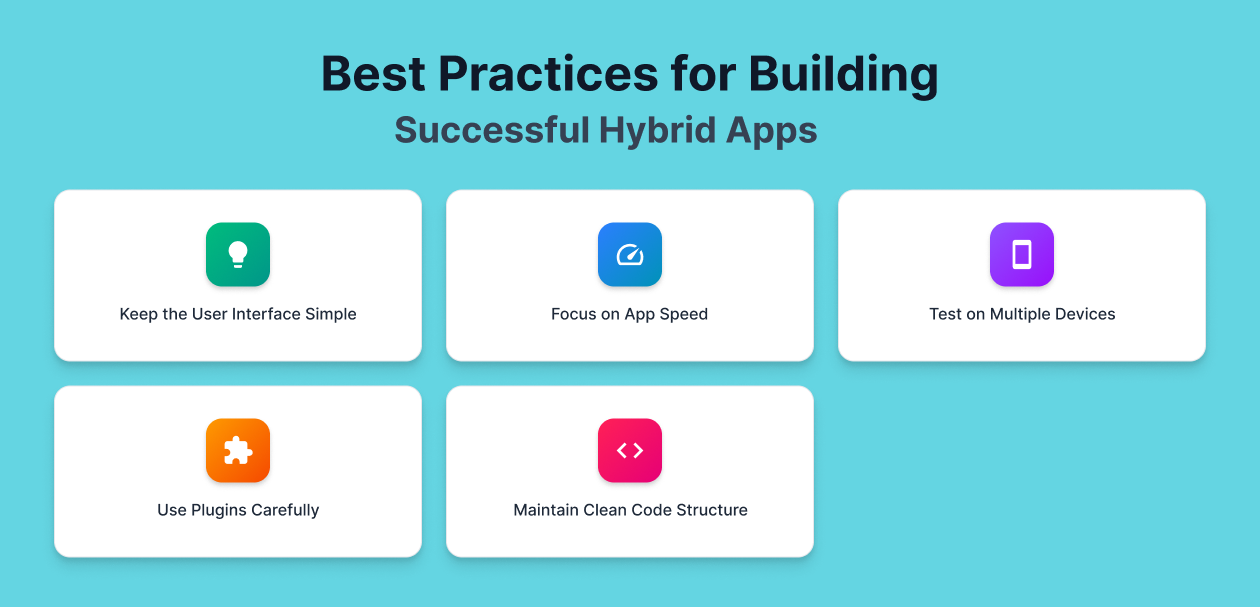
Keep the User Interface Simple
Users prefer clean and easy-to-use mobile applications.
Simple navigation and organized design improve user engagement and overall experience.
Focus on App Speed
Performance plays a major role in app success.
Developers should optimize:
- Images
- Animations
- API requests
- Loading times
to ensure the app runs smoothly.
Test on Multiple Devices
Different devices behave differently.
Testing apps across multiple screen sizes and operating systems helps deliver a consistent user experience.
Use Plugins Carefully
Plugins are useful for accessing native device features, but unnecessary plugins can reduce app performance.
Developers should only use essential integrations.
Maintain Clean Code Structure
Well-structured code makes:
- Future updates easier
- Debugging faster
- App scaling more efficient
Clean coding practices improve long-term app quality.
Latest Trends in Hybrid App Development
Hybrid app technology is continuously evolving. Here are some important trends shaping the future of mobile app development.
AI Integration in Mobile Apps
Artificial Intelligence is becoming a major part of modern applications.
Businesses now use AI features such as:
- Chatbots
- Personalized recommendations
- Smart search
- Voice assistants
to improve user experiences.
Progressive Web Apps (PWAs)
Progressive Web Apps combine the features of websites and mobile applications.
They offer:
- Offline access
- Fast loading speed
- Lower development costs
- Improved accessibility
PWAs are becoming increasingly popular among businesses.
Cloud-Based Mobile Applications
Cloud integration allows mobile apps to become more scalable and efficient.
Benefits include:
- Real-time synchronization
- Better storage management
- Improved app performance
- Faster data access
Better Cross-Platform Frameworks
Frameworks like Flutter and React Native continue to improve with:
- Faster rendering engines
- Better UI tools
- Enhanced debugging
- Improved performance optimization
This is helping hybrid apps compete more closely with native apps.
Stronger Mobile App Security
Security is now a top priority for mobile applications.
Modern hybrid apps use:
- Secure authentication systems
- End-to-end encryption
- Data protection tools
- Biometric login support
to improve user safety and trust.
Common Use Cases of Hybrid Apps
Hybrid apps are widely used across different industries because of their flexibility and affordability.
E-Commerce Applications
Online shopping businesses use hybrid apps to quickly reach customers across multiple devices.
Social Media Platforms
Social networking and communication apps require smooth performance across platforms, making hybrid development a practical option.
Education and E-Learning Apps
Learning platforms often require:
- Offline support
- Video streaming
- Multi-device accessibility
Hybrid apps are well-suited for these features.
Finance and Banking Applications
Modern hybrid frameworks now support secure and scalable fintech applications.
Healthcare Applications
Healthcare and telemedicine apps use hybrid technology for:
- Appointment booking
- Health tracking
- Online consultations
- Patient communication
Business Productivity Tools
Task managers, collaboration tools, and communication apps commonly use hybrid development to support cross-platform functionality.
Hybrid Apps vs Native Apps
| Feature | Hybrid Apps | Native Apps |
| Development Speed | Faster | Slower |
| Development Cost | Lower | Higher |
| Codebase | Single | Separate |
| Maintenance | Easier | More Complex |
| Performance | Good | Excellent |
| Platform Support | Android + iOS | Platform Specific |
If businesses want faster development and lower costs, hybrid apps are usually the better option.
However, for extremely performance-heavy applications like advanced gaming, native development may still be preferred.
Future of Hybrid Mobile App Development
The future of hybrid app development looks very promising.
Modern frameworks continue to improve in terms of:
- Speed
- Performance
- Security
- Scalability
- User experience
The gap between hybrid and native applications is becoming smaller every year.
As businesses continue looking for faster and more affordable development solutions, hybrid app development will continue to grow in popularity.
Technologies like Artificial Intelligence, cloud computing, and advanced cross-platform frameworks are making hybrid apps more powerful than ever before.
Conclusion
Hybrid mobile app development has become one of the most practical and cost-effective solutions for modern businesses.
It allows companies to:
- Build apps faster
- Reduce development costs
- Reach both Android and iOS users
- Simplify maintenance
- Scale more efficiently
Frameworks like React Native and Flutter have transformed hybrid development, making it suitable for most business applications.
For startups, growing businesses, and enterprises looking for flexibility and faster market entry, hybrid app development is an excellent choice for the future of mobile applications.