Customers now have high expectations and look for personalised recommendations, fast replies, easy payments and quicker delivery. This can be difficult for businesses who have lots of items in stock and orders to manage.
AI (Artifical Intelligence) can help businesses understand customer behaviours and manage inventory. It can also help automate customer service and improve business.
By using intelligent tools, such as recommendations and chatbots powered by AI, businesses can help improve the shopping experience and improve their business.
Let’s take a look at how AI is changing the retail and e-commerce industry and how businesses can take advantage.
What is AI in Retail and E-commerce?
Using AI in retail and e-commerce can help businesses improve their shopping experience.
The technology can analyse customer data, purchase behaviours and market trends to help make informed decisions.
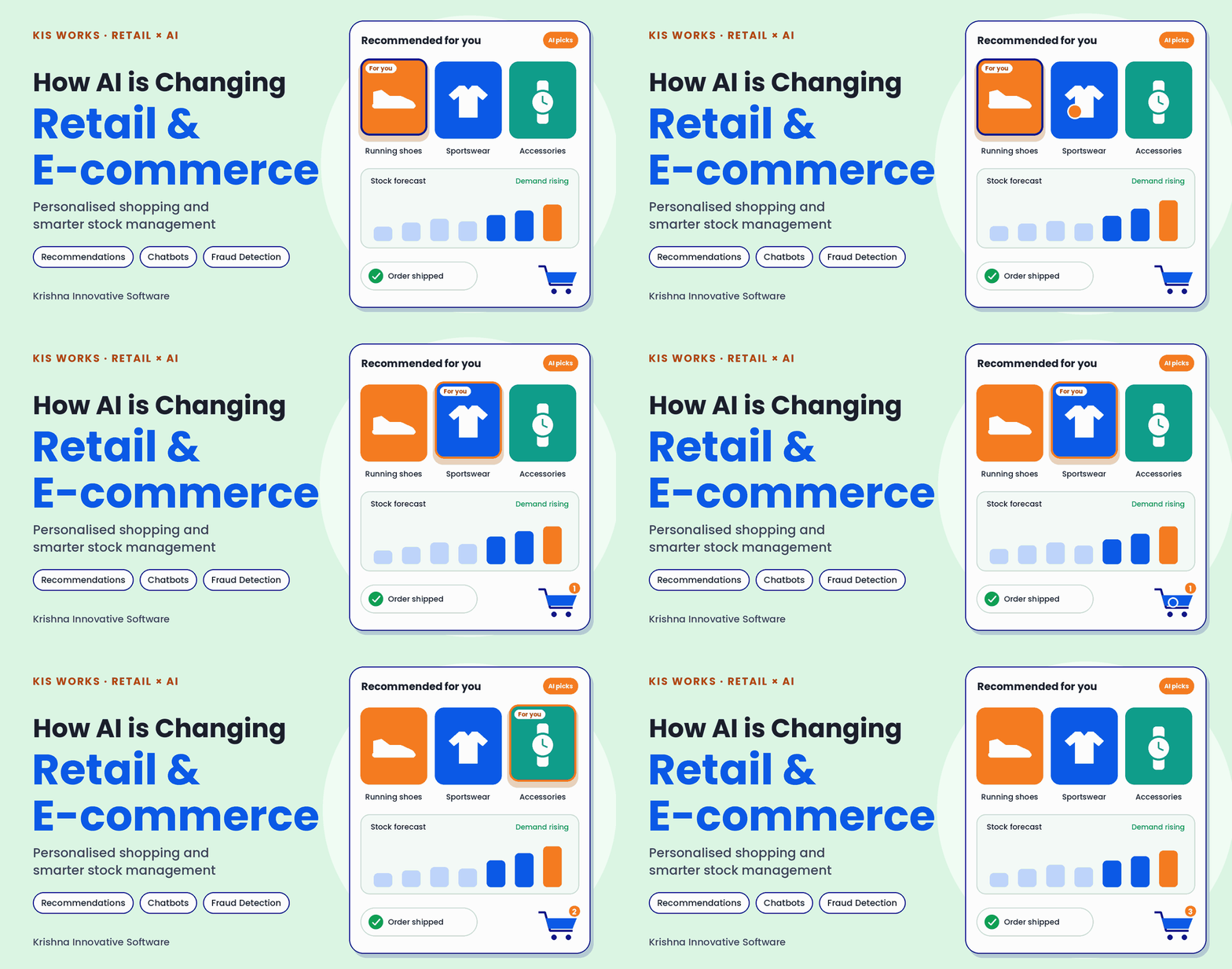
When customers go onto an online shopping site, they often get recommendation suggestions based on what they’ve searched for and purchased. AI can analyse this data and provide recommendations tailored to their interests.
Similarly, AI can help retailers predict demand, manage stock and improve customer service.
7 Ways AI is Changing Retail and E-commerce Businesses
1. Personalised Recommendations
Every customer is different and has different interests. AI can help you understand their preferences by analysing what they’ve previously searched and purchased.
AI can then provide recommendations based on the data.
If a customer often searches for sports shoes, the online store can use AI to recommend similar shoes, sportswear and exercise accessories.
Benefits
- More relevant recommendations
- Better engagement
- Improved shopping experience
- Increased repeat purchases
2. AI Chatbots
Customer service is very important within any retail business. Customers often have questions such as what products are in stock, what the status of their order is, what payment options there are and what their return policy is.
With AI chatbots, you can provide answers to common questions automatically.
If a customer has a question like ‘Where is my order?’, an AI chatbot can link into the order management system to provide them with the latest info.
Benefits
- Fast response times
- Reduce repetition
- Offer support outside of business hours
- Improved management of customer queries
3. Intelligent Stock Management
Keeping stock levels can be a common issue within retail businesses. Too much stock can increase storage costs and too little stock can cause you to miss out on sales for popular items.
AI can help you predict what your stock levels will need to be in the future by analysing past sales, seasonal demand and customer purchase behaviours.
For example, an clothing store can use AI to predict increased demand for winter jackets during colder months.
Benefits
- Improved stock planning
- Reduce overstocking
- Reduce out of stock issues
- Improved management of stock
4. AI Product Search
Sometimes customers aren’t sure of what they’re looking for or the exact name of the product. They might just have a picture.
With AI visual search customers can upload a picture of the product they want and it will find similar items within the online store.
AI can also understand natural language searches. For example ‘comfortable shoes to run everyday’.
Benefits
- Easier to find products
- More relevant searches
- Faster shopping
- Increased product visibility
5. Dynamic Pricing & Sales Analysis
Pricing of products can depend on market demand, competitor prices, seasonal trends and availability.
AI pricing will help analyse this data so you can make informed pricing choices.
For example, an electronics retailer can analyse competitor prices and customer demand to find opportunities to change the price of products.
AI can also help understand which discounts and promotions are working best.
Benefits
- Improved pricing decisions
- Improved promotion planning
- Understand market trends
- Improved sales strategies
6. Fraud Detection
Online shopping businesses have lots of transactions to process. With AI you can analyse transactions to find any suspicious activity.
For example, if an account suddenly starts making multiple high value purchases from unusual locations, AI can pick up on this.
Benefits
- Identify suspicious activity early
- Improved security with payments
- Reduce financial loss
- Improved customer protection
7. Supply chain & Delivery Management
As e-commerce businesses grow, managing suppliers, warehouses, transport and deliveries can become complex.
AI can help by analysing order volume, delivery locations, traffic and past performance.
This can help companies improve delivery routes, plan warehouse management and identify any issues with the supply chain.
Benefits
- Improved delivery planning
- Improved warehouse management
- Reduce delays
- Improved order management
Real World Examples of AI in Retail Businesses
AI can help a variety of retail and e-commerce businesses. These include:
- Fashion Stores – Recommendation, trend analysis, seasonal demand predictions.
- Supermarkets – Stock management, demand predictions, reduce waste.
- Electronics Stores – Chatbots, technical support.
- Online Shopping – Personalised recommendations, visual search, automated customer service.
- Physical Stores – Customer traffic analysis, shelf monitoring.
This shows how AI can be useful for businesses who offer services both in-store and online.
Challenges with AI in Retail
Whilst there are many benefits to using AI, there are some things to consider.
Data Protection
You’ll need to ensure customer data is secure and protected under any data protection laws.
Cost
It may cost money to develop AI and integrate it.
Integration
You may need some development to integrate AI with your CRM, stock and e-commerce systems.
Data
AI will need accurate and relevant data to produce useful results.
Human Input
Whilst AI can help automate many processes, important business decisions still need to be made by humans.
Start with solutions that actually help with your business challenges.
The Future of AI in Retail and E-commerce
In the future, retail will become more intelligent and personal. AI shopping assistants will become more advanced and help customers compare products, understand specifications and make purchases.
AI agents can help with stock management, sales reports, order tracking and customer service coordination.
With technologies such as computer vision, predictive analysis and automation, there will be more opportunities for retail businesses to improve.
The real benefit of using AI comes down to choosing the correct technology to solve your business problems.
Conclusion
AI is helping retail and e-commerce businesses manage their customers, products, stock, payments and deliveries. It can help automate repetitive tasks, understand customer behaviours and make better decisions.
However, it’s important to ensure you plan properly to implement AI. You will need good data and integrate it with your systems.
Whatever AI you choose whether it’s chatbots, personalised recommendations or intelligent stock management you can start with small AI tools and scale as your needs increase.
Those who use AI effectively will be better prepared for changing customer expectations and future growth.
FAQs
1. How is AI used in retail and e-commerce?
AI is used for personalised recommendations, customer service chatbots, stock management, product search, fraud detection and demand predictions.
2. How can AI chatbots help e-commerce businesses?
AI chatbots can answer customer questions, give order updates, explain returns policies and automatically answer common questions.
3. Can small retail businesses use AI?
Yes! Small retail businesses can use affordable AI tools to help with customer service, recommendations, sales analysis and stock management.
4. How can AI help with stock management?
AI can help analyse past sales, seasonal trends and customer demand to help you predict what your stock levels will need to be and reduce over stocking or out of stock issues.
5. What is the future of AI in e-commerce?
AI will help provide more personal shopping experiences online with intelligent shopping assistants, automated customer service, predictive analysis and AI product discovery.
6. Is AI expensive to use in retail businesses?
It depends on what solution you go for. Start with small AI tools and invest in more as your needs increase.