Hospitals will often have hundreds of patients contacting them to enquire about doctor availability, appointment times, consultation costs, medical services, test services and other basic information. This means that hospital receptionists and administrators will have to be continually busy managing appointments, patient details, billing questions and other tasks.
As this can be quite a demanding task to manage manually, especially if there are a high number of patient inquiries, it can cause issues.
AI chatbots
AI powered chatbots will help to streamline your patient communications. They will allow you to easily provide answers to frequently asked questions, manage patient requests for appointments and provide information.
If the correct systems are put in place these chatbots can be a key part of your digital communication strategy.
What are AI chatbots?
AI chatbots within healthcare are software programs designed to communicate with patients through text or voice. They use technologies such as Artificial Intelligence (AI), Natural Language Processing (NLP) and Large Language Models (LLM) to understand what the patients are asking and provide answers.
Unlike traditional chatbots that rely on pre-set questions and answers, AI chatbots will understand variations in how patients ask the same question.
For example:
Is there a cardiologist available tomorrow?
I would like to make an appointment with a heart specialist?
Can I meet with a heart doctor this week?
The AI chatbot will understand these are all queries relating to making an appointment with a cardiologist.
Depending on what systems are in place the chatbot can provide information about doctor availability, suggest appointment times, gather patient details and help to make the appointment.
The main aim is to streamline patient communications and reduce any repetitive admin tasks.
Why do Hospitals/Clinics need AI chatbots?
Healthcare communication is an important part of your business. Patients will expect fast responses to their questions.
However, hospital staff will often have many other tasks to complete.
Common issues include:
- Repetitive Inquiries
Hospitals will often have many repetitive inquiries about consultation costs, doctor times, location, departments and services. This can take up a large amount of time.
- Missed Calls
Sometimes patients will contact you outside of working hours, or during busy times. This can mean you miss out on potential appointments and inquiries.
- Manual Appointment Management
Managing appointments manually can cause confusion. This could include calling appointments, appointment books, spreadsheets or separate systems. It can cause double bookings and errors in appointments.
- High Volume of Inquiries
Large hospitals and multi speciality clinics will have lots of patient inquiries. As the organisation gets larger it can be difficult to manage the communications manually.
AI chatbots will help overcome these issues.
How AI Chatbots Can Help Manage Patient Inquiries & Appointments
AI chatbots can help with various tasks within patient communication. Let us explain how.
- Provide Answers to Frequently Asked Questions
One of the best uses of AI chatbots is providing answers to frequently asked questions.
Often patients will want to know basic information before visiting your hospital. They may want to know what departments you have, if there is a specific specialist available, what services you provide and how to get in touch.
The AI chatbot can provide answers to these using approved information.
For example, if a patient is visiting your hospital website they may ask:
“Do you have a skin specialist?”
The chatbot will be able to identify the correct department and provide the relevant information. It can also tell the patient how they can request an appointment.
This will reduce the need for patients to call reception.
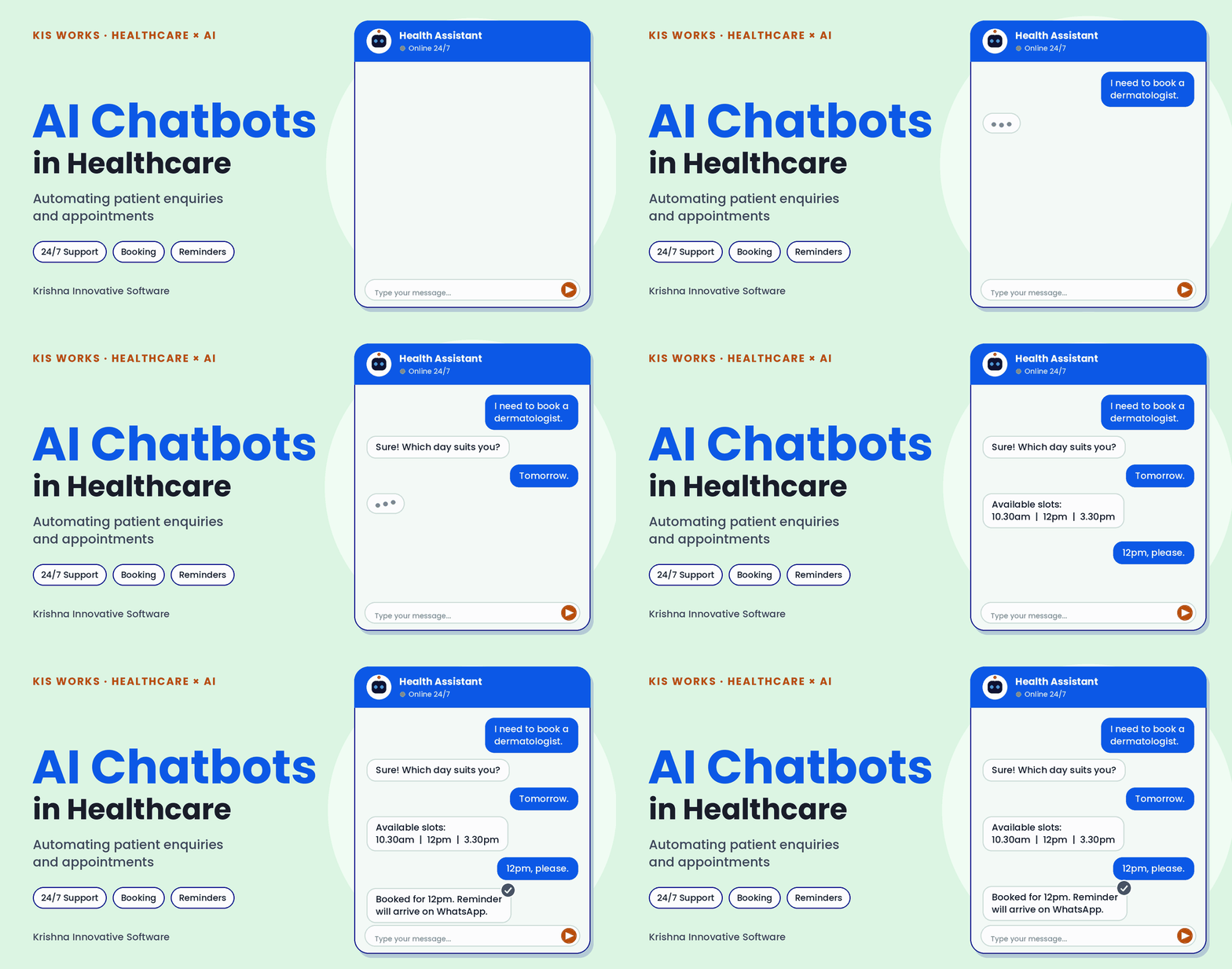
- Book Doctor Appointments
One of the most useful features of AI within healthcare is being able to book appointments.
Traditionally patients will have to call the hospital, explain what they need, ask about availability and wait for a response from reception.
Using an AI chatbot can make this simple.
For example:
Patient: I would like to book an appointment with a dermatologist.
AI Chatbot: Of course! Would you like to book an appointment today?
Patient: Tomorrow.
AI Chatbot: Let me check.
AI Chatbot: We have appointment times at 10.30am, 12pm and 3.30pm.
Patient: 12pm.
AI Chatbot: Could you please provide your name and contact details.
Once the patient provides the requested information the chatbot can integrate with your appointment management system. It will reserve a time and send a confirmation.
This can make booking appointments easier and reduce the workload on reception.
- 24/7 Patient Support
Sometimes patients will not be searching for healthcare services during working hours. They may want to know what time consultations are available late at night or want to book an appointment early in the morning.
By setting up the chatbot correctly it will be available 24/7.
It can answer frequently asked questions, book appointments, provide information and guide patients through simple processes. Even if the reception desk isn’t open.
If the patient needs human support the chatbot can gather the relevant information and book a follow up with the hospital.
This makes it easy for patients to communicate with your healthcare organisation.
- Appointment Reminders
Missing appointments can cause issues with the hospital schedule and make it difficult for other patients to get available consultation times.
Using AI healthcare software can help reduce this issue. Once an appointment is confirmed the system can send reminders.
For example, once confirmed the hospital can send a reminder using the integrated communication system (WhatsApp, SMS, Email etc).
Patients may receive reminders for:
Doctor appointments.
Appointment times.
Appointment confirmation.
Appointment cancellations.
Instructions provided by the hospital.
This keeps patients informed and reduces the need for staff to call individually.
- Gather Patient Details
Often patients will need to provide some basic information before visiting the hospital. This may include their name, contact details, preferred department and what they need the appointment for.
The AI chatbot can gather this information.
For example, if someone wants to book an appointment the chatbot can ask what doctor they would like to see, what date they would like to have a consultation and basic contact details.
This can then be passed onto your hospital appointment management software (depending on your privacy and security policies).
This can help the hospital staff prepare for the appointment and reduce repetitive gathering of information.
- Multi Language Support
Sometimes language can be a barrier.
A patient may feel more comfortable asking questions in Hindi, Punjabi or another regional language.
By using a multi language AI chatbot patients can communicate in their preferred language.
This can make it easier for patients from different regions to get basic information and book appointments. However, it is important to ensure that multi language responses are tested properly, especially if there are any important medical instructions.
Real Life Examples
AI chatbots can be useful for a variety of healthcare organisations.
Multi Speciality Hospital
An AI chatbot can help patients find the correct department, check doctor availability, understand what services you have and book appointments.
Private Clinics
Small clinics can use an AI chatbot to provide answers to frequently asked questions about consultation costs, clinic times, doctor availability and appointment bookings.
Diagnostic Centres
Chatbots can be used to provide information about what tests you have available, explain how to book appointments, provide approved instructions and book test appointments.
Dental Clinics
Appointment bookings can be automated. The chatbot can answer questions about what dental services you have, provide consultation times and send reminders.
Healthcare Chains
Healthcare groups with multiple branches can use AI chatbots to help patients find local facilities, find available specialists and connect to the right branch.
How AI Healthcare Chatbots Work
From a software perspective an AI chatbot will be more complex than simply a messaging system. There are many technologies involved to provide accurate answers.
Here is how it generally works.
Patient sends a message
The patient will interact with the chatbot through the hospital website, mobile application or integrated messaging system.
NLP Understands
The system will analyse the message. It will understand why the patient is contacting you (asking about doctors, requesting appointments or asking about hospital times).
AI Provides Answer
The AI chatbot will provide the answer using the knowledge base it has been set up with. It will provide an answer based on approved hospital information.
Software Integrations
If the patient is requesting an appointment the chatbot can integrate with your backend system using APIs. It will provide information about what times are available or book the appointment.
Appointment Confirmed
Once the appointment has been booked successfully the system can update the appointment and send a confirmation.
Human Support
If the chatbot does not understand what the patient is asking, there is an issue with the system or a request that requires professional judgement it can handover to an authorised member of hospital staff.
This makes AI chatbots useful as they use a range of technologies including AI, backend development, databases and third party integrations.
Key Features to Consider
Every healthcare organisation will have different requirements. When developing your chatbot it is important to consider what issues you are facing with patient communications and admin.
Key features to consider:
NLU – The chatbot should understand the questions patients are asking in different ways.
Appointment Integration – The chatbot should integrate with your current appointment system so it can check availability.
Multi Language – The chatbot should support the languages your patients are using.
Automated Reminders – The chatbot should support appointment confirmations, reminders and important updates.
Data Security – Patient data should be protected.
Human Support – Patients should have the option to speak to hospital staff if the chatbot cannot provide the right answers.
Reports – Hospital administrators can use reports to understand what questions patients are asking, what appointments they are requesting.
Benefits of Using AI Chatbots
When implemented correctly AI chatbots can help improve many areas within your healthcare admin.
Reduce Admin Work
Hospital staff will have less time answering repetitive questions. They can focus on patient coordination and other important tasks.
Fast Patient Communications
Patients can get information and book appointments quicker.
Appointment Management
Integration with your appointment system can help you manage availability, confirmations and appointments.
Improved Patient Experience
Patients can easily get basic information and appointments.
Increased Efficiency
Automating simple tasks can help you manage higher volumes of inquiries.
Insight into Communications
Using chatbot analytics can help you understand what questions patients are frequently asking, what appointments they are requesting and areas to improve.
Limitations of AI Chatbots
Whilst there are many benefits to using an AI chatbot, it is important to understand the limitations.
Patient Data – Communication within healthcare can include personal and medical information. You must ensure you follow the correct privacy requirements and use secure systems to gather, store and process patient data.
Incorrect AI Responses – Sometimes the AI can misunderstand questions. Ensure the chatbot only provides answers from approved sources. Regularly test.
Medical Advice – A general chatbot should not provide diagnosis, prescriptions or replace qualified healthcare professionals.
Integration – Integrating a chatbot can be quite complex. It may require bespoke API development.
Human Oversight – Some questions will require empathy, professional judgement or urgency. Healthcare organisations must have a clear process in place to pass these to qualified staff.
The aim should not be to replace healthcare professionals with AI. Chatbots should help support them.
The Future of AI Chatbots in Healthcare
AI is being used within healthcare in more advanced ways.
Improvements to AI models, NLP, voice and integration means healthcare chatbots can provide more advanced communication.
Over the next few years healthcare organisations may use advanced AI assistants. These can understand voice questions, coordinate appointments between departments, provide personal admin support and communicate with different hospital systems.
The AI agent can also help manage complex admin processes. For example, gathering appointment requirements, checking availability and sending confirmations.
However, there will need to be strong privacy, reliable integration, human oversight and correct clinical boundaries.
Investing in a well planned AI solution can help you create a more efficient communication system.
Conclusion
Managing patient inquiries and appointments can be an important part of your hospital / clinic. If everything is done manually it can be difficult for healthcare staff to provide fast responses and manage increased volumes.
AI chatbots can help to automate simple patient communications, help manage appointments, send reminders and provide basic information about your hospital.
The real value of an AI chatbot for healthcare businesses will depend on how well it integrates with your current systems.
At Krishna Innovative Software (KIS Works) we understand that every healthcare organisation will have different software requirements. Using AI development, API integration and bespoke software solutions businesses can explore intelligent systems that are tailored to their needs.
Are you looking to develop an AI chatbot for your hospital, clinic or healthcare business? The right AI solution can help streamline your patient communications, reduce repetitive admin and create a more organised appointment process.