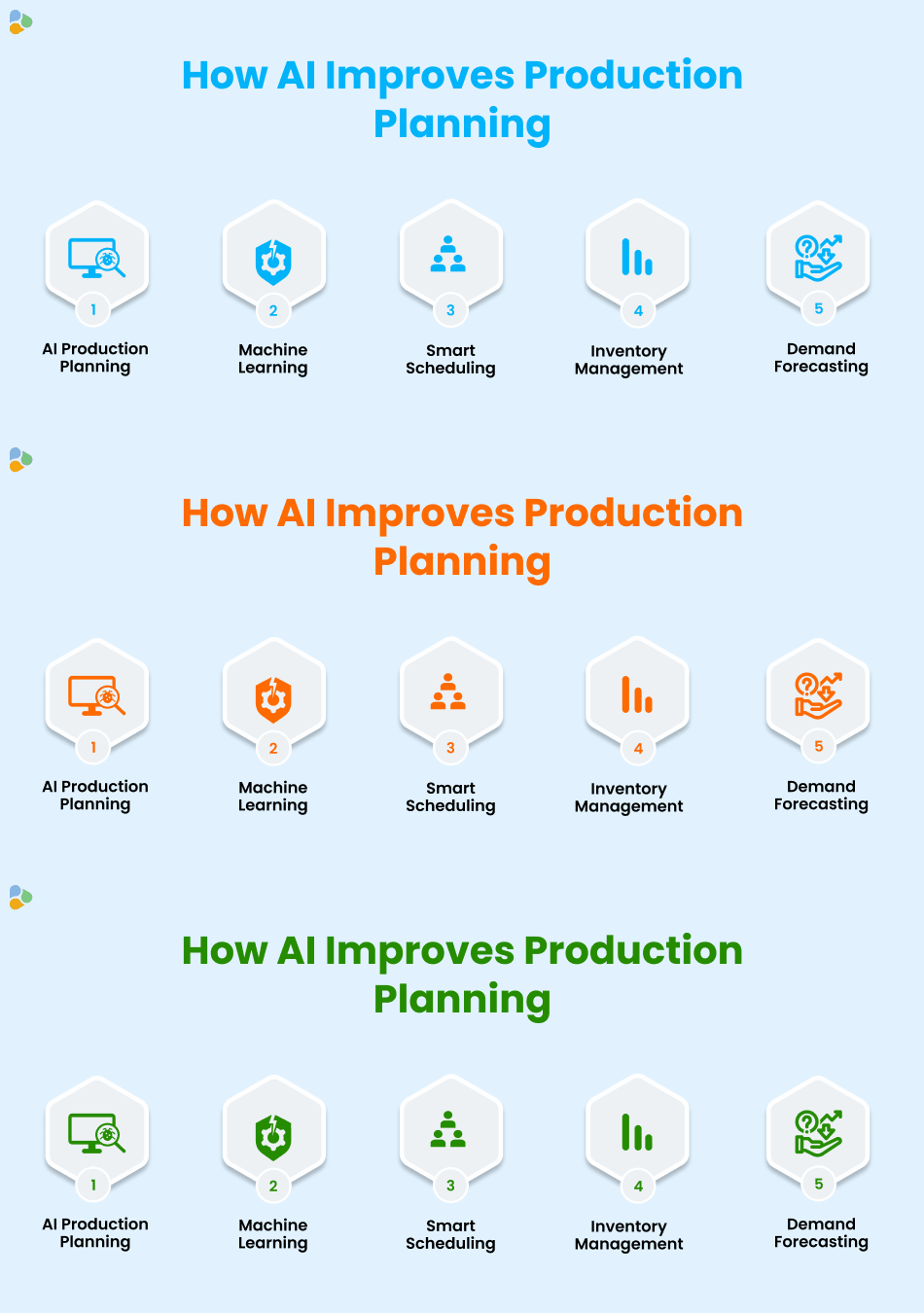
This is where artificial intelligence (AI) and machine learning (ML) are helping manufacturers make better production decisions.
AI in production planning enables businesses to analyze historical production data, forecast demand, identify potential bottlenecks, and optimize manufacturing schedules. Instead of relying entirely on spreadsheets, fixed schedules, and manual calculations, manufacturers can use data-driven insights to plan operations more effectively.
Machine learning takes this process further by identifying patterns in production data and improving predictions as new information becomes available. When integrated with existing manufacturing systems, these technologies can help businesses use resources efficiently, reduce avoidable delays, and respond to changing production requirements.
In this blog, we will explore how AI and machine learning work in production planning, their key applications and benefits, the challenges manufacturers may face, and how businesses can implement these technologies successfully.
What Is AI in Production Planning?
AI in production planning refers to the use of artificial intelligence technologies to analyze manufacturing information, predict future requirements, and support decisions about production activities.
Production planning determines what products need to be manufactured, how many units are required, which resources will be used, and when production should take place.
Traditional production planning often depends on historical reports, manually maintained spreadsheets, fixed schedules, and the experience of production managers. Although these methods remain useful, they can become less effective when manufacturers face sudden changes in demand, equipment failures, or material shortages.
AI-powered production planning uses information from different sources to provide more accurate forecasts and practical recommendations.
For example, a manufacturing company may receive several urgent customer orders while one of its machines is already operating at full capacity. An AI-powered planning system can analyze machine availability, delivery deadlines, material inventory, and production priorities to recommend an alternative schedule.
This helps managers make informed decisions without manually reviewing every possible scheduling option.
How Does Machine Learning Improve Production Planning?
Machine learning is a branch of AI that enables computer systems to learn patterns from data and use them to make predictions or recommendations.
In manufacturing, machine learning models can analyze historical production records, machine performance, customer orders, inventory levels, and delivery information.
The process generally involves four stages.
1. Collecting Production Data
The first step is gathering accurate information from manufacturing operations.
Common data sources include:
- Historical production records
- Customer orders and sales forecasts
- Raw material availability
- Machine operating hours and downtime
- Workforce availability
- Production costs and cycle times
- Supplier delivery schedules
This information gives the system a clearer picture of current manufacturing conditions and past performance.
2. Analyzing Historical Patterns
Machine learning models analyze the collected data to identify trends and relationships.
For example, a model may identify seasonal changes in product demand or discover that a particular production line regularly experiences delays during specific manufacturing stages.
These patterns help manufacturers understand which factors influence production efficiency.
3. Predicting Future Requirements
Once trained on suitable data, machine learning models can estimate future demand, production duration, material requirements, or the likelihood of scheduling disruptions.
For example, a demand forecasting model can estimate how many units a manufacturer may need to produce next month based on historical sales, current orders, and other relevant factors.
Predictions are not guaranteed to be accurate, so manufacturers should monitor model performance and account for unexpected changes.
4. Optimizing Production Decisions
AI systems can combine these predictions with scheduling rules and optimization techniques to recommend production plans.
The system may suggest changing job sequences, reallocating workloads, adjusting production quantities, or prioritizing orders with earlier delivery deadlines.
Some systems can update schedules automatically within approved constraints, while others provide recommendations for managers to review.
The result is a more flexible planning process that combines machine learning insights with operational expertise.
Key Applications of AI in Production Planning
AI and machine learning can support several important areas of manufacturing operations.
1. Demand Forecasting and Production Planning
Accurate demand forecasting helps manufacturers determine how much to produce and when to produce it.
When demand is overestimated, businesses may manufacture excess products and increase storage costs. When demand is underestimated, they may experience stock shortages, delayed orders, and lost sales opportunities.
Machine learning can analyze historical sales, seasonal trends, current orders, and relevant market information to estimate future product demand.
For example, a consumer goods manufacturer can use AI to identify seasonal increases in demand and adjust its production plans before the busy period begins.
These forecasts help production managers align manufacturing capacity with expected customer requirements.
2. Intelligent Production Scheduling
Production scheduling determines the sequence of manufacturing tasks, the machines assigned to each job, and the time allocated to individual operations.
Manual scheduling becomes challenging when multiple orders compete for limited machines, skilled workers, tools, and production time.
AI-powered scheduling systems can evaluate these constraints and recommend schedules that balance delivery deadlines, machine availability, setup times, and production priorities.
For example, a metal fabrication company may need to manufacture several products using the same equipment. An intelligent scheduling system can recommend a sequence that reduces unnecessary setup changes while meeting important delivery deadlines.
When a machine becomes unavailable or an urgent order arrives, the system can help planners evaluate alternative schedules.
3. Inventory and Raw Material Management
Production planning depends on having the correct materials available when they are needed.
Excess inventory ties up working capital, while insufficient raw materials can interrupt production and delay customer orders.
AI can analyze inventory levels, material consumption, supplier lead times, and planned production quantities to estimate future material requirements.
For instance, a furniture manufacturer can use machine learning to forecast demand for wood panels, fittings, and other components based on upcoming production orders.
The system can then recommend replenishment quantities and alert purchasing teams when materials may become insufficient.
When integrated with inventory management or enterprise resource planning (ERP) software, these insights help businesses coordinate purchasing and manufacturing activities.
4. Machine Capacity and Resource Allocation
Every manufacturing facility has limited production resources. Machines have different capacities, employees have different skills, and production processes require specific tools and equipment.
AI helps manufacturers analyze these constraints and allocate available resources more effectively.
For example, if one production line has a heavy workload while another has available capacity, a planning system may recommend transferring suitable jobs to the less busy line.
It can also help managers evaluate whether additional shifts, overtime, or equipment are required to meet production targets.
These recommendations help reduce bottlenecks and improve the utilization of existing resources.
5. Predictive Maintenance and Production Scheduling
Machine breakdowns can disrupt even a carefully prepared production schedule.
Predictive maintenance uses equipment data to identify warning signs that may indicate an upcoming failure. When these insights are connected to production planning, manufacturers can account for potential maintenance requirements before scheduling important jobs.
For example, if machine data indicates that a critical component may require inspection, the planning system can help managers evaluate maintenance timing against upcoming production commitments.
This coordination can reduce conflicts between maintenance activities and manufacturing schedules.
However, predictions should be treated as estimates rather than guaranteed failure dates. Maintenance teams must validate the information and follow appropriate safety procedures.
6. Real-Time Production Monitoring
Manufacturing conditions can change throughout the day. A machine may operate more slowly than expected, a material shipment may arrive late, or a quality issue may require additional inspection.
AI-powered monitoring systems can analyze production information and identify deviations from planned performance.
When a significant issue occurs, the system can alert the relevant team and help planners assess its effect on production targets and delivery deadlines.
For example, if a production line falls behind schedule, the system may recommend reallocating certain tasks or adjusting the sequence of upcoming jobs.
This allows manufacturers to respond to disruptions more quickly instead of waiting for end-of-shift reports.
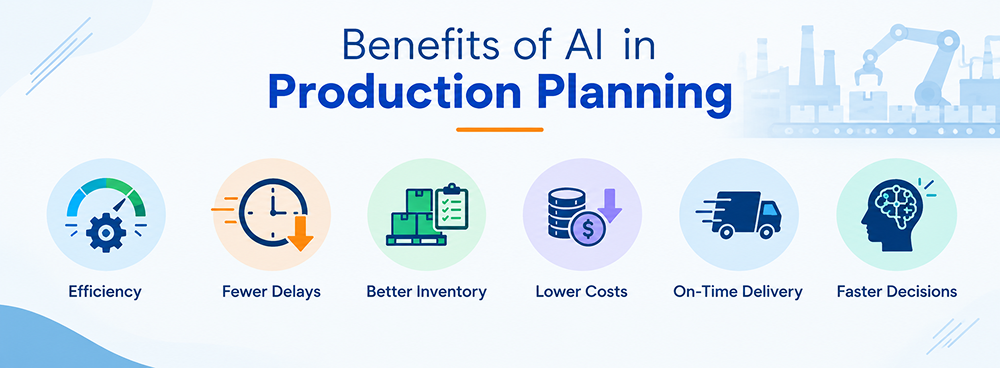
Benefits of AI in Production Planning
When implemented with suitable data and clear business objectives, AI can help manufacturers improve several aspects of production performance.
Improved Manufacturing Efficiency
AI helps businesses identify bottlenecks, coordinate production activities, and make better use of available resources.
More informed planning can reduce unnecessary waiting time and improve the flow of work between manufacturing stages.
Reduced Production Delays
Machine learning predictions and intelligent scheduling can help managers identify potential disruptions earlier.
By considering machine availability, material requirements, and delivery deadlines, manufacturers can prepare alternative plans before certain problems become more serious.
Better Inventory Control
AI-powered demand forecasting helps manufacturers estimate material and product requirements more accurately.
This can support better inventory decisions, reduce avoidable overstocking, and lower the risk of production interruptions caused by missing materials.
Lower Operational Costs
Production inefficiencies can increase labor expenses, energy consumption, material waste, and machine operating costs.
AI can help identify opportunities to improve resource allocation, reduce unnecessary changeovers, and avoid certain forms of unplanned downtime.
Actual cost savings depend on the manufacturing environment, implementation expenses, and how effectively recommendations are applied.
Improved Delivery Performance
When production schedules account for available capacity, material readiness, and customer priorities, manufacturers can plan delivery commitments more realistically.
AI can also help identify orders that are at risk of missing their deadlines, giving teams more time to take corrective action.
Faster Decision-Making
AI systems can analyze large volumes of production information faster than many manual reporting processes.
Production managers can use dashboards, forecasts, and alerts to understand operational conditions and evaluate possible changes.
Human judgment remains essential for reviewing recommendations and handling situations that require broader business context.
AI-Based Production Planning vs. Traditional Planning
Both traditional and AI-powered production planning can support manufacturing operations. Their main differences relate to data analysis, adaptability, and the way planning decisions are made.
| Feature | Traditional Production Planning | AI-Based Production Planning |
| Demand forecasting | Historical reports and manual estimates | Machine learning forecasts using multiple data sources |
| Scheduling | Fixed schedules and manual adjustments | Data-driven scheduling recommendations |
| Inventory management | Reorder rules and manual reviews | Predictive material planning and inventory alerts |
| Disruption handling | Often requires manual replanning | Can evaluate alternative plans using updated information |
| Resource allocation | Based on established schedules and experience | Can compare resource availability and competing constraints |
| Decision support | Reports and manual analysis | Forecasts, alerts, and optimization recommendations |
AI does not eliminate the need for traditional planning methods. Many manufacturing operations still rely on established production rules, ERP systems, and mathematical optimization.
In practice, combining existing planning methods with machine learning can provide a more useful and reliable solution than replacing every system at once.
Challenges of Implementing AI in Production Planning
Although AI offers several potential benefits, manufacturers need to address important implementation challenges.
1. Data Quality and Availability
Machine learning models depend on accurate and relevant data. Incomplete production records, inconsistent inventory information, and missing machine readings can reduce prediction quality.
Businesses should establish reliable data collection, validation, and maintenance processes before deploying AI.
2. Integration With Existing Systems
Manufacturing companies may use separate systems for ERP, inventory management, machine monitoring, maintenance, and production execution.
Integrating these systems can be technically challenging, particularly when older equipment or software does not support modern data connections.
A clear integration strategy helps ensure that AI systems receive the information required for effective planning.
3. Initial Investment and Implementation Costs
AI implementation may require software development, data infrastructure, system integration, employee training, and ongoing maintenance.
Manufacturers should begin with a specific problem and estimate the expected business value before making a large investment.
4. Employee Training and Adoption
Production planners and factory managers need to understand how AI recommendations are generated and when they should be reviewed.
Involving employees during implementation helps build trust and ensures that the system reflects real manufacturing requirements.
5. Changing Production Conditions
A machine learning model trained on historical information may perform less effectively when product designs, customer demand, production processes, or supplier conditions change significantly.
Manufacturers should monitor prediction accuracy, update models when necessary, and maintain suitable fallback planning procedures.
How to Implement AI in Production Planning
A structured implementation approach helps manufacturers adopt AI without disrupting existing production activities.
Step 1: Identify the Main Production Challenge
Start by identifying an issue that affects efficiency, such as frequent scheduling delays, excess inventory, inaccurate demand forecasts, or poor machine utilization.
Define measurable objectives so that the impact of the solution can be evaluated.
Step 2: Assess Available Data
Review historical orders, production schedules, inventory records, machine data, and delivery information.
Determine whether the data is sufficiently accurate, complete, and relevant to the selected use case.
Step 3: Select the Right AI Solution
Choose a solution that addresses the identified problem. Demand forecasting may require machine learning models, while production scheduling may need a combination of AI predictions and optimization algorithms.
The technology should fit the manufacturer’s existing systems and operational requirements.
Step 4: Start With a Pilot Project
Test the solution in one production line, product category, or planning activity.
For example, a manufacturer can begin by forecasting demand for a selected product group or improving the schedule for a specific machine.
A focused pilot makes it easier to measure results and identify problems before expanding the implementation.
Step 5: Measure Performance
Compare the results with the original baseline using relevant metrics, such as forecast accuracy, schedule adherence, machine utilization, inventory levels, production lead time, or on-time delivery.
Use these measurements to determine whether the solution is delivering practical value.
Step 6: Integrate and Scale Gradually
Once the pilot demonstrates value, integrate the solution with relevant manufacturing systems and extend it to additional operations.
Continue monitoring model performance, data quality, security, and employee feedback to maintain reliable results.
The Future of AI in Production Planning
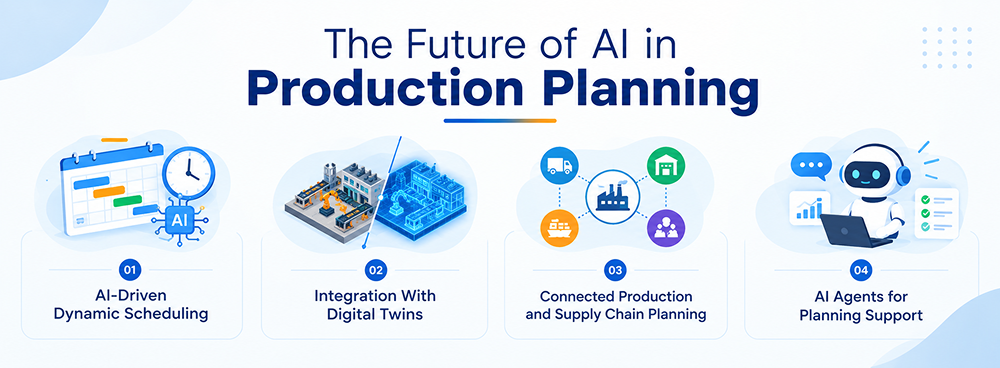
AI-based production planning is expected to become more closely connected with smart factories, predictive maintenance, digital twins, and supply chain management.
AI-Driven Dynamic Scheduling
Traditional production schedules may become outdated when unexpected changes occur.
AI-driven dynamic scheduling can use updated information about machine availability, production progress, material supply, and order priorities to help planners revise schedules more effectively.
The objective is to maintain practical production plans even when factory conditions change.
Integration With Digital Twins
Digital twins provide digital representations of physical machines, production lines, or manufacturing systems.
When connected with AI, they can help manufacturers simulate alternative schedules, evaluate production scenarios, and assess the possible impact of operational changes before implementing them.
This can support more informed planning decisions, although the accuracy of the simulation depends on the quality of the underlying model and data.
Connected Production and Supply Chain Planning
AI can help connect production schedules with procurement, inventory, logistics, and customer demand.
Better coordination between these activities helps manufacturers understand how a supplier delay or sudden demand increase may affect production commitments.
This integrated approach can improve planning across the wider manufacturing process.
AI Agents for Planning Support
AI agents may help production teams gather information from business systems, summarize production reports, investigate scheduling conflicts, and prepare recommendations.
For example, an AI agent could identify an order at risk of delay, retrieve the relevant machine and inventory information, and prepare alternative scheduling options for a planner to review.
Such systems require appropriate permissions, validation, and human oversight before critical production changes are approved.
Conclusion
AI in production planning is helping manufacturers improve the way they forecast demand, schedule production, manage inventory, allocate resources, and respond to operational disruptions.
By combining machine learning with manufacturing data and existing planning systems, businesses can gain better visibility into production requirements and make more informed decisions.
However, successful implementation depends on reliable data, suitable technology, effective system integration, and employee involvement. AI should support production planners with useful predictions and recommendations rather than being treated as a replacement for manufacturing expertise.
For manufacturers looking to improve efficiency, starting with a specific planning challenge and measuring the results can provide a practical path toward wider AI adoption.
At Krishna Innovative Software (KIS Works), businesses can explore AI development and integration solutions designed around their operational needs. With the right implementation strategy, AI-powered planning can support more efficient, flexible, and data-driven manufacturing operations.
Frequently Asked Questions (FAQs)
1. What is AI in production planning?
AI in production planning uses artificial intelligence and machine learning to analyze manufacturing data, forecast demand, optimize schedules, manage resources, and support production decisions.
2. How does machine learning improve production planning?
Machine learning identifies patterns in historical and current manufacturing data to predict demand, estimate production requirements, identify potential bottlenecks, and support better scheduling decisions.
3. What are the main applications of AI in production planning?
The main applications include demand forecasting, production scheduling, inventory management, resource allocation, predictive maintenance coordination, and real-time production monitoring.
4. Can AI reduce manufacturing costs?
AI can help reduce certain manufacturing costs by improving resource utilization, minimizing avoidable delays, supporting inventory optimization, and identifying production inefficiencies. The results depend on the application and implementation quality.
5. What data is required for AI-based production planning?
Common data requirements include historical orders, sales forecasts, production schedules, inventory records, machine availability, cycle times, maintenance information, and supplier lead times.
6. What is the difference between AI and traditional production planning?
Traditional production planning often relies on established rules, manual analysis, and fixed schedules. AI-based planning uses data analysis and predictive models to support more adaptive decisions when conditions change.
7. Is AI suitable for small manufacturing businesses?
Yes. Small manufacturers can start with focused applications such as demand forecasting, inventory planning, or production scheduling. A pilot project helps evaluate the benefits before investing in a larger solution.
8. How can manufacturers implement AI in production planning?
Manufacturers can begin by identifying a specific planning problem, assessing data quality, selecting an appropriate solution, testing it through a pilot project, measuring performance, and expanding gradually.