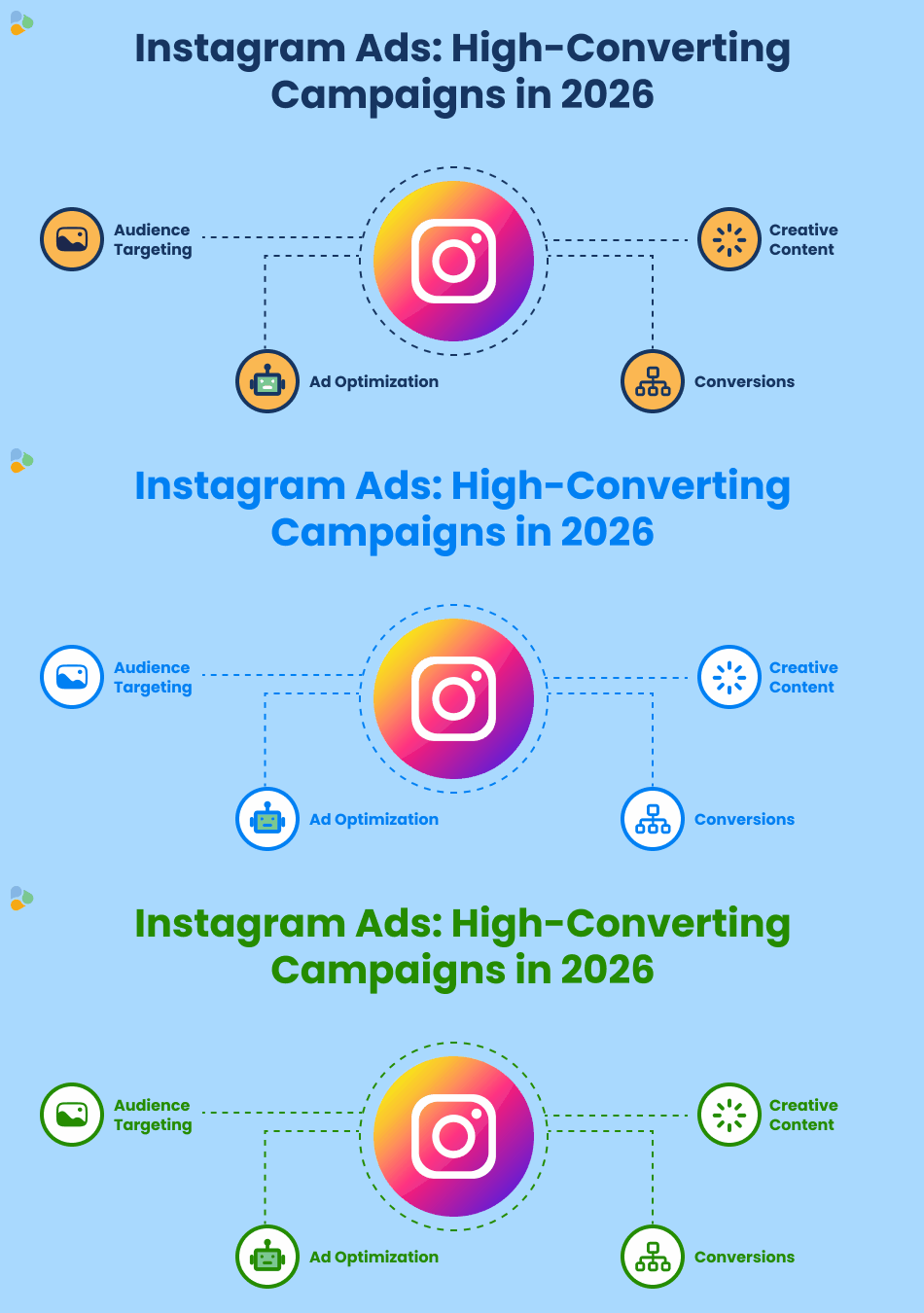
But with more businesses competing for attention, simply running Instagram Ads is not enough. A successful campaign needs the right audience, creative content, clear messaging, a strong offer, and continuous optimization.
In 2026, the focus should be less on getting impressions and more on getting meaningful actions from the right audience.
This guide explains how to create Instagram Ads that can attract attention, generate engagement, and turn potential customers into leads or buyers.
What Are Instagram Ads?
Instagram Ads are paid advertisements that businesses use to promote products, services, offers, or content to selected audiences.
Depending on your campaign and creative, ads can appear in places such as:
- Instagram Feed
- Instagram Stories
- Instagram Reels
- Carousel placements
- Explore and other eligible placements
Instagram Ads can support different business goals, including:
- Generating leads
- Increasing website traffic
- Driving online purchases
- Promoting products or services
- Increasing brand awareness
- Generating inquiries
- Promoting events or offers
- Retargeting potential customers
The right objective depends on what you want users to do after seeing your advertisement.
Why Instagram Ads Matter in 2026
Organic social media can help businesses build an audience, but organic reach alone may not be enough to consistently reach new potential customers.
Paid advertising gives businesses more control over who sees their content and allows them to measure what happens after someone interacts with an advertisement.
However, more competition also means users are exposed to a huge amount of content every day.
This makes relevance and creative quality extremely important.
A strong Instagram advertising strategy combines:
Relevant audience + strong creative + clear message + valuable offer + optimized landing page + continuous testing.
If one part of this process is weak, campaign performance can suffer.
For example, you might create an excellent ad that gets many clicks, but if the landing page is confusing, visitors may leave without converting.
Step-by-Step Guide to High-Converting Instagram Ads
Step 1: Define Your Campaign Goal
Before creating an Instagram Ad, decide what you want the campaign to achieve.
Don’t start with a vague goal such as:
“I want more people to see my business.”
Instead, create a measurable objective.
For example:
- Generate 100 qualified leads
- Increase product purchases
- Get more consultation requests
- Drive traffic to a specific service page
- Generate WhatsApp inquiries
- Promote a new product
Your goal should influence your audience, creative, copy, CTA, landing page, and measurement strategy.
Example
A software development company might have the goal:
Generate qualified leads from businesses looking for AI development services.
This is much more useful than simply trying to increase followers.
Step 2: Understand Your Target Audience
One of the most common Instagram advertising mistakes is trying to target everyone.
Your audience should be based on your ideal customer.
Ask yourself:
- Who is most likely to buy from us?
- What problem are they trying to solve?
- What industry are they in?
- What motivates them?
- What objections might they have?
- What questions do they ask before purchasing?
- What type of content do they engage with?
For example, instead of targeting simply:
Business owners
you could define your audience more specifically:
Small and mid-sized businesses looking to automate repetitive business processes using AI.
A clearer audience makes it easier to create relevant advertisements.
Step 3: Choose the Right Instagram Ad Format
Different ad formats can support different goals.
Reels Ads
Short-form video is useful for grabbing attention quickly.
You can use Reels Ads for:
- Product demonstrations
- Educational videos
- Customer testimonials
- Before-and-after content
- Quick tutorials
- Problem-solution videos
- Industry tips
Your opening seconds are particularly important because users can quickly scroll past your content.
Stories Ads
Stories are designed for quick, vertical content.
They can work well for:
- Limited-time offers
- Promotions
- Lead generation
- Product launches
- Events
- Announcements
Keep the message simple and make the CTA easy to understand.
Feed Ads
Feed Ads provide more space to communicate your message.
They can be useful for:
- Product advertising
- Service promotion
- Case studies
- Educational content
- Special offers
Carousel Ads
Carousel Ads allow you to display multiple images or videos in a single advertisement.
They are useful for:
- Showing different products
- Explaining multiple benefits
- Presenting features
- Sharing a step-by-step process
- Telling a visual story
The best format depends on your audience, offer, message, and campaign objective.
Step 4: Create a Strong Hook
People scroll quickly on social media.
Your advertisement needs to capture attention quickly.
A weak opening might be:
“We provide professional digital marketing services.”
A stronger hook could be:
“Getting website traffic but still not getting enough leads?”
Another example:
“Your ads may not be the problem. Your landing page might be.”
Good hooks often focus on:
- A customer problem
- A desired result
- A common mistake
- A surprising insight
- A specific benefit
- A question
- Curiosity
Your hook should give users a reason to stop scrolling.
Step 5: Write Benefit-Focused Ad Copy
Your Instagram Ad doesn’t need to explain everything about your business.
Focus on one clear message.
A simple structure is:
Problem → Solution → Benefit → CTA
Example
Problem:
“Still spending hours answering repetitive customer questions?”
Solution:
“An AI-powered customer support system can automate common queries.”
Benefit:
“Give your team more time to focus on complex customer issues.”
CTA:
“Book a consultation.”
Also remember the difference between a feature and a benefit.
A feature tells people what your product does.
A benefit tells them why it matters.
Instead of:
“Our software has automated reporting.”
Try:
“Get your reports faster without spending hours preparing them manually.”
Step 6: Add a Clear Call to Action
Every advertisement should tell users what to do next.
Depending on your campaign, your CTA could be:
- Learn More
- Shop Now
- Get Quote
- Book Now
- Sign Up
- Download
- Contact Us
- Send Message
Don’t make the user guess what happens next.
For example:
Book your free consultation today.
is much clearer than:
Find out more about our services.
Keep your CTA aligned with the campaign goal.
Step 7: Create a Landing Page That Matches Your Ad
Getting a click is only one part of the customer journey.
The landing page needs to convince the visitor to take the next step.
For example, if your advertisement says:
Get a Free AI Consultation
but clicking the ad takes users to a generic homepage, the experience can become confusing.
Instead, create a landing page that continues the same message.
A good landing page should have:
- A clear headline
- Strong value proposition
- Relevant information
- Benefits
- Social proof
- Simple form
- Clear CTA
- Mobile-friendly design
- Fast loading experience
The customer journey should feel consistent:
Ad → Landing Page → Action
Step 8: Set Up Tracking Before Launch
Don’t launch an Instagram campaign without knowing how you will measure results.
Your tracking setup should help you understand what happens after someone interacts with your advertisement.
Depending on your campaign, you may want to track:
- Website visits
- Form submissions
- Purchases
- Phone calls
- Messages
- Downloads
- Sign-ups
- Bookings
Proper tracking helps you understand which advertisements are contributing to actual business results.
Step 9: Create Multiple Ad Variations
Don’t expect one advertisement to work perfectly from the beginning.
Create multiple versions with different creative angles.
For example:
Ad A — Problem-Focused
“Still losing leads because your team responds too slowly?”
Ad B — Benefit-Focused
“Turn more website visitors into qualified leads.”
Ad C — Educational
“3 ways AI can automate your customer support.”
Ad D — Social Proof
“See how businesses are using AI to reduce repetitive customer tasks.”
Testing different messages helps you discover what your audience responds to.
Step 10: Test Your Ads
Testing is an important part of Instagram advertising.
You can test different:
- Hooks
- Videos
- Images
- Headlines
- Offers
- CTAs
- Audiences
- Landing pages
- Ad formats
Try to make your tests meaningful.
For example, keep your audience and offer similar while testing two different hooks.
If one performs better, you have learned something useful about your audience.
Over time, these insights can help improve your campaigns.
Step 11: Use Retargeting
Not everyone will convert after seeing your advertisement once.
A potential customer might:
- See your Instagram Ad.
- Visit your website.
- Read your service page.
- Leave without converting.
- See another advertisement later.
- Return and finally contact you.
Retargeting helps businesses reconnect with people who have already interacted with their brand.
Depending on your setup, you can create audiences around actions such as:
- Website visitors
- Instagram engagers
- Video viewers
- Product viewers
- Previous customers
- People who started but didn’t complete an action
Retargeting can be particularly useful for products or services that require more consideration before purchase.
Step 12: Measure the Right Metrics
Don’t judge your Instagram Ads only by likes.
Likes can show engagement, but they don’t necessarily mean your campaign is generating business.
Important metrics include:
Reach
The number of unique people who saw your advertisement.
Impressions
The total number of times your advertisement was displayed.
Click-Through Rate
The percentage of people who clicked after seeing the advertisement.
Cost Per Click
The average amount spent for each click.
Conversion Rate
The percentage of visitors who completed your desired action.
Cost Per Lead
The average cost of generating a lead.
Return on Ad Spend
The revenue generated compared with your advertising spend.
The most important metrics depend on your campaign objective.
For e-commerce, purchases and ROAS may be critical.
For B2B businesses, qualified leads and cost per qualified lead may matter more.
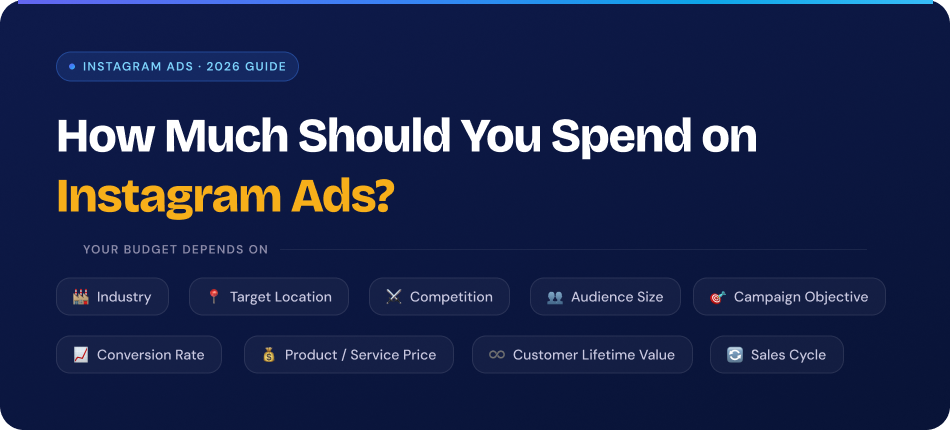
How Much Should You Spend on Instagram Ads in 2026?
There is no universal Instagram Ads budget.
Your budget depends on:
- Industry
- Target location
- Competition
- Audience size
- Campaign objective
- Product or service price
- Customer lifetime value
- Conversion rate
- Sales cycle
Instead of asking:
“What is the cheapest budget?”
ask:
“What budget will give us enough data to make informed decisions?”
A practical approach is to start with a controlled budget, monitor results, identify what works, and gradually allocate more budget to campaigns that consistently deliver strong business outcomes.
Common Instagram Ads Mistakes to Avoid
1. Using the Same Creative for Too Long
If people repeatedly see the same advertisement, performance may eventually decline.
Test new hooks, visuals, messages, and creative concepts.
2. Targeting Everyone
A large audience isn’t necessarily a valuable audience.
Understand who your ideal customers are and create content that speaks directly to them.
3. Making Every Ad Too Promotional
People don’t open Instagram because they want to see advertisements.
Make your content useful, relevant, educational, entertaining, or interesting.
4. Ignoring the Landing Page
Your advertisement might generate clicks, but a poor landing page can prevent conversions.
5. Focusing Only on Likes
Likes don’t necessarily translate into leads or sales.
Track metrics that connect to your actual business goals.
6. Changing Campaigns Too Frequently
Making constant changes can make it difficult to understand what is actually working.
Allow campaigns to collect enough meaningful data before making major decisions.
7. Running Only One Creative
Different people respond to different messages.
Test multiple creative angles instead of relying on a single advertisement.
Instagram Ads vs Organic Instagram Marketing
Businesses don’t necessarily need to choose between paid and organic marketing.
The two can support each other.
Organic Instagram Marketing Can Help You:
- Build trust
- Educate your audience
- Establish expertise
- Develop a community
- Test content ideas
- Build long-term visibility
Instagram Ads Can Help You:
- Reach targeted audiences
- Promote specific offers
- Generate leads
- Drive website traffic
- Scale successful content
- Retarget potential customers
A strong strategy can use organic content to understand what resonates with your audience and paid advertising to amplify the strongest messages.
A Simple Instagram Ads Strategy for 2026
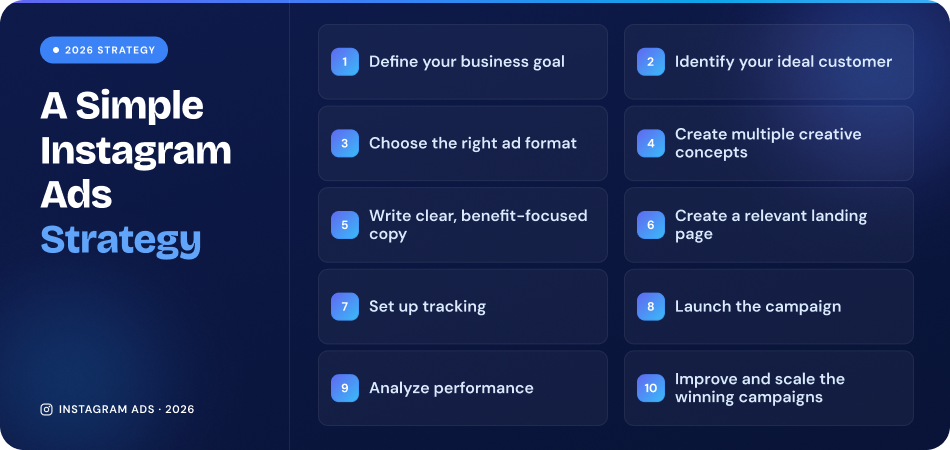
This approach helps turn Instagram advertising into a structured marketing process instead of a guessing game.
Frequently Asked Questions About Instagram Ads in 2026
What are Instagram Ads?
Instagram Ads are paid advertisements businesses use to promote products, services, offers, or content to selected audiences on Instagram. They can appear in formats such as Feed, Stories, Reels, and Carousel.
How can I create high-converting Instagram Ads?
Start with a clear campaign goal and target audience. Then create a strong hook, choose an appropriate ad format, write benefit-focused copy, add a clear CTA, build a relevant landing page, and continuously test and optimize your campaign.
Which Instagram Ad format is best for conversions?
There is no single format that works for every business. Reels can be useful for grabbing attention, Stories can work well for quick promotions and lead generation, while Feed and Carousel Ads can be useful for explaining products, services, and benefits.
How much should I spend on Instagram Ads in 2026?
There is no fixed budget. Your spending should depend on your industry, target audience, location, competition, campaign objective, product value, and conversion rate. Start with a controlled budget and use campaign data to determine whether you should scale.
What metrics should I track for Instagram Ads?
Important metrics include reach, impressions, CTR, CPC, conversion rate, cost per lead, purchases, and ROAS. The metrics you prioritize should match your campaign objective.
Why are my Instagram Ads getting clicks but no conversions?
Possible reasons include poor audience targeting, an unclear offer, a mismatch between your ad and landing page, a complicated conversion process, or a weak landing page. Review the complete journey from ad to landing page to conversion.
Should I use organic Instagram content along with paid ads?
Yes. Organic content can help build trust, educate your audience, and identify topics that resonate with users. Paid advertising can then help you reach specific audiences and scale successful campaigns.
How often should I change my Instagram Ad creatives?
There is no fixed schedule. Monitor your campaign performance and audience response. If results begin declining, test new hooks, visuals, messages, offers, or creative concepts.
Final Thoughts
High-converting Instagram Ads don’t come from one viral Reel or a clever headline.
They come from combining several important elements:
The right audience + the right message + strong creative + a relevant offer + a good landing page + continuous optimization.
In 2026, businesses should focus less on simply getting impressions and more on creating advertising experiences that move people from attention to action.
Start with a clear goal, test different creative ideas, measure meaningful results, and improve your campaigns based on real data.
The goal isn’t to create an advertisement that gets the most views.
The goal is to create an advertisement that gets the right people to take the right action.