As businesses explore AI adoption, one question comes up frequently: Should you choose AI Agents or AI Workflows?
Although both are designed to automate work, they are built for different purposes. Understanding the difference can help you invest in the right solution and get better returns from your AI initiatives.
In this guide, we’ll explain AI Agents and AI Workflows in simple terms, compare their capabilities, and help you decide which option is the best fit for your business.
What Are AI Workflows?
Think of an AI workflow as a well-planned process. Every step is predefined, and the system follows those steps in the same order every time.
For example, when a customer places an online order, the workflow can automatically:
- Send an order confirmation email
- Update inventory
- Generate an invoice
- Notify the warehouse
- Share shipping details with the customer
The process remains the same regardless of who places the order.
AI workflows are ideal for repetitive, rule-based tasks where consistency and speed matter the most.
Common Use Cases
- Invoice processing
- Employee onboarding
- Customer support ticket routing
- Lead qualification
- CRM updates
- Email categorization
- Report generation
The biggest advantage of AI workflows is reliability. They reduce manual work, improve accuracy, and save valuable time without changing the existing business process.
What Are AI Agents?
AI Agents take automation a step further.
Instead of following a fixed sequence, they are designed to achieve a goal. They can analyze information, make decisions, use different tools, and adapt to changing situations.
Imagine a customer contacts your business because their shipment is delayed. Rather than simply forwarding the query, an AI Agent can:
- Check the shipment status
- Identify the reason for the delay
- Suggest alternative delivery options
- Update the customer automatically
- Notify the logistics team if needed
It behaves more like a digital assistant than a traditional automation tool.
AI Agents are best suited for situations where decision-making and problem-solving are required.
AI Agents vs AI Workflows: Key Differences
| Feature | AI Workflows | AI Agents |
| Process | Fixed and rule-based | Dynamic and adaptive |
| Decision Making | Follows predefined rules | Makes decisions based on context |
| Flexibility | Limited | High |
| Best For | Repetitive tasks | Complex tasks and problem-solving |
| Human Involvement | Higher | Lower |
| Implementation | Easier | More advanced |
Simply put, AI workflows focus on automation, while AI agents focus on intelligent execution.
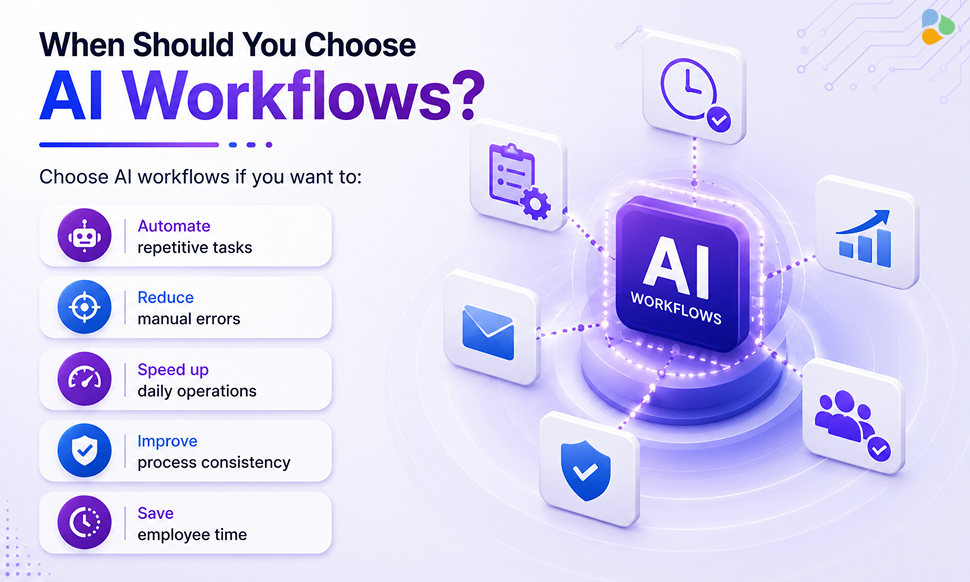
When Should You Choose AI Workflows?
AI workflows are the right choice if your business has structured processes that rarely change.
Choose AI workflows if you want to:
- Automate repetitive tasks
- Reduce manual errors
- Speed up daily operations
- Improve process consistency
- Save employee time
For example, finance teams can automate invoice approvals, HR departments can streamline onboarding, and marketing teams can schedule campaigns automatically.
If your goal is to make existing processes more efficient, AI workflows are an excellent starting point.
When Should You Choose AI Agents?
AI Agents are ideal when your business deals with complex situations that require reasoning and adaptability.
They are useful for:
- AI-powered customer support
- Sales assistants
- Business research
- Supply chain management
- Marketing optimization
- Intelligent data analysis
Instead of waiting for human instructions at every step, AI Agents can evaluate the situation and decide the next action.
For businesses handling large amounts of data or customer interactions, AI Agents can significantly improve productivity while delivering a better user experience.
Can AI Agents and AI Workflows Work Together?
Absolutely.
In fact, many businesses achieve the best results by combining both.
For example, an AI workflow can automatically receive and categorize customer support requests. Once a complex issue is detected, an AI Agent can step in to analyze the problem, gather information, suggest a solution, and draft a response.
This combination allows businesses to automate routine work while using AI intelligence where it’s needed most.
Which One Is Right for Your Business?
The answer depends on your business goals.
Choose AI Workflows if you need:
- Process automation
- Faster repetitive tasks
- Better operational efficiency
- Lower implementation costs
Choose AI Agents if you need:
- Intelligent decision-making
- Personalized customer experiences
- Adaptive problem-solving
- End-to-end task automation
If you’re just starting your AI journey, implementing workflows first can deliver quick wins. As your business grows, AI Agents can add intelligence to more complex operations.
How KIS Works Can Help
At KIS Works, we help businesses adopt AI solutions that solve real business challenges—not just follow trends.
Our team specializes in:
- AI Agent Development
- AI Workflow Automation
- Custom AI Applications
- AI Integration Services
- Business Process Automation
- AI-Powered Chatbots
- Predictive Analytics
- Enterprise AI Solutions
Whether you’re looking to automate repetitive tasks or build intelligent AI agents, we create scalable solutions tailored to your business goals.
Final Thoughts
AI is no longer a future investment—it’s becoming an essential part of modern business operations.
AI Workflows and AI Agents both offer significant advantages, but they serve different purposes. Workflows are perfect for structured, repetitive tasks, while AI Agents are designed for dynamic situations that require reasoning and decision-making.
For many businesses, the smartest approach is to combine both. By using AI Workflows for routine operations and AI Agents for complex tasks, you can improve efficiency, reduce costs, and deliver better customer experiences.
If you’re ready to explore how AI can transform your business, KIS Works can help you choose, build, and implement the right solution.
FAQs
1. What is the main difference between AI Agents and AI Workflows?
AI Workflows follow predefined rules to automate repetitive tasks, while AI Agents can analyze situations, make decisions, and adapt to changing conditions.
2. Are AI Agents better than AI Workflows?
Not necessarily. The best choice depends on your business needs. Workflows are ideal for structured processes, while AI Agents are better for complex and dynamic tasks.
3. Can small businesses use AI Agents?
Yes. Small businesses can use AI Agents for customer support, sales, marketing, and other areas where intelligent automation can improve efficiency.
4. Can AI Workflows and AI Agents work together?
Yes. Many businesses combine both to automate routine tasks while using AI Agents for decision-making and problem-solving.
5. How can KIS Works help with AI implementation?
KIS Works provides AI consulting, AI Agent development, workflow automation, custom AI solutions, and integration services to help businesses streamline operations and accelerate growth.