From automating customer support and managing business operations to generating reports and analyzing data, AI agents are helping organizations work smarter while reducing operational costs. Whether you’re a startup, an eCommerce brand, a manufacturing company, or an enterprise, AI agents can improve efficiency, increase productivity, and free your team from repetitive tasks.
In this blog, we’ll explore what AI agents are, how they work, their business benefits, and why investing in AI-powered automation is becoming a strategic advantage.
What Are AI Agents?
AI agents are intelligent software programs designed to complete tasks autonomously based on goals, data, and user instructions. Unlike traditional automation tools that only follow predefined rules, AI agents can understand context, analyze information, and make decisions in real time.
Think of an AI agent as a digital employee that works around the clock. It can answer customer questions, manage workflows, summarize documents, generate reports, schedule meetings, and even collaborate with other business systems.
The real power of AI agents lies in their ability to adapt. As they process more data and interactions, they become better at solving problems and delivering accurate results.
AI Agents Work
AI agents combine technologies such as machine learning, natural language processing (NLP), and automation to complete business tasks efficiently.
A typical AI agent follows these steps:
- Collects information from emails, CRM systems, databases, websites, or documents.
- Understands the request or business objective.
- Analyzes available data and determines the best course of action.
- Performs the required task automatically.
- Learns from feedback and improves future performance.
For example, if a customer asks about an order status, an AI agent can retrieve the order details from the CRM, verify the shipping information, and provide an instant response without human involvement.
Key Benefits of AI Agents for Business
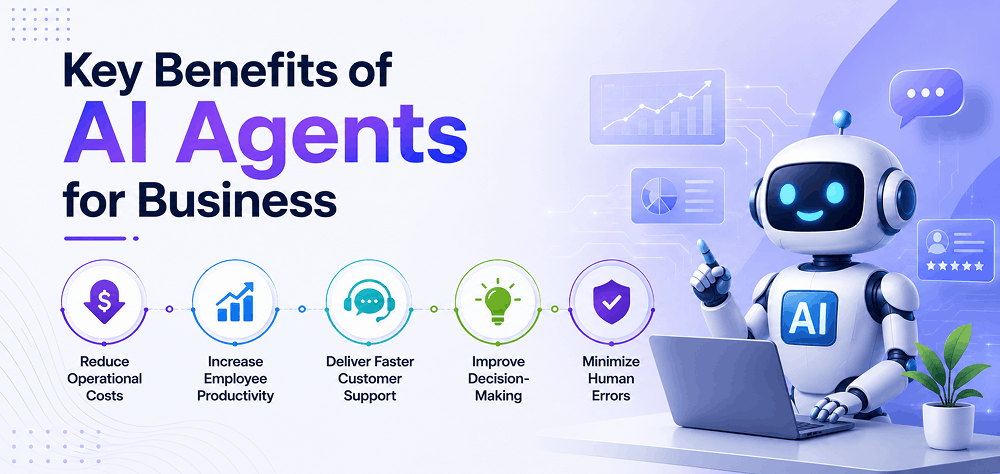
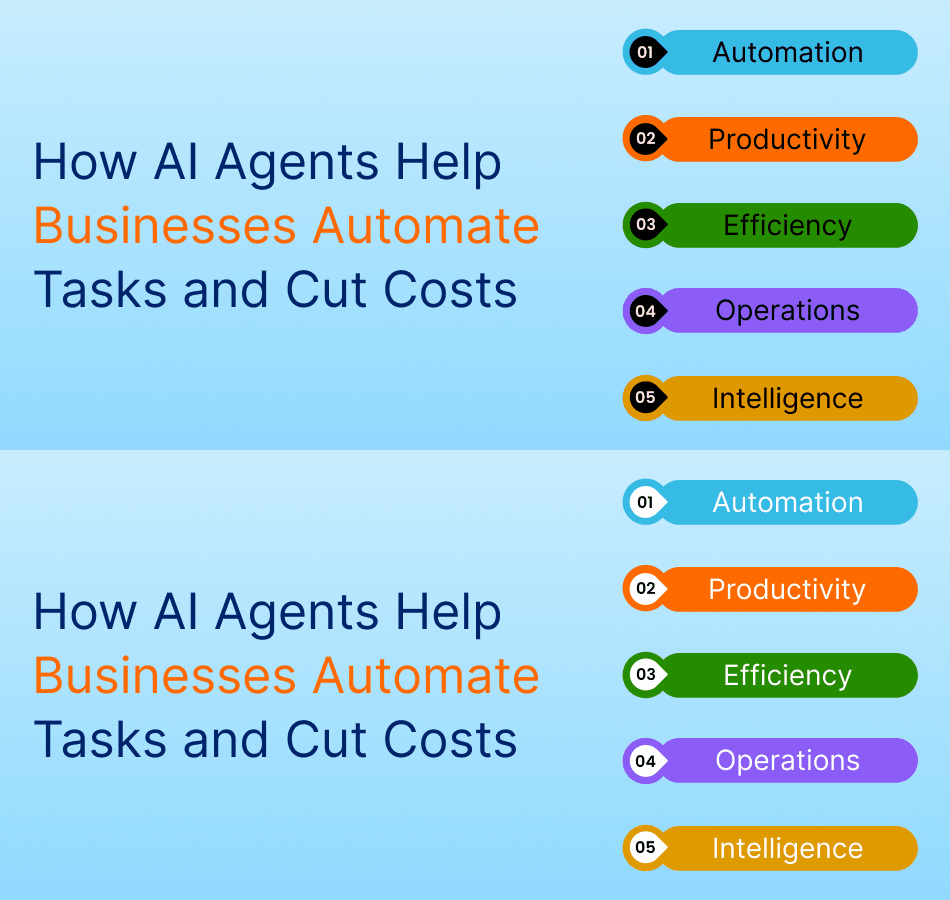
1. Reduce Operational Costs
One of the biggest reasons businesses invest in AI agents is cost savings. Routine tasks such as data entry, invoice processing, customer support, and appointment scheduling can be automated, reducing the need for manual effort.
Instead of hiring additional staff to manage repetitive work, businesses can deploy AI agents that operate 24/7 without overtime or additional resources.
2. Increase Employee Productivity
Employees often spend hours on repetitive administrative tasks that add little strategic value. AI agents take over these responsibilities, allowing teams to focus on innovation, customer relationships, and business growth.
This improves overall productivity while increasing employee satisfaction.
3. Deliver Faster Customer Support
Modern customers expect quick and accurate responses. AI agents can instantly answer common questions, process service requests, track orders, and escalate complex issues to human agents when needed.
This leads to shorter response times, improved customer experiences, and higher retention rates.
4. Improve Decision-Making
AI agents analyze large volumes of business data within seconds. They can identify sales trends, customer behavior, operational bottlenecks, and market opportunities that might otherwise go unnoticed.
These insights help business leaders make faster and more informed decisions.
5. Minimize Human Errors
Manual processes often result in mistakes that affect productivity and customer satisfaction. AI agents perform repetitive tasks consistently and accurately, reducing errors in data processing, reporting, and workflow management.
Real-World Business Applications
AI agents are transforming businesses across industries by automating everyday operations.
Customer Service
AI agents can handle FAQs, process refund requests, track orders, and provide technical support around the clock. Human agents can then focus on resolving complex customer issues.
Sales and Lead Management
Sales teams use AI agents to qualify leads, send follow-up emails, schedule meetings, and update CRM records automatically. This reduces administrative work and helps sales representatives spend more time closing deals.
Human Resources
HR departments use AI agents to screen resumes, schedule interviews, onboard employees, answer HR-related questions, and manage leave requests.
Finance and Accounting
AI agents simplify invoice processing, expense management, financial reporting, payment reminders, and compliance checks, saving valuable time while improving accuracy.
Marketing
Marketing teams rely on AI agents to create content, personalize email campaigns, analyze customer data, schedule social media posts, and measure campaign performance.
AI Agents vs Traditional Automation
Although both improve efficiency, AI agents are far more advanced than traditional automation tools.
| Traditional Automation | AI Agents |
| Rule-based workflows | Intelligent decision-making |
| Fixed instructions | Learns from new data |
| Limited flexibility | Adapts to changing situations |
| Performs repetitive tasks | Understands context and intent |
| Requires frequent manual updates | Continuously improves over time |
This flexibility makes AI agents suitable for dynamic business environments where decisions often depend on changing information.
How AI Agents Reduce Business Costs
Imagine a customer support team that receives thousands of inquiries every month. Without automation, businesses must hire additional staff to handle increasing workloads.
An AI agent can automatically resolve common requests such as password resets, order tracking, appointment bookings, and frequently asked questions. Human agents only need to manage complex cases that require personal attention.
Similarly, finance teams can automate invoice approvals, HR departments can streamline employee onboarding, and sales teams can automate lead follow-ups. These improvements reduce labor costs, improve response times, and increase operational efficiency.
Is Your Business Ready for AI Agents?
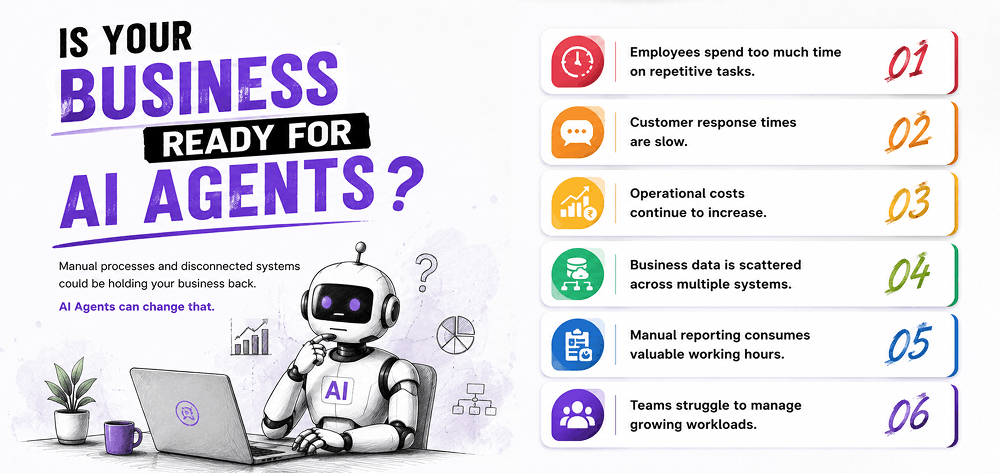
Your organization can benefit from AI agents if you experience any of the following challenges:
- Employees spend too much time on repetitive tasks.
- Customer response times are slow.
- Operational costs continue to increase.
- Business data is scattered across multiple systems.
- Manual reporting consumes valuable working hours.
- Teams struggle to manage growing workloads.
If these issues sound familiar, implementing AI agents can help streamline operations and improve overall business performance.
Best Practices for Successful AI Adoption
To maximize the value of AI agents, businesses should follow a structured implementation approach.
Start by identifying repetitive processes that consume the most time. Set clear business goals such as reducing response times, improving productivity, or lowering operational costs.
Choose AI solutions that integrate with your existing CRM, ERP, HR, and accounting software. Most importantly, remember that AI should support employees rather than replace them. Human oversight remains essential for strategic decision-making and customer relationship management.
Regularly monitor performance metrics such as time saved, cost reductions, customer satisfaction, and employee productivity to ensure continuous improvement.
Why Businesses Are Investing in AI Agents
As competition grows, companies need smarter ways to operate without significantly increasing costs. AI agents offer a practical solution by automating repetitive work, improving accuracy, and helping employees focus on higher-value tasks.
Businesses that adopt AI early gain advantages such as faster service delivery, improved customer experiences, better resource utilization, and stronger long-term profitability.
From startups to global enterprises, AI agents are becoming an essential part of digital transformation strategies.
Why Choose KISWorks for AI Development?
At KISWorks, we help businesses harness the power of Artificial Intelligence through custom AI solutions tailored to their unique needs. Whether you need AI agents for customer support, workflow automation, business intelligence, or process optimization, our experienced development team can build scalable and secure AI solutions that deliver measurable results.
Our goal is simple: help businesses automate operations, reduce costs, and accelerate growth through innovative AI technology.
Conclusion
AI agents are changing the way businesses operate by automating repetitive tasks, improving decision-making, and reducing operational expenses. Unlike traditional automation tools, AI agents understand context, adapt to new information, and continuously improve their performance.
As organizations continue their digital transformation journey, AI agents will play an increasingly important role in driving efficiency and business growth. Companies that invest in AI today will be better positioned to meet customer expectations, optimize operations, and stay ahead of the competition.
If you’re ready to transform your business with intelligent automation, partnering with an experienced AI development company like KISWorks can help you unlock the full potential of AI agents and build a smarter, more efficient future.
Frequently Asked Questions
Q1. What are AI agents in business?
AI agents are intelligent software systems that automate business tasks, analyze data, and make decisions with minimal human intervention.
Q2. How do AI agents reduce business costs?
They automate repetitive work, reduce manual errors, improve employee productivity, and lower operational expenses.
Q3. Which industries can use AI agents?
Healthcare, manufacturing, retail, finance, logistics, education, IT, real estate, and eCommerce are among the many industries benefiting from AI agents.
Q4. Are AI agents suitable for small businesses?
Yes. Small businesses can use AI agents for customer support, appointment scheduling, lead management, and administrative automation without investing in large teams.