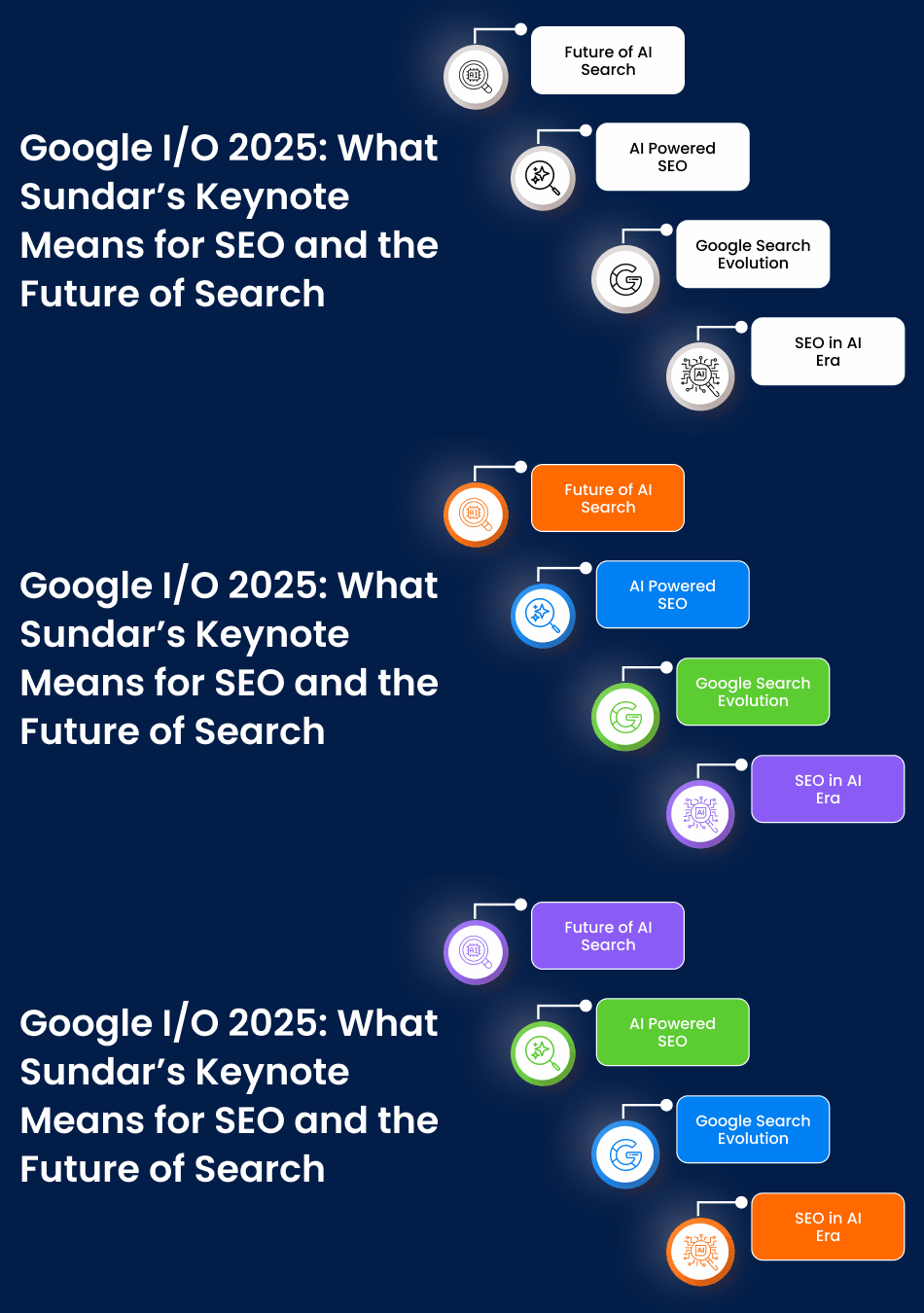
One thing became very obvious after the event — Google is moving towards a smarter and more AI-driven search experience. Search is no longer just about typing keywords and getting a list of links. It is becoming more conversational, personalized, and focused on giving users direct answers.
For businesses, marketers, and website owners, this means SEO is entering a completely new phase.
The way people search online is changing, and because of that, the way websites need to create content and build visibility is changing too.
In this blog, we’ll break down the biggest highlights from Google I/O 2025 in a simple and easy-to-understand way. We’ll also look at what these updates mean for SEO and how businesses can prepare for the future of search.
What Was the Main Focus of Google I/O 2025?
This year, Google placed a huge focus on Artificial Intelligence and how it will be integrated into almost every Google product and service.
From Search and Android to Workspace and Shopping, AI was at the center of nearly every announcement.
Some of the major updates included:
- AI-powered Google Search
- Gemini AI updates
- AI Mode in Search
- More conversational search experiences
- AI-generated search answers
- Smarter shopping and recommendations
- Multimodal search using text, voice, and images
Google is moving from a traditional search engine toward an AI assistant that can answer questions, understand context, and even help users complete tasks.
This is a huge shift for SEO.
Search Is No Longer Just “10 Blue Links”
For years, Google Search mainly showed a list of website links.
Users searched keywords → clicked websites → found information.
Now Google is changing that experience.
With AI Overviews and AI-powered Search, Google can generate answers directly inside search results.
Example
Instead of searching:
“Best SEO tools”
Users may now ask:
“What are the best SEO tools for a small business with a low budget and AI features?”
Google’s AI can generate a complete summary instantly.
This means users may get answers without clicking multiple websites.
What Does This Mean for SEO?
Many people are asking:
“Is SEO dead?”
The answer is no.
But SEO is definitely changing.
Google still needs trusted websites and content to generate AI answers.
The difference is:
SEO is no longer only about ranking pages.
Now it is also about becoming a trusted source for AI-generated search results.
AI Overviews Are Changing User Behavior
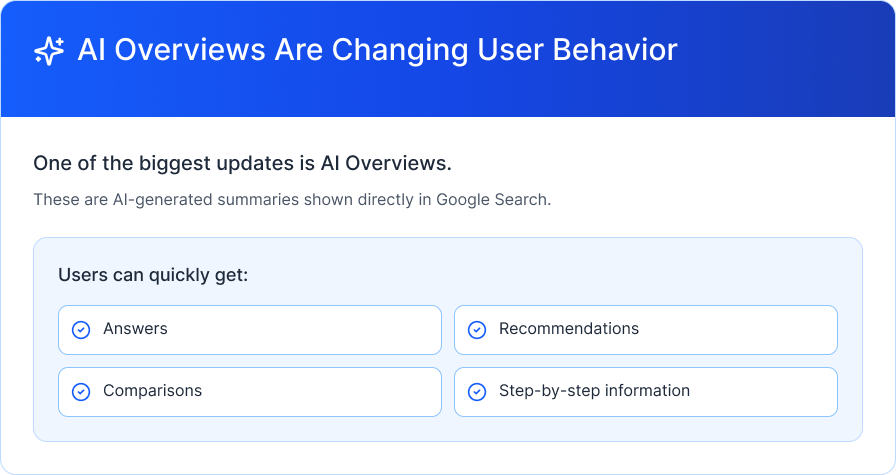
One of the biggest updates is AI Overviews.
These are AI-generated summaries shown directly in Google Search.
Users can quickly get:
- Answers
- Recommendations
- Comparisons
- Step-by-step information
Without visiting many websites.
Why This Matters
Traditional organic clicks may decrease for some types of searches.
But websites with high-quality content can still benefit because Google uses trusted sources to create those summaries.
Businesses should now focus on:
- Helpful content
- Clear answers
- Authority
- Trustworthiness
Instead of only focusing on rankings.
Google Is Focusing More on Search Intent
Google’s AI is becoming much better at understanding user intent.
This means Google no longer relies only on exact keywords.
Instead, it tries to understand:
- What users actually mean
- What problem they want to solve
- What type of answer they need
Old SEO Strategy
Repeating keywords multiple times.
New SEO Strategy
Creating useful content that naturally answers user questions.
Content written for humans will perform better than content written only for search engines.
Brand Authority Is Becoming More Important
Google is putting more focus on trusted brands and reliable creators.
AI systems want trustworthy information.
This means businesses should focus on building:
- Brand credibility
- Online reputation
- Expert content
- Customer trust
- Consistent digital presence
Google is becoming better at identifying whether a business is genuinely helpful and trustworthy.
Video and Visual Content Will Grow Faster
Google also highlighted multimodal AI experiences.
This means users can search using:
- Voice
- Images
- Video
- Text
As a result, visual content is becoming more important for SEO.
Businesses should start investing more in:
- Short videos
- Infographics
- Visual explainers
- YouTube SEO
- Image optimization
The future of search is not only text-based anymore.
Technical SEO Still Matters
Even with AI-powered search, technical SEO remains very important.
Google still needs websites that are:
- Fast
- Mobile-friendly
- Secure
- Easy to crawl
- Structured properly
Websites with poor performance may struggle to stay visible in AI-driven search results.
Businesses should focus on:
- Core Web Vitals
- Schema markup
- Mobile optimization
- Clean website structure
- Fast loading speed
What Businesses Should Do After Google I/O 2025
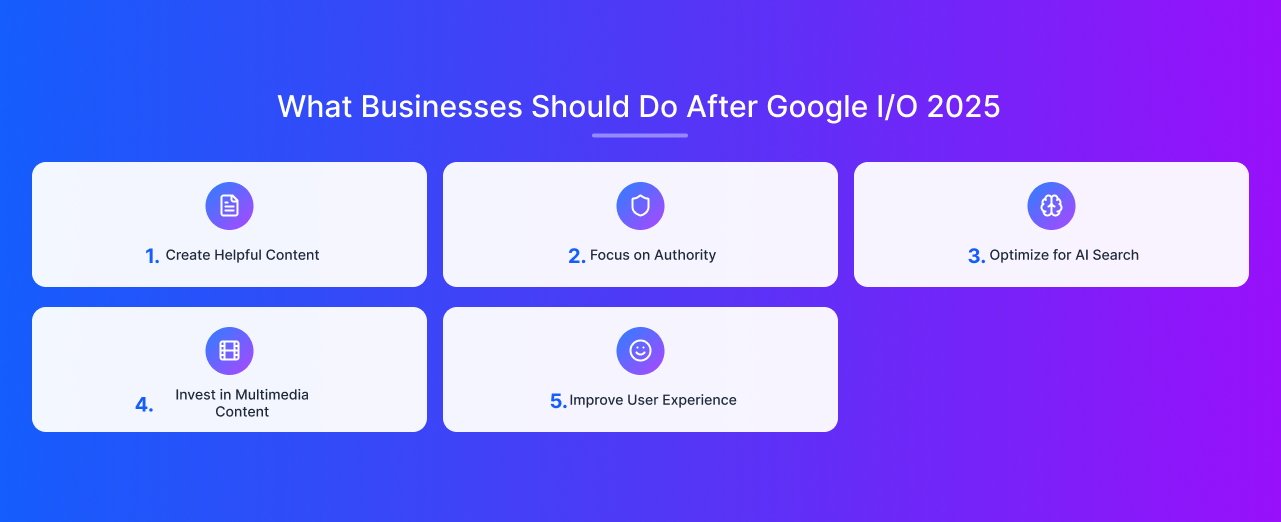
1. Create Helpful Content
Write content that genuinely helps users.
Answer real questions clearly and naturally.
Focus on Authority
Build trust through:
- Expert content
- Reviews
- Backlinks
- Brand mentions
- Social proof
Optimize for AI Search
Use:
- FAQ sections
- Conversational headings
- Structured data
- Topic-focused content
This helps Google understand your content better.
Invest in Multimedia Content
Create:
- Videos
- Visual guides
- Interactive content
- Infographics
AI-powered search is becoming more visual.
Improve User Experience
A fast, user-friendly website is now more important than ever.
Good UX helps both rankings and engagement.
The Future of Search Is AI-First
Google I/O 2025 confirmed that AI is now at the center of Google Search.
Search is becoming:
- More conversational
- More personalized
- More visual
- More intelligent
This does not mean websites will disappear.
It means businesses need to adapt their SEO strategies to work alongside AI-powered search experiences.
The businesses that focus on quality, trust, and user experience will have the biggest advantage moving forward.
Final Thoughts
Google I/O 2025 was a major turning point for the future of SEO and search marketing.
The biggest lesson from Sundar Pichai’s keynote is simple:
Google wants to deliver faster, smarter, and more helpful answers through AI.
For businesses, this means the future of SEO is no longer just about keywords and rankings.
It’s about:
- Building authority
- Creating genuinely useful content
- Improving user experience
- Becoming a trusted source for AI-driven search
Businesses that adapt early to these changes will be in a much stronger position in the future of search.