From replying to customer inquiries to managing projects and generating reports, AI agents can automate many daily business activities. This helps companies save time, reduce costs, and allow employees to focus on more important work.
In this guide, you’ll learn what AI agents are, how they work, their business benefits, real-world use cases, and how your business can start using them.
What Are AI Agents?
An AI agent is an intelligent software system that can understand information, make decisions, and complete tasks automatically.
Unlike traditional automation, which follows fixed rules, AI agents can analyze situations, learn from data, and choose the best action based on the goal they are given.
Think of an AI agent as a digital employee that can work 24/7 without getting tired.
For example, an AI agent can:
- Answer customer emails
- Schedule meetings
- Generate reports
- Update CRM records
- Assign support tickets
- Monitor business performance
- Create invoices
- Manage inventory alerts
Instead of needing multiple people for repetitive tasks, businesses can let AI agents handle these activities automatically.
How AI Agents Work
AI agents usually follow a simple process:
Step 1: Collect Information
The AI agent gathers data from different sources such as:
- CRM software
- ERP systems
- Emails
- Chat applications
- Documents
- Databases
- Websites
Step 2: Analyze the Data
The agent understands the information using AI and machine learning.
For example:
- Is this customer asking for a refund?
- Is this invoice overdue?
- Is stock running low?
- Is this support request urgent?
Step 3: Make a Decision
Based on company rules and business goals, the AI agent decides what action should be taken.
Step 4: Complete the Task
The AI agent performs the required action automatically, such as:
- Sending an email
- Updating software
- Creating a ticket
- Notifying employees
- Scheduling appointments
- Generating reports
The entire workflow happens with little or no human involvement.
Why Businesses Are Using AI Agents
Companies across different industries are adopting AI agents because they improve productivity while reducing manual work.
Some major benefits include:
Save Time
Employees spend hours every week on repetitive tasks.
AI agents complete these tasks within seconds.
Examples include:
- Data entry
- Report generation
- Email responses
- Lead qualification
- Appointment booking
Reduce Human Errors
Manual work often leads to mistakes.
AI agents follow predefined instructions and analyze data consistently, reducing errors in daily operations.
Lower Business Costs
Businesses can automate repetitive work without hiring additional staff.
This reduces operational costs while increasing efficiency.
Work 24/7
Unlike employees, AI agents never need breaks.
They can answer customers, monitor systems, and complete tasks at any time of the day.
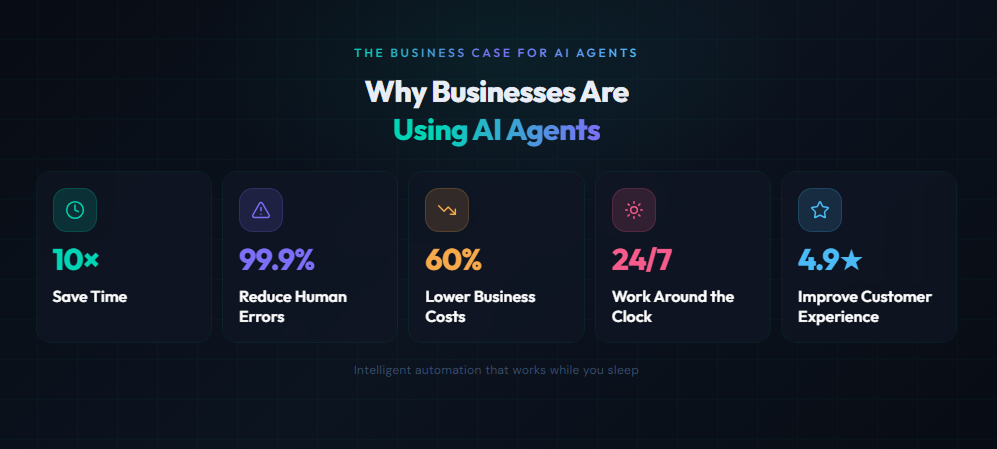
Improve Customer Experience
Customers expect quick responses.
AI agents provide instant replies, faster issue resolution, and personalized support.
Business Workflows That AI Agents Can Automate
Almost every department can benefit from AI automation.
Customer Support
AI agents can:
- Answer common questions
- Create support tickets
- Track complaint status
- Escalate complex issues
- Send follow-up emails
Customers receive faster responses without waiting for business hours.
Sales
Sales teams spend a lot of time on repetitive tasks.
AI agents can:
- Qualify leads
- Schedule meetings
- Send follow-up emails
- Update CRM records
- Generate sales reports
This allows sales representatives to focus on closing deals.
Marketing
Marketing teams can automate:
- Social media posting
- Email campaigns
- Content recommendations
- Customer segmentation
- Campaign performance reports
AI agents help marketers work faster while improving campaign performance.
Human Resources
HR departments can use AI agents for:
- Resume screening
- Interview scheduling
- Employee onboarding
- Leave management
- Internal FAQs
This saves significant administrative time.
Finance
Finance teams can automate:
- Invoice creation
- Payment reminders
- Expense approvals
- Financial reports
- Budget tracking
This improves accuracy and speeds up financial operations.
Inventory Management
AI agents can monitor stock levels and automatically:
- Detect low inventory
- Create purchase requests
- Notify suppliers
- Update inventory systems
This reduces stock shortages and unnecessary over-ordering.
Real-Life Example of AI Workflow Automation
Imagine an online store.
A customer places an order.
Instead of employees manually processing everything, AI agents handle the entire workflow.
The AI agent:
- Receives the order
- Updates inventory
- Generates an invoice
- Sends a confirmation email
- Notifies the warehouse
- Creates a shipping request
- Shares tracking information with the customer
- Updates the CRM
The entire process happens automatically within minutes.
Industries Using AI Agents
AI agents are helping businesses across many industries.
Healthcare
- Appointment scheduling
- Patient support
- Medical record management
- Follow-up reminders
Retail
- Product recommendations
- Inventory tracking
- Customer service
- Order management
Manufacturing
- Production monitoring
- Equipment maintenance alerts
- Quality checks
- Supply chain management
Logistics
- Route optimization
- Shipment tracking
- Delivery updates
- Warehouse automation
Banking and Finance
- Fraud detection
- Customer verification
- Loan processing
- Financial reporting
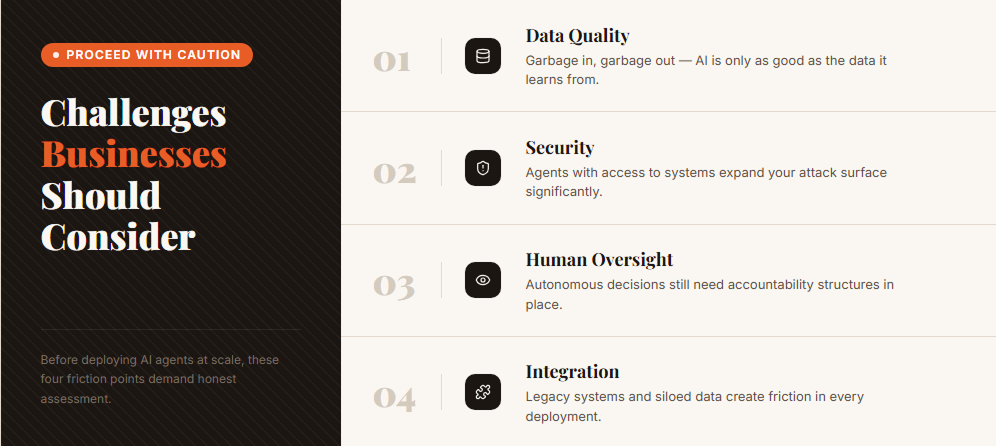
Challenges Businesses Should Consider
Although AI agents offer many advantages, businesses should plan carefully before implementation.
Data Quality
AI works best with clean and accurate data.
Poor-quality data can lead to incorrect decisions.
Security
AI agents often access business systems.
Companies should use proper security measures and control who can access sensitive information.
Human Oversight
AI should support employees, not completely replace them.
Important decisions should still involve human review when necessary.
Integration
AI agents should connect smoothly with existing business software for the best results.
How to Start Using AI Agents
Businesses don’t need to automate everything at once.
A better approach is to begin with simple tasks.
Step 1: Identify repetitive work.
Examples include:
- Email replies
- Report generation
- Customer support
- Data entry
Step 2: Choose the right AI tools.
Select solutions that integrate with your existing software.
Step 3: Test one workflow.
Measure the results before expanding automation.
Step 4: Improve continuously.
Monitor performance and update workflows as business needs change.
The Future of AI Agents
AI agents are becoming smarter every year.
In the near future, businesses will use multiple AI agents working together across departments.
For example:
- A sales agent finds a new lead.
- A marketing agent sends personalized content.
- A finance agent prepares a quotation.
- A customer support agent follows up after the purchase.
These connected AI agents will automate complete business operations with minimal human effort.
Companies that adopt AI early will be better prepared for faster growth, improved efficiency, and stronger customer experiences.
Conclusion
AI agents are no longer just a future technology—they are becoming an essential part of modern businesses. They can automate repetitive tasks, improve productivity, reduce operational costs, and help teams focus on high-value work.
Whether you’re in healthcare, retail, manufacturing, finance, or logistics, AI agents can streamline your business workflows and improve the way your organization operates.
The best way to begin is with one simple process. As you see the results, you can expand automation across your business. Over time, AI agents can become reliable digital teammates that help your company work faster, smarter, and more efficiently.
Frequently Asked Questions (FAQs)
1. What is an AI agent?
An AI agent is intelligent software that can understand information, make decisions, and complete tasks automatically with little or no human intervention.
2. How are AI agents different from traditional automation?
Traditional automation follows fixed rules, while AI agents can analyze data, adapt to different situations, and make decisions based on the information they receive.
3. Can small businesses use AI agents?
Yes. AI agents are available for businesses of all sizes. Small businesses can start by automating simple tasks like customer support, email responses, or appointment scheduling.
4. Which departments benefit the most from AI agents?
Sales, marketing, customer support, HR, finance, operations, and inventory management can all improve efficiency by using AI agents.
5. Will AI agents replace employees?
AI agents are designed to handle repetitive tasks and support employees. They allow teams to spend more time on creative, strategic, and customer-focused work instead of routine activities.