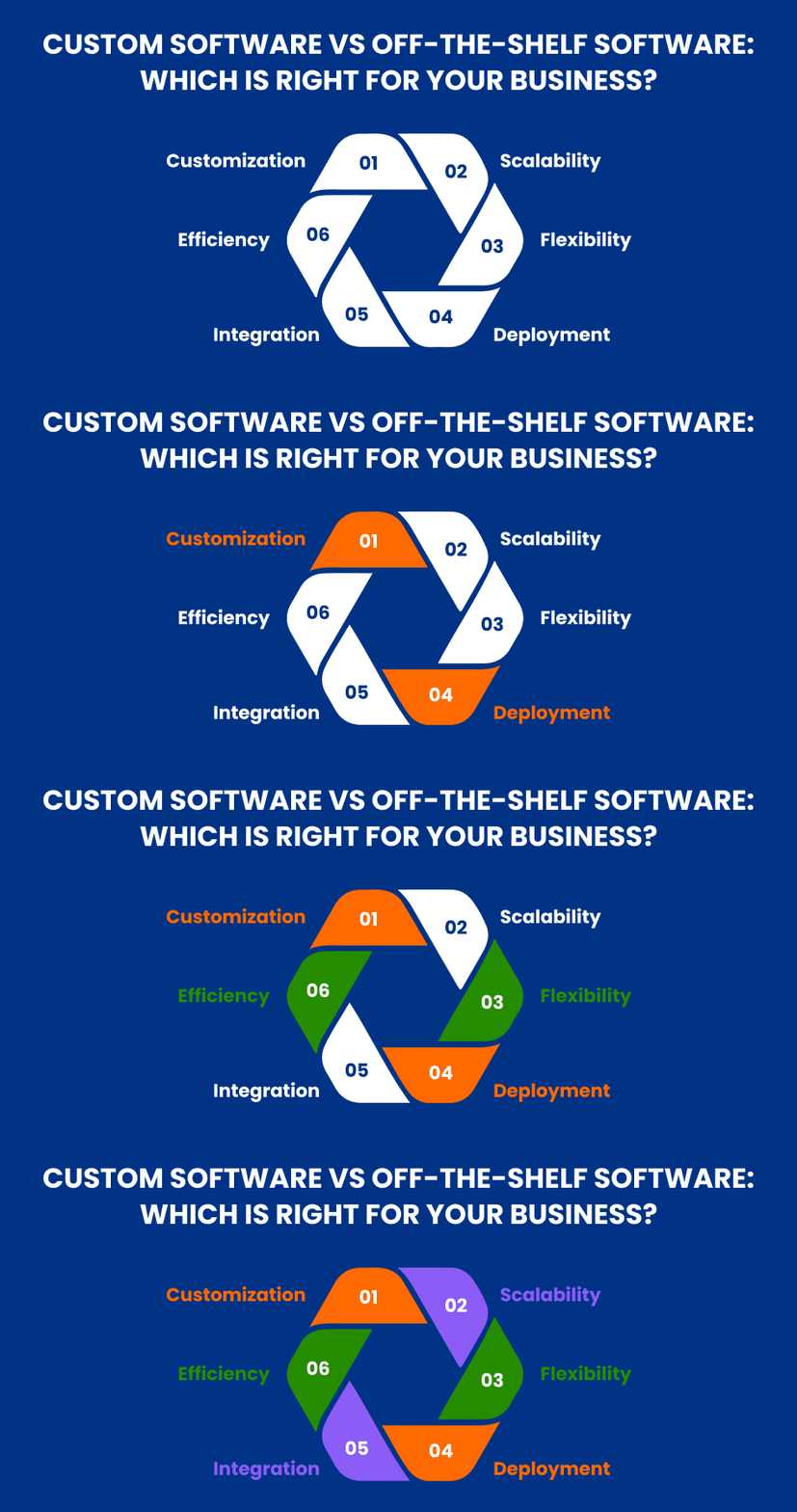
One of the biggest decisions businesses face is choosing between custom software and off-the-shelf software. While both options are designed to solve business challenges, they differ significantly in terms of flexibility, cost, scalability, and long-term value.
Some businesses need a quick, ready-made solution that can be implemented immediately. Others require software built specifically for their unique workflows and business goals.
So, how do you decide which option is right for your business?
In this guide, we’ll compare custom software and off-the-shelf software, explain their advantages and limitations, share real-world examples, and help you make an informed decision.
What Is Custom Software?
Custom software is an application designed and developed specifically for a business or organization. Instead of adapting your processes to fit the software, the software is built around your business needs.
Every feature, workflow, and integration is tailored to your operations, making it a highly personalized solution.
Businesses often choose custom software when they have unique requirements that cannot be addressed by standard software products.
Common Examples of Custom Software
- Customer Relationship Management (CRM) systems
- Enterprise Resource Planning (ERP) solutions
- Inventory management software
- Healthcare management platforms
- Learning Management Systems (LMS)
- Logistics and fleet management software
- Banking and financial applications
Example
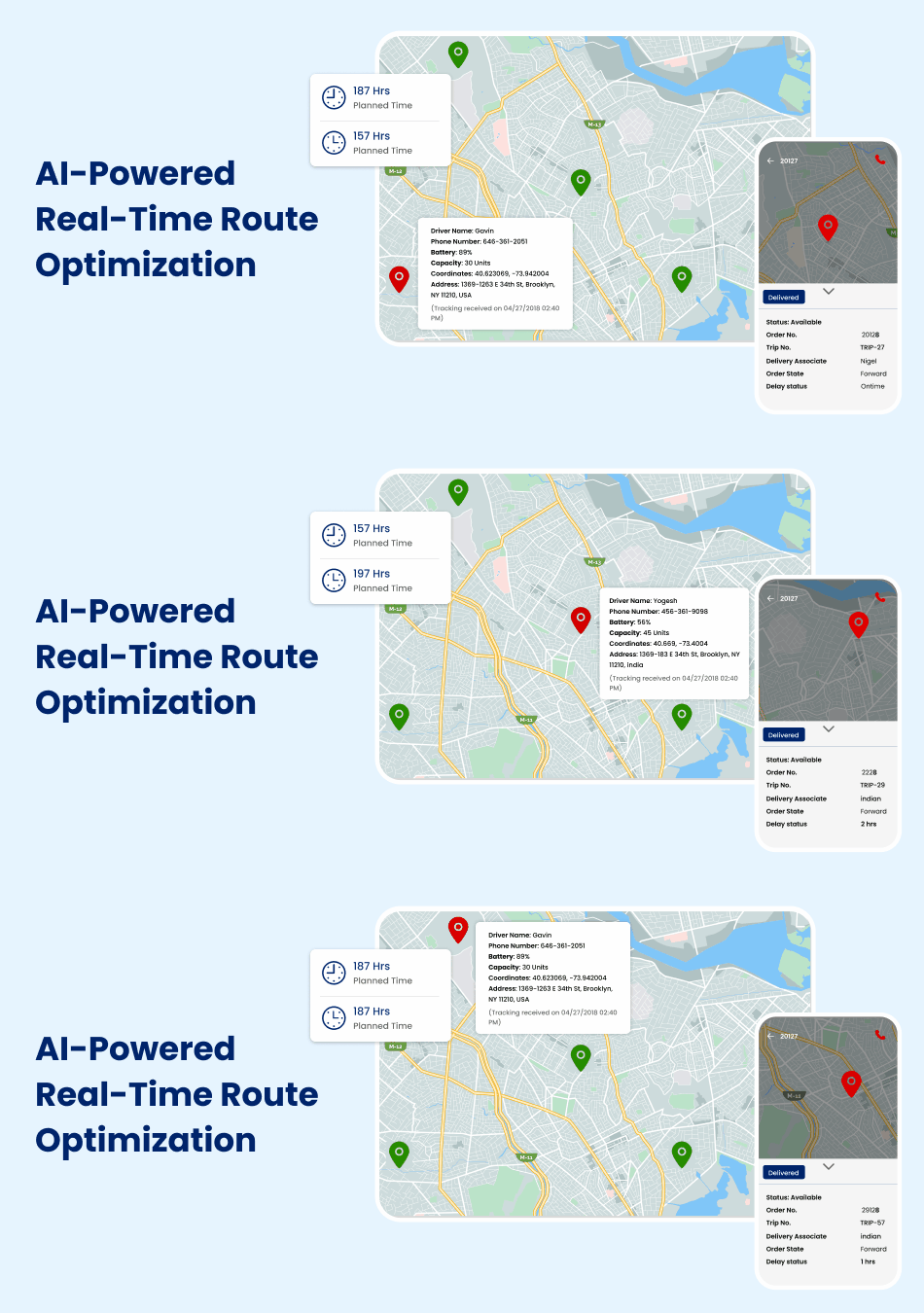
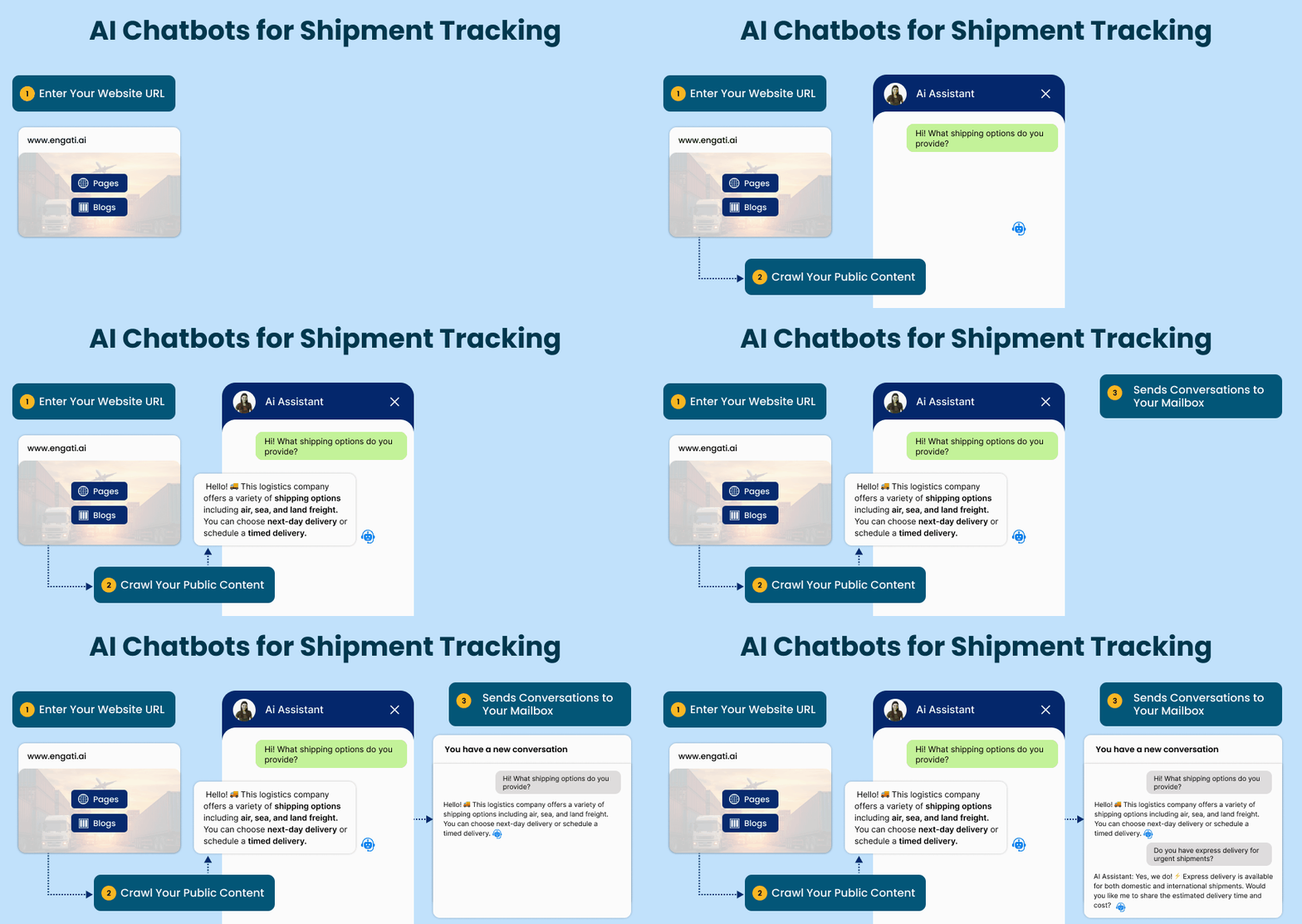
Imagine a logistics company that manages thousands of daily deliveries. It needs software that can optimize delivery routes, track vehicles in real time, calculate fuel costs, and integrate with GPS devices.
A generic logistics platform may provide some of these features, but it may not match the company’s exact workflow. A custom-built solution can address these specific requirements while improving operational efficiency.
What Is Off-the-Shelf Software?
Off-the-shelf software is a ready-made application designed to serve a broad range of businesses and industries.
It comes with predefined features and can usually be purchased through a subscription or one-time license.
Because these solutions are developed for a large audience, businesses can start using them almost immediately without waiting for development.
Popular examples include:
- Microsoft 365
- Slack
- Zoom
- Trello
- Shopify
- QuickBooks
- Salesforce
These applications work well for businesses with common operational requirements.
Example
A small accounting firm needs accounting software to generate invoices, manage expenses, and prepare financial reports.
Instead of building software from scratch, it can implement QuickBooks and start managing finances within a few hours.
Custom Software vs Off-the-Shelf Software: Key Differences
| Feature | Custom Software | Off-the-Shelf Software |
| Development | Built specifically for one business | Developed for a broad audience |
| Customization | Fully customizable | Limited customization |
| Initial Cost | Higher upfront investment | Lower upfront cost |
| Scalability | Highly scalable | Depends on vendor capabilities |
| Ownership | Business owns the software | Vendor owns the software |
| Integration | Easy integration with existing systems | May require third-party tools |
| Maintenance | Managed by development partner | Managed by software vendor |
| Security | Tailored security measures | Standard security for all users |
| Competitive Advantage | High | Limited |
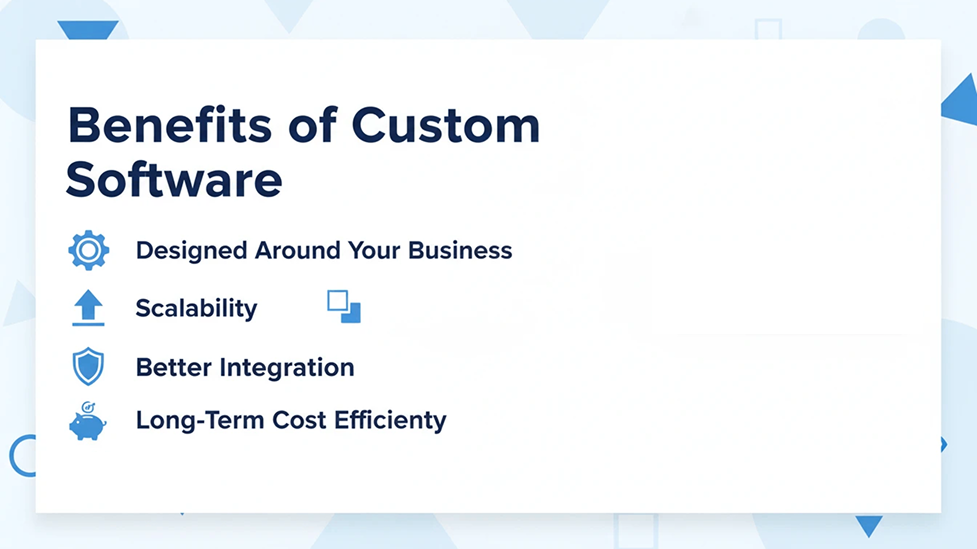
Benefits of Custom Software
Designed Around Your Business
One of the biggest advantages of custom software is that it supports your existing workflows instead of forcing your employees to change how they work.
Every feature is developed with your business objectives in mind.
Example
A manufacturing company may require production scheduling, quality control, warehouse management, and supplier tracking in one platform.
Instead of using multiple disconnected applications, a custom solution brings everything together in a single system.
Scalability
Businesses evolve over time.
You may expand into new markets, launch new services, or hire additional employees.
Custom software grows alongside your business.
New modules and features can be added whenever required without replacing the entire system.
Better Integration
Most businesses already use multiple applications, such as CRM software, accounting tools, payment gateways, HR systems, and cloud storage.
Custom software integrates these systems into one centralized platform, reducing manual work and improving data accuracy.
Example
An eCommerce company integrates its online store, inventory management system, payment gateway, shipping provider, and CRM into one custom dashboard.
Employees no longer switch between multiple applications, saving time and reducing errors.
Enhanced Security
Every business has different security requirements.
A healthcare organization handles sensitive patient information, while a financial institution manages confidential transaction data.
Custom software allows businesses to implement security measures that align with industry regulations and internal policies.
This level of control is often difficult to achieve with generic software products.
Long-Term Cost Efficiency
Although custom software requires a larger initial investment, it can reduce long-term costs.
Businesses avoid paying for unnecessary features, multiple software subscriptions, and expensive third-party integrations.
Over time, a well-designed custom solution often delivers a stronger return on investment.
Benefits of Off-the-Shelf Software
Faster Deployment
Ready-made software can be implemented almost immediately.
Most solutions require only account creation, basic configuration, and employee training.
This makes off-the-shelf software ideal for businesses that need a quick solution.
Lower Initial Investment
Small businesses and startups often have limited budgets.
Off-the-shelf software offers an affordable entry point through monthly or annual subscription plans.
Instead of investing heavily in software development, businesses can begin using professional tools at a predictable cost.
Proven Reliability
Popular software products are used by millions of businesses worldwide.
They undergo regular testing, updates, and improvements based on user feedback.
This reduces the risk associated with newly developed applications.
Vendor Support and Regular Updates
Software vendors continuously release:
- Security patches
- Performance improvements
- Bug fixes
- New features
Businesses benefit from ongoing maintenance without managing software development themselves.
Real-World Comparison
Let’s compare two growing businesses.
Business A: Local Retail Store
The store needs:
- Billing
- Inventory tracking
- Basic accounting
- Employee management
A ready-made retail management solution is affordable, easy to implement, and meets all operational requirements.
For this business, off-the-shelf software is the practical choice.
Business B: Healthcare Technology Company
The company requires:
- Patient management
- Electronic health records
- Insurance integration
- Appointment scheduling
- Video consultations
- Regulatory compliance
- AI-powered reporting
Using multiple generic applications would create data silos and increase administrative work.
A custom software solution can integrate all these functions into a secure platform designed specifically for the healthcare industry.
In this case, custom software provides greater flexibility, efficiency, and long-term value.
Which Option Is More Cost-Effective?
Many businesses assume that off-the-shelf software is always cheaper.
While it has a lower upfront cost, long-term expenses can increase due to:
- Monthly subscription fees
- Additional user licenses
- Third-party integrations
- Feature limitations
- Upgrade costs
Custom software requires a higher initial investment but often delivers better value over time because businesses pay only for the features they need and retain complete ownership of the solution.
The right choice depends on your budget, growth plans, and operational complexity—not just the initial price.
When Should You Choose Custom Software?
Custom software is the right choice when your business has unique processes that standard applications cannot support. It is particularly valuable for organizations that are planning for long-term growth and need technology that can evolve with their changing requirements.
You should consider custom software if:
- Your business has unique workflows or industry-specific requirements.
- You need software that integrates with multiple internal systems.
- Data security and regulatory compliance are top priorities.
- You expect your business to scale significantly in the coming years.
- Existing software requires too many manual workarounds.
- You want complete ownership and control over your application.
Example
A healthcare provider manages patient records, appointment scheduling, insurance claims, billing, and telemedicine services. Using separate software for each function creates inefficiencies and increases the risk of data inconsistencies.
A custom healthcare platform integrates all these processes into one secure system, improving efficiency, reducing administrative work, and delivering a better patient experience.
When Should You Choose Off-the-Shelf Software?
Off-the-shelf software is ideal for businesses with standard operational needs that do not require extensive customization.
It works well when:
- You need a solution quickly.
- Your budget is limited.
- Your requirements are relatively simple.
- You are a startup testing a new business idea.
- You do not require specialized features or complex integrations.
Example
A newly established marketing agency needs project management, video conferencing, file sharing, and accounting software.
Instead of investing in custom development, the agency can use tools like Trello, Zoom, Google Workspace, and QuickBooks to manage daily operations efficiently while keeping costs low.
Common Mistakes Businesses Make
Choosing business software is a strategic decision. Unfortunately, many organizations focus only on the initial price rather than the long-term value.
Here are some common mistakes to avoid:
Choosing Based Only on Cost
The cheapest solution isn’t always the most cost-effective. Subscription fees, add-ons, user licenses, and integration costs can increase significantly over time.
Ignoring Future Growth
A software solution that meets today’s requirements may not support your business as it expands. Consider where your business will be in the next three to five years.
Overlooking Integration Requirements
If your software cannot connect with your CRM, ERP, payment gateway, or other business applications, employees may spend unnecessary time transferring data manually.
Not Involving End Users
Employees who use the software every day should be part of the evaluation process. Their feedback helps identify practical challenges and ensures the solution supports real business needs.
Underestimating Training and Support
Even the best software requires proper onboarding and ongoing support. Choose a solution that offers documentation, training, and reliable technical assistance.
Questions to Ask Before Making Your Decision
Before selecting any software solution, ask yourself the following questions:
- What business problem am I trying to solve?
- Will this software support my business as it grows?
- Can it integrate with my existing systems?
- Does it provide the security and compliance my industry requires?
- What is the total cost of ownership over the next five years?
- Will my team find it easy to use?
- Can the software be customized if my requirements change?
- Do I need complete ownership of the software?
Answering these questions will help you make a decision based on long-term business value rather than short-term convenience.
Custom Software vs Off-the-Shelf Software: A Quick Decision Guide
Choose Custom Software if you:
- Need unique business features.
- Want complete control over functionality.
- Require advanced integrations.
- Plan for long-term business growth.
- Operates in a highly regulated industry.
- Need enterprise-grade security.
Choose Off-the-Shelf Software if you:
- Need software immediately.
- Have a limited budget.
- Have standard business processes.
- Want minimal implementation effort.
- Don’t require extensive customization.
Frequently Asked Questions (FAQs)
What is the main difference between custom software and off-the-shelf software?
Custom software is built specifically for one business and its unique requirements, while off-the-shelf software is designed for a broad audience with standard features.
Is custom software more expensive?
Custom software usually requires a higher upfront investment. However, it often delivers better long-term value by reducing subscription fees, eliminating unnecessary features, and improving operational efficiency.
Which option is better for small businesses?
It depends on the business. Startups and small businesses with standard requirements may benefit from off-the-shelf software. Businesses with unique workflows or growth plans may find custom software to be a better long-term investment.
Can off-the-shelf software be customized?
Many off-the-shelf applications offer limited customization through settings, plugins, or third-party integrations. However, they cannot usually be modified as extensively as custom software.
How long does it take to build custom software?
Development timelines vary based on complexity. Small applications may take a few months, while enterprise-grade platforms with advanced integrations can take longer.
Which option offers better security?
Custom software allows businesses to implement security measures tailored to their specific needs. Off-the-shelf software also provides security, but the features are designed for a broad customer base.
Can I migrate from off-the-shelf software to custom software later?
Yes. Many businesses begin with ready-made software and later transition to a custom solution as their operations grow and their requirements become more complex.
How do I know which solution is right for my business?
Evaluate your budget, business processes, scalability requirements, security needs, and long-term goals. If your software needs are unique and expected to evolve, custom software is often the better choice.
Why Partner with KIS Works?
At KIS Works, we help businesses transform ideas into powerful digital solutions. Whether you need a fully customized enterprise application or expert guidance in selecting the right software for your organization, our experienced development team is here to help.
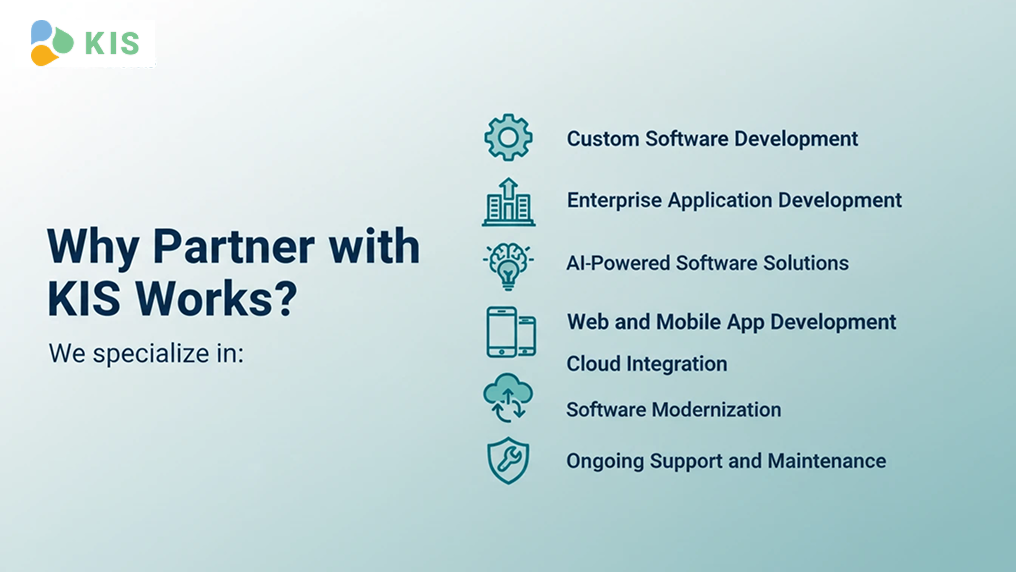
Our goal is to build secure, scalable, and high-performing software that aligns with your business objectives and delivers measurable results.
Final Thoughts
There is no one-size-fits-all answer when it comes to choosing between custom software and off-the-shelf software. The right decision depends on your business objectives, operational complexity, budget, and future growth plans.
If your requirements are straightforward and you need a quick solution, off-the-shelf software can help you get started with minimal investment. However, if your business relies on unique workflows, requires seamless integrations, or plans to scale over time, custom software offers greater flexibility, control, and long-term value.
Rather than focusing solely on the initial cost, consider the total value the software will deliver over its lifetime. Investing in the right solution today can improve productivity, reduce operational challenges, and create a stronger foundation for future growth.
Ready to Build Software That Fits Your Business?
If you’re evaluating custom software or looking to modernize your existing systems, KIS Works can help you make the right technology investment.