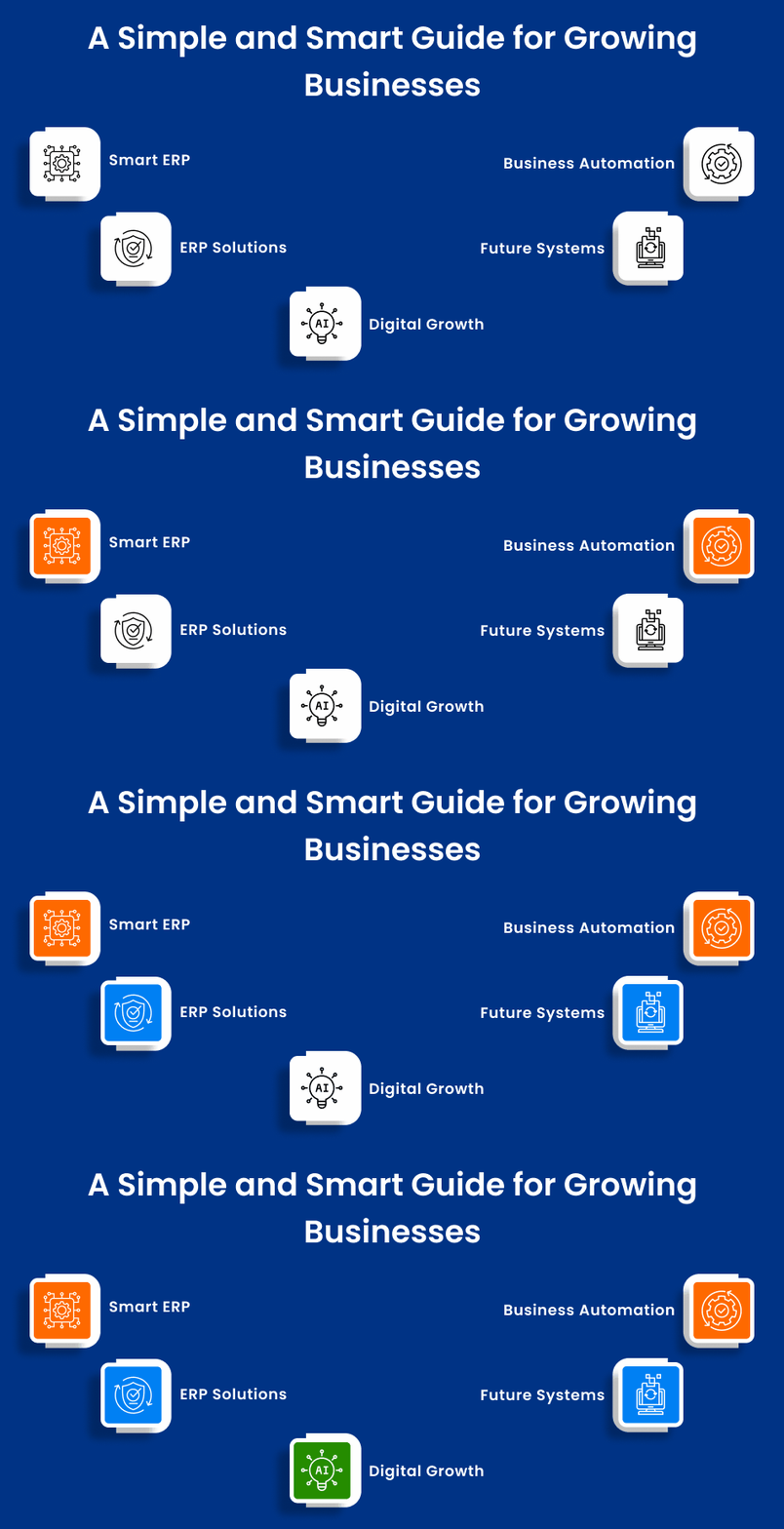
That is where ERP systems come in.
An ERP system helps businesses manage everything from sales and inventory to finance, HR, customer support, and reporting in one place. Instead of using different tools for different departments, businesses can connect all operations through a single platform.
For growing businesses, ERP is no longer just a large enterprise solution. It has become a practical and smart investment for companies that want better control, higher productivity, and faster growth.
In this guide, we will explain ERP systems in simple language, how they work, their benefits, trends in 2026, and how businesses can choose the right ERP solution.
What is an ERP System?
ERP stands for Enterprise Resource Planning.
An ERP system is software that helps businesses manage daily operations from one centralized platform. It connects different departments so information flows smoothly across the organization.
For example, when a sales order is placed:
- The inventory updates automatically
- The finance team gets billing details
- The warehouse receives shipment instructions
- Management can track revenue in real time
Without ERP, teams often work separately using spreadsheets, emails, or disconnected software. This creates delays, errors, and confusion.
ERP solves this problem by bringing everything together.
Why ERP Systems Matter More in 2026
Businesses in 2026 are facing new challenges:
- Rising operational costs
- Faster customer expectations
- Remote and hybrid work environments
- Data security concerns
- Need for automation
- Real time business insights
Traditional business management methods are no longer enough.
ERP systems help companies stay organized, improve efficiency, and make smarter decisions using real time data.
Today, even small and medium businesses are adopting ERP platforms to compete with larger companies.
Key Features of Modern ERP Systems
ERP platforms in 2026 are smarter, faster, and more user friendly than older systems.
Here are the most important features businesses look for today.
Finance and Accounting Management
ERP systems help businesses manage:
- Invoices
- Expenses
- Tax calculations
- Financial reports
- Payroll
- Cash flow tracking
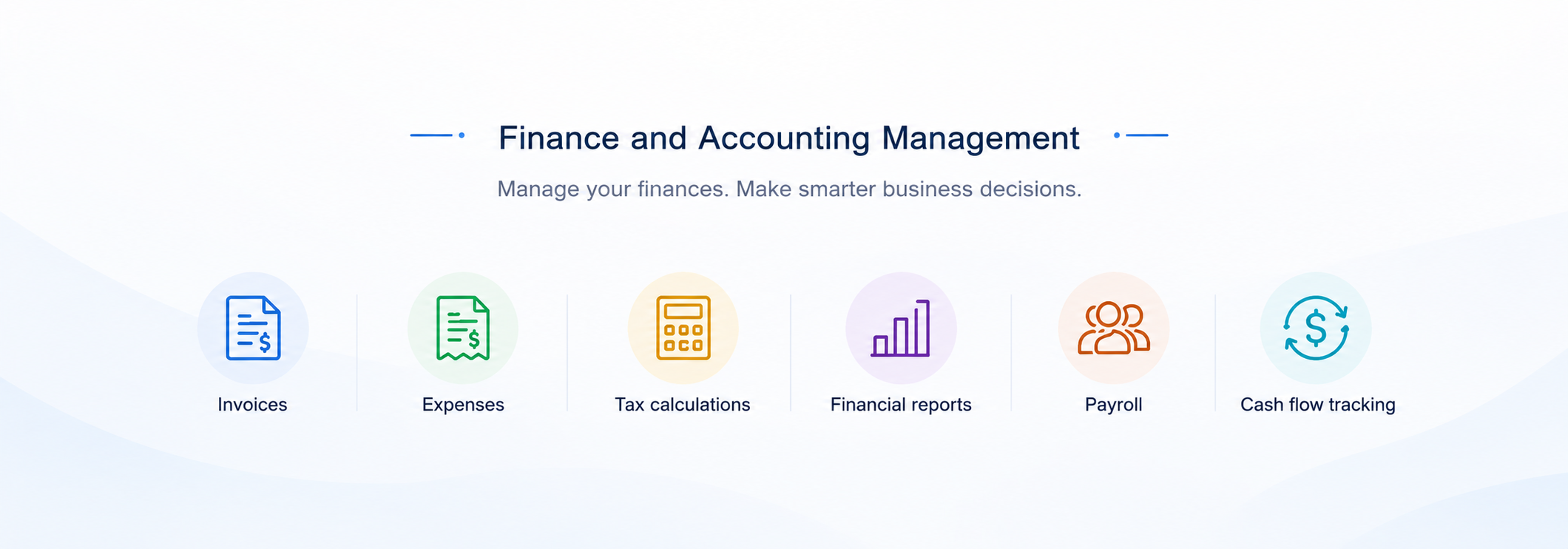
This reduces manual accounting work and improves accuracy.
Inventory Management
Businesses can track stock levels in real time.
ERP systems help avoid:
- Overstocking
- Product shortages
- Inventory mismatches
This is especially useful for ecommerce, retail, manufacturing, and logistics companies.
Human Resource Management
Modern ERP systems include HR tools for:
- Employee attendance
- Payroll processing
- Recruitment
- Performance tracking
- Leave management
Everything stays organized in one system.
Customer Relationship Management
Many ERP platforms now include CRM features that help businesses manage:
- Leads
- Sales pipelines
- Customer communication
- Support tickets
- Marketing activities
This improves customer experience and sales performance.
Real Time Reporting and Analytics
One of the biggest advantages of ERP is data visibility.
Business owners can instantly see:
- Sales reports
- Revenue trends
- Operational performance
- Employee productivity
- Inventory status
This helps companies make faster and smarter decisions.
Top ERP Trends in 2026
ERP technology is evolving rapidly. Here are the biggest trends businesses are following in 2026.
AI Powered ERP Systems
Artificial Intelligence is becoming a major part of ERP software.
AI can help businesses:
- Predict inventory demand
- Automate repetitive tasks
- Generate reports automatically
- Detect unusual financial activity
- Improve customer support
AI driven ERP systems save time and improve efficiency.
Cloud Based ERP Solutions
More businesses are moving to cloud ERP systems because they offer:
- Remote access
- Lower infrastructure costs
- Better scalability
- Automatic updates
- Improved data security
Cloud ERP is especially useful for businesses with remote teams or multiple locations.
Mobile Friendly ERP Platforms
Business owners and employees now expect access from mobile devices.
Modern ERP systems allow teams to:
- Approve invoices
- Check reports
- Manage inventory
- Track sales
directly from smartphones or tablets.
Industry Specific ERP Software
ERP vendors are now building solutions for specific industries such as:
- Healthcare
- Retail
- Manufacturing
- Construction
- Education
- Logistics
Industry focused ERP systems are easier to implement because they already include specialized features.
Benefits of ERP Systems for Growing Businesses
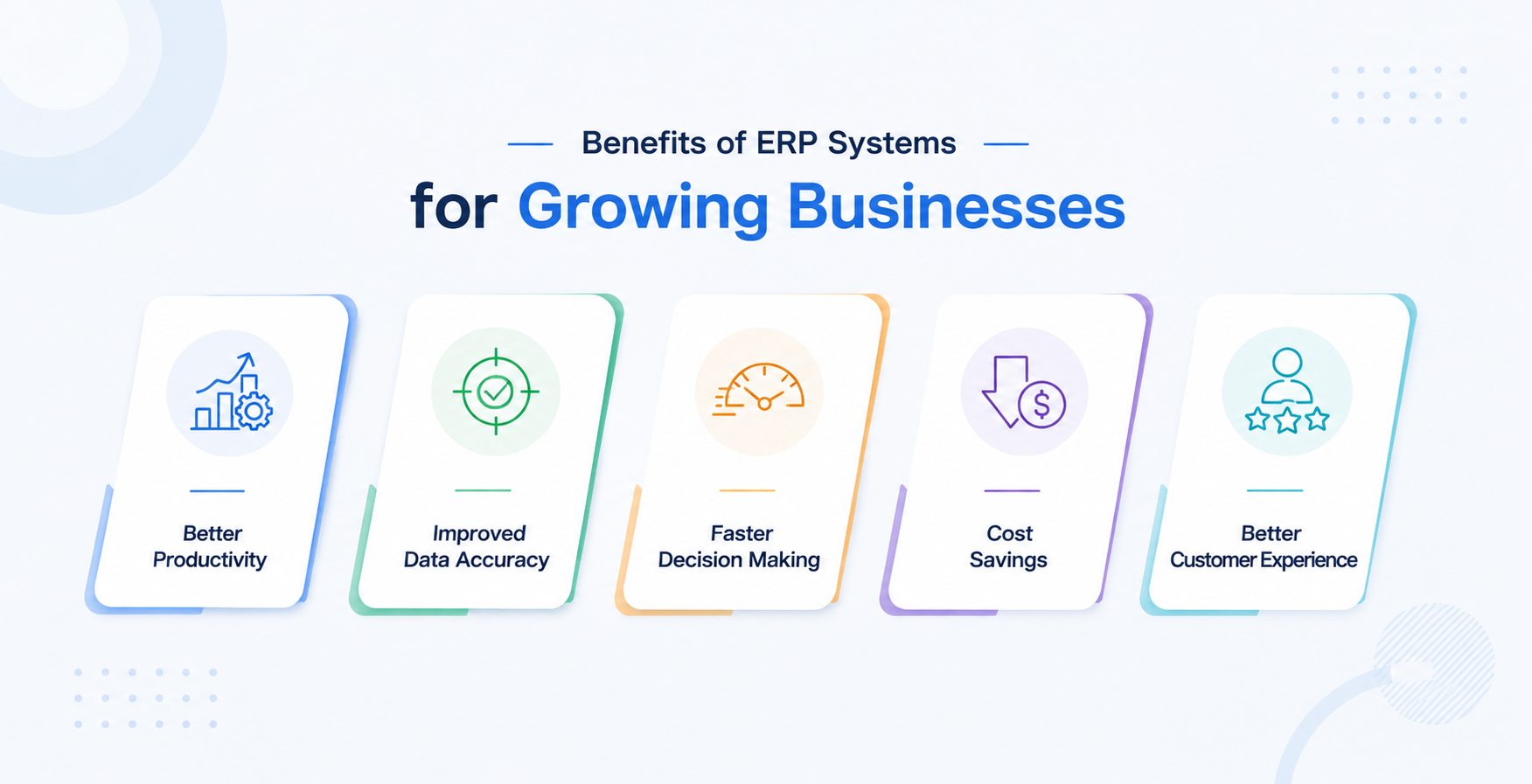
ERP systems are not just about software. They directly improve business performance.
Better Productivity
Employees spend less time on repetitive manual work.
Automation helps teams focus on important business tasks instead of data entry.
Improved Data Accuracy
Since all departments use the same system, data duplication and errors are reduced.
Everyone works with accurate and updated information.
Faster Decision Making
Real time dashboards and analytics help business owners make informed decisions quickly.
This improves business planning and growth strategies.
Cost Savings
ERP systems reduce operational inefficiencies.
Businesses can save money by improving:
- Inventory management
- Workforce productivity
- Financial tracking
- Process automation
Better Customer Experience
When teams have access to customer data and order history, they can provide faster and more personalized support.
Happy customers are more likely to stay loyal to a business.
Challenges Businesses Face During ERP Implementation
ERP implementation can be highly beneficial, but businesses may also face challenges if planning is poor.
High Initial Investment
Some ERP systems require significant setup costs, especially for custom development.
However, cloud ERP options have made implementation more affordable for smaller businesses.
Employee Resistance
Teams may hesitate to switch from old systems to new software.
Proper training and support are important for smooth adoption.
Data Migration Issues
Moving data from old systems to ERP platforms can be complex.
Businesses should ensure proper backup, testing, and validation before migration.
Customization Complexity
Every business has different workflows.
Choosing an ERP system that allows flexible customization is important for long term success.
How to Choose the Right ERP System in 2026
Selecting the right ERP platform is one of the most important business decisions.
Here are a few things businesses should consider.
Understand Your Business Needs
Before choosing software, identify:
- Current business challenges
- Departments needing automation
- Future growth plans
- Budget requirements
This helps narrow down the right solution.
Choose Scalable Software
Your ERP system should grow with your business.
Avoid software that only supports your current size.
Check Integration Capabilities
Modern businesses use many tools like ecommerce platforms, payment gateways, CRM systems, and marketing software.
Your ERP should integrate easily with existing systems.
Prioritize User Experience
Complicated software reduces employee adoption.
Choose ERP systems with clean dashboards and easy navigation.
Evaluate Vendor Support
Reliable technical support is critical.
Choose a vendor that offers:
- Training
- Maintenance
- Security updates
- Customer support
Industries That Benefit Most from ERP Systems
Almost every industry can benefit from ERP software, but some industries see faster results.
Manufacturing
ERP helps manufacturers manage:
- Production planning
- Raw materials
- Inventory
- Supply chains
Ecommerce and Retail
Retail businesses use ERP for:
- Inventory management
- Order processing
- Customer tracking
- Multi channel sales
Healthcare
Healthcare organizations use ERP systems for:
- Patient records
- Staff management
- Billing
- Compliance tracking
Logistics and Supply Chain
ERP platforms improve shipment tracking, warehouse management, and delivery planning.
Future of ERP Systems Beyond 2026
ERP technology will continue evolving with AI, automation, machine learning, and predictive analytics.
In the future, ERP systems may offer:
- Voice controlled dashboards
- Advanced AI business forecasting
- Hyper automation
- Smarter customer insights
- Deeper cloud integration
Businesses that adopt modern ERP solutions early will likely gain a competitive advantage.
Final Thoughts
ERP systems in 2026 are no longer complicated tools only for large corporations.
They have become essential business solutions for companies that want to improve efficiency, automate operations, and scale faster.
Whether you run a startup, retail store, manufacturing company, or growing enterprise, the right ERP system can simplify operations and help your business grow with confidence.
The key is choosing an ERP solution that matches your business goals, supports future growth, and provides a smooth user experience.
As businesses continue moving toward digital transformation, ERP systems will remain one of the smartest investments for long term success.