Introduction
Search has changed dramatically.
What used to be a list of blue links has evolved into something far more intelligent. Today, Google AI Overviews sit at the top of search results, delivering AI-generated summaries that combine information from multiple trusted websites.
Instead of clicking several results, users can now get answers instantly.
For SEO professionals and businesses, this shift is massive.
Ranking #1 is no longer the only goal. The real opportunity now is getting your content cited inside Google AI Overviews.
If Google’s AI trusts your content enough to include it in these summaries, your brand gains top-of-page visibility, authority, and credibility — even before users click a result.
In this guide, you’ll learn proven strategies to optimize your content for Google AI Overviews, improve search visibility, and future-proof your SEO strategy.
What Are Google AI Overviews?
Google AI Overviews are AI-generated summaries displayed at the top of search results. They combine information from multiple high-quality sources to answer user queries quickly.
These summaries are powered by Google’s Gemini AI model and typically appear for informational, conversational, or multi-intent queries.
Key Characteristics
- Appear at the top of the search results page (SERP)
- Combine information from multiple trusted sources
- Provide inline citations linking to websites
- Focus on clear, helpful answers
- Frequently appear for question-based searches
Industry data suggests AI Overviews now appear in more than 25% of search queries, and that number continues to grow.
This creates a new SEO goal:
Instead of just ranking on Google, aim to be cited in Google AI Overviews.
Why Google AI Overviews Matter for SEO
AI Overviews are reshaping how users interact with search results.
Here’s how they differ from traditional featured snippets:
| Feature | Featured Snippets | AI Overviews |
| Sources | Usually one source | Multiple sources |
| Query type | Simple questions | Complex or conversational queries |
| Content format | Short extract | AI-generated summary |
| Citations | Single link | Multiple inline links |
This creates a major opportunity.
Unlike featured snippets where only one website wins, AI Overviews allow multiple authoritative websites to appear in the same answer.
That means more brands can gain visibility — if their content is optimized correctly.
Build Strong E-E-A-T Signals
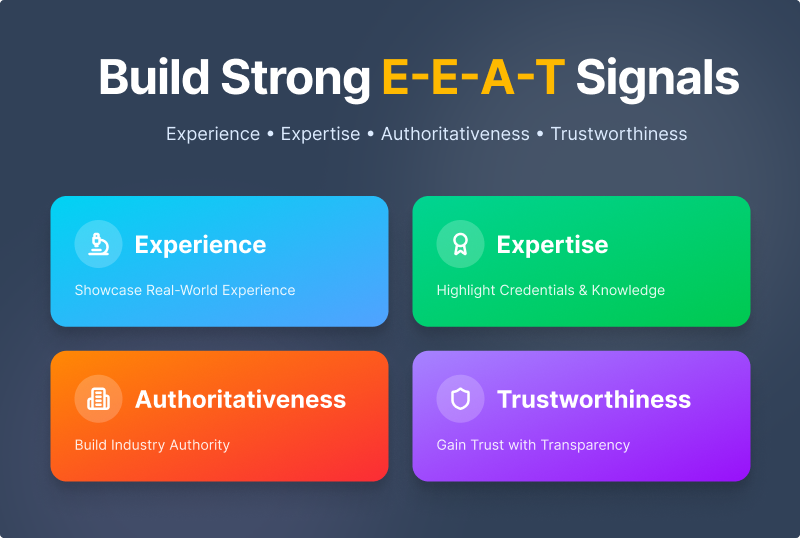
One of the most important ranking factors for AI Overviews is E-E-A-T.
E-E-A-T stands for:
- Experience
- Expertise
- Authoritativeness
- Trustworthiness
Google uses these signals to evaluate whether your content is credible enough to be cited in AI-generated results.
How to Strengthen E-E-A-T
Show real experience
Include:
- Case studies
- Real SEO results
- Data from projects
- First-hand insights
Demonstrate expertise
Your content should include:
- Industry terminology
- Deep explanations
- Strategic insights
Build authority
Authority grows through:
- High-quality backlinks
- Mentions from trusted websites
- Consistent publishing on a specific topic
Increase trust signals
Make sure your website includes:
- HTTPS security
- Clear About page
- Author profiles
- Contact information
- Editorial guidelines
Pro Tip
Add Author Schema (schema.org/Person) to every blog article and connect it to:
- Professional profiles
- Industry publications
This helps Google understand who wrote the content and why they are qualified.
Optimize for Conversational Search Queries
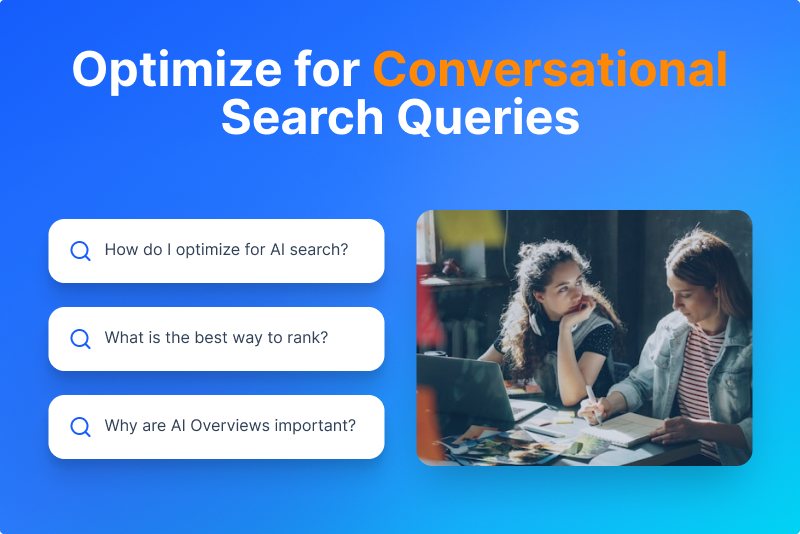
Most AI Overviews are triggered by natural language queries.
Examples include:
- “How do I optimize content for AI search?”
- “What is the best way to rank in AI Overviews?”
- “Why are Google AI Overviews important for SEO?”
Short keyword phrases rarely trigger AI Overviews.
This means modern SEO should focus on questions instead of keywords.
How to Find Conversational Queries
Use:
- Google People Also Ask
- Google Autocomplete suggestions
- Google Related Searches
- SEO tools like Semrush or Ahrefs
Content Optimization Tip
Structure content like this:
Question (Heading)
Direct answer in 1–2 sentences
Detailed explanation afterward.
This structure is ideal for:
- AI Overviews
- Featured snippets
- Voice search
Use Structured Data and Schema Markup
Structured data helps search engines understand your content more clearly.
Schema markup provides a machine-readable structure that improves how Google interprets your page.
Most Important Schema Types
FAQ Schema
One of the most powerful schema types for AI Overview optimization.
HowTo Schema
Perfect for step-by-step guides.
Article Schema
Supports:
- Author signals
- Publish dates
- Updated dates
Person Schema
Strengthens author credibility.
Breadcrumb Schema
Helps Google understand site structure.
Best Practice
Always validate your schema using:
- Google Rich Results Test
- Schema Markup Validator
Even small syntax errors can prevent Google from reading your structured data.
Build Topical Authority
Google prefers websites that cover a topic deeply, not just a single article.
The best strategy for this is the Pillar and Cluster content model.
How It Works
Create a pillar page covering a broad topic.
Example:
Pillar Topic
AI SEO Strategy
Then create supporting cluster articles such as:
- AI Overviews SEO Guide
- Entity SEO Explained
- Passage Ranking Optimization
- Schema Markup for SEO
- AI Search Ranking Factors
Each article links back to the pillar page.
Benefits
- Stronger topical authority
- Better internal linking
- Higher rankings
- Increased AI Overview citations
Websites that consistently publish related content become trusted knowledge hubs.
Optimize for Passage Ranking
Google can rank individual sections of your content, not just the entire page.
This technology is called Passage Ranking.
AI Overviews often pull specific paragraphs from articles, not entire pages.
How to Optimize for Passage Ranking
Write self-contained sections
Each section should make sense on its own.
Answer first
Provide the direct answer in the first 1–2 sentences.
Use clear headings
Match headings with search queries.
Example:
H2: How to Build Topical Authority for SEO
Use bullet points and lists
Structured content is easier for AI systems to analyze.
Keep Your Content Fresh
Fresh content is more likely to appear in AI Overviews.
Google prioritizes updated information for topics that evolve quickly.
Content Freshness Best Practices
- Audit content every 3–6 months
- Update outdated statistics
- Add new examples and insights
- Update your Last Updated date
- Expand older articles with new sections
Google rewards meaningful updates, not just minor edits.
Understand Zero-Click Searches
AI Overviews increase zero-click searches, where users get answers without visiting a website.
This can reduce direct traffic.
However, being cited still provides value.
Benefits of AI Overview Citations
- Increased brand visibility
- Stronger industry authority
- Higher brand recognition
- More branded searches
Think of AI Overviews as top-of-funnel visibility, not just traffic opportunities.
Optimize for Entity-Based SEO
Google’s Knowledge Graph connects entities such as brands, people, and topics.
AI systems rely heavily on this knowledge base.
Entity SEO Optimization Tips
- Create Wikidata entry for your company
- Use sameAs schema to connect social profiles
- Maintain consistent >NAP information
- Publish consistent content about your core topic
- Earn mentions from trusted websites
Over time, Google begins associating your brand with specific topics.
Track AI Overview Performance
AI search results change frequently.
To stay competitive, you must monitor your performance regularly.
Metrics to Track
AI Overview appearance
Monitor whether your content appears in AI summaries.
Click-through rate (CTR)
Lower CTR can indicate AI answers replacing clicks.
Impressions vs clicks
High impressions but low clicks may indicate AI Overview exposure.
Featured snippet ownership
Pages with featured snippets often appear in AI Overviews.
Conclusion: The Future of SEO Is AI-First
Optimizing for Google AI Overviews is not a temporary tactic — it represents the next evolution of search engine optimization.
The core principle remains the same:
Create helpful, authoritative content for real people.
However, modern SEO requires stronger signals that help AI systems understand and trust your content.
By focusing on:
- E-E-A-T signals
- Conversational queries
- Structured data
- Topical authority
- Passage optimization
- Content freshness
- Entity SEO
you can position your content to earn consistent visibility in AI-driven search results.
The future of SEO belongs to creators who think beyond keywords and focus on topics, expertise, and real authority.