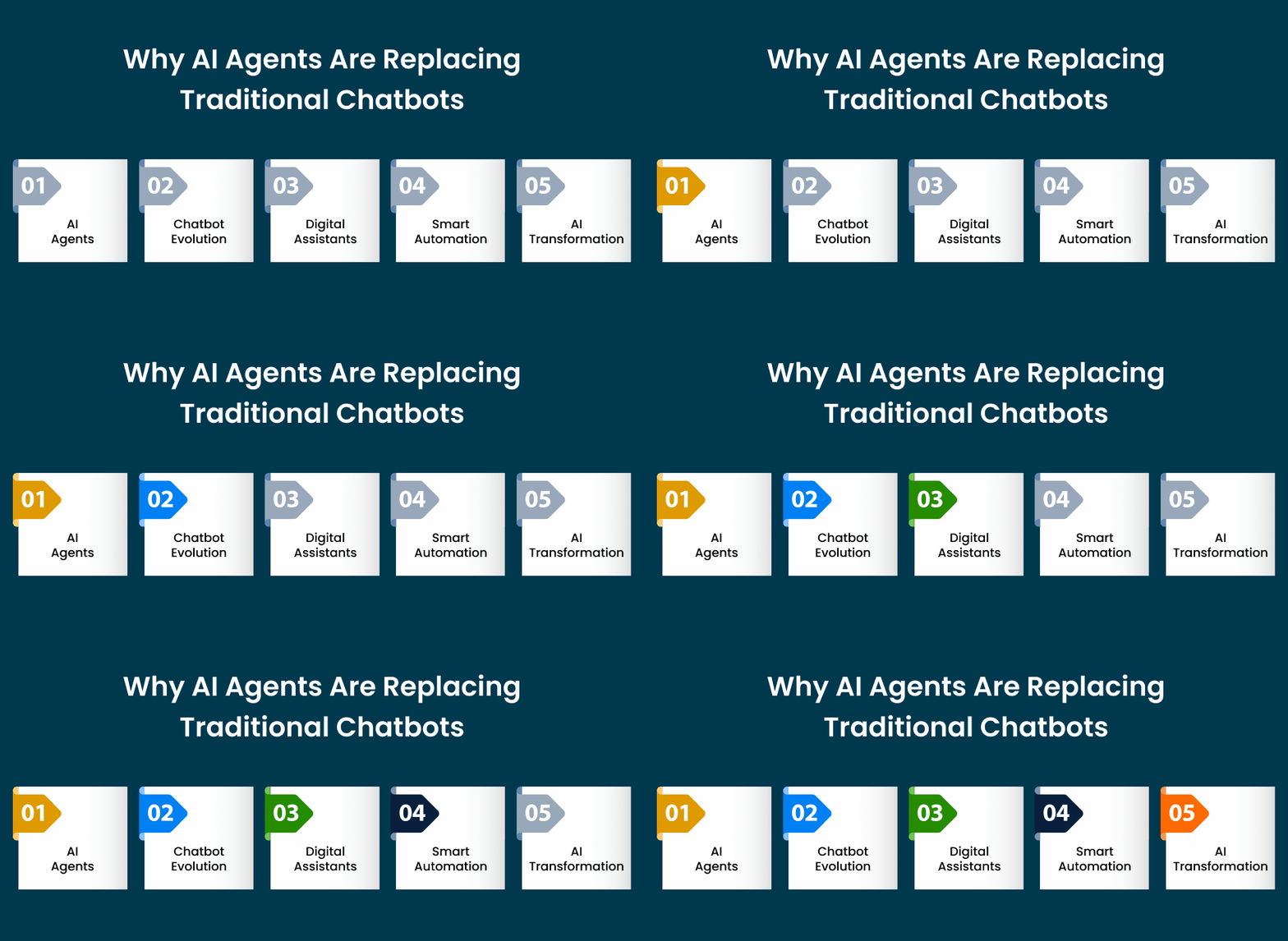
In 2026, the focus has shifted from conversation to execution.
AI agents are emerging as the next evolution of intelligent automation. They do more than respond — they reason, plan, integrate with systems, and take action. As organizations aim for greater efficiency, scalability, and smarter operations, AI agents are steadily replacing traditional chatbots.
This shift is not just technological. It is strategic.
The Rise and Limitations of Traditional Chatbots
Traditional chatbots were designed to simulate human conversations. Early versions were rule-based, following decision trees and predefined scripts. Even advanced AI chatbots focused primarily on understanding queries and generating responses.
They worked well for:
- Answering frequently asked questions
- Booking appointments
- Providing order updates
- Handling simple customer support queries
- Collecting user information
However, they struggled with:
- Complex problem-solving
- Multi-step task execution
- Context retention across sessions
- Deep personalization
- Integration with multiple enterprise systems
A chatbot could guide a user to complete a process.
It could not complete the process itself.
As digital ecosystems grew more complex, these limitations became a barrier to scalability.
What Are AI Agents?
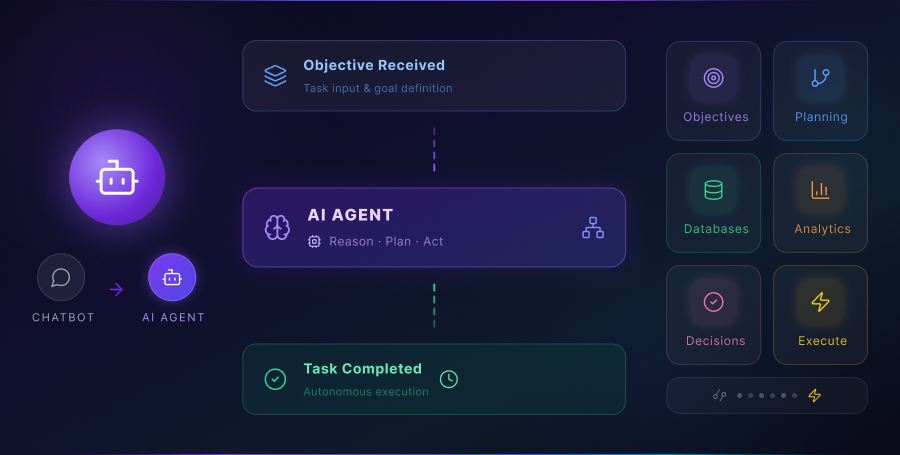
AI agents are autonomous systems powered by advanced AI models, reasoning frameworks, and workflow automation capabilities. Unlike chatbots, AI agents are goal-oriented.
They can:
- Understand objectives
- Break down tasks into actionable steps
- Access databases and external software
- Analyze real-time information
- Make decisions based on data
- Execute actions independently
In simple terms:
Chatbots communicate.
AI agents accomplish.
For example, if a customer requests a subscription cancellation:
- A chatbot may provide cancellation instructions.
- An AI agent can verify the account, check billing status, process the cancellation, update records, and send confirmation — automatically.
This is the fundamental difference.
From Reactive Support to Proactive Intelligence
Chatbots operate reactively. They wait for user input before responding.
AI agents operate proactively.
They can monitor systems, identify patterns, detect risks, and initiate actions without human prompts.
Examples include:
- A manufacturing AI agent predicting machine failure and scheduling maintenance.
- A supply chain agent forecasting inventory shortages and placing orders.
- A finance agent identifying irregular transactions before fraud occurs.
- A marketing agent adjusting campaigns based on real-time performance metrics.
This proactive behavior shifts AI from a support function to a strategic asset.
Context Awareness and Long-Term Memory
One major weakness of traditional chatbots is limited contextual awareness. Conversations often reset, and personalization remains surface-level.
AI agents maintain contextual memory across sessions and workflows. They learn from historical data and interactions.
This enables:
- Personalized customer experiences
- Ongoing task management
- Predictive recommendations
- Intelligent follow-ups
- Continuous process optimization
Instead of handling isolated queries, AI agents manage end-to-end processes.
Seamless Integration with Enterprise Systems
Modern businesses operate through interconnected systems — CRM, ERP, HR software, marketing automation platforms, financial tools, and analytics dashboards.
Traditional chatbots often sit at the front end of a website or app.
AI agents integrate deeply with backend systems.
They can:
- Retrieve customer insights from CRM platforms
- Update ERP records
- Generate invoices
- Trigger automated workflows
- Interact with APIs across departments
This connectivity transforms AI into an operational engine rather than a conversational tool.
The outcome:
- Reduced manual workload
- Faster execution
- Improved data accuracy
- Greater operational efficiency
Multi-Step Reasoning and Autonomous Execution
Traditional chatbots rely on predefined conversation paths.
AI agents use dynamic reasoning.
They can:
- Interpret complex goals
- Plan multiple steps
- Execute tasks sequentially
- Adjust based on results
- Deliver outcomes
For example, if leadership requests a quarterly performance summary, an AI agent can:
- Extract relevant data
- Analyze performance metrics
- Compare historical trends
- Identify improvement opportunities
- Generate reports
- Share insights with stakeholders
All without manual coordination.
This level of automation directly impacts productivity and decision-making speed.
Stronger ROI and Business Impact
Businesses today demand measurable results from technology investments.
AI agents provide value by:
- Reducing operational costs
- Automating repetitive processes
- Increasing processing speed
- Improving decision accuracy
- Scaling without proportional staffing increases
Instead of expanding teams for repetitive tasks, organizations deploy AI agents that operate 24/7.
This shift allows human teams to focus on strategic, creative, and high-value initiatives.
Industry Applications Driving the Shift
AI agents are replacing traditional chatbots across industries:
Manufacturing
- Predictive maintenance
- Automated production planning
- Intelligent supply chain optimization
Healthcare
- Patient workflow coordination
- Claims automation
- Data-driven clinical insights
Finance
- Risk monitoring
- Automated compliance
- Fraud detection
E-commerce
- Dynamic pricing
- Inventory forecasting
- Personalized product recommendations
Across sectors, AI agents are moving businesses from conversation-based automation to outcome-based automation.
Chatbots vs AI Agents: The Core Difference
| Feature | Traditional Chatbots | AI Agents |
| Purpose | Conversation | Goal Execution |
| Context | Limited | Persistent & Intelligent |
| Integration | Minimal | Deep System Integration |
| Reasoning | Scripted Flows | Multi-Step Planning |
| Autonomy | Reactive | Proactive & Autonomous |
The difference is strategic, not incremental.
Are Chatbots Becoming Obsolete?
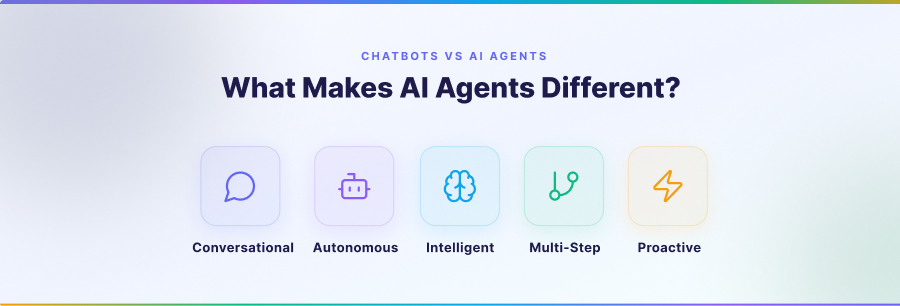
Chat interfaces will continue to play a role in user interaction. However, they are evolving into just one component of a broader AI architecture.
The future model looks like this:
User Interface (Chat or Voice)
→ AI Agent
→ Business Systems
→ Automated Execution
Chat initiates the request.
AI agents deliver the result.
Final Thoughts
The evolution from traditional chatbots to AI agents represents a fundamental transformation in enterprise AI adoption.
Chatbots improved communication.
AI agents improve outcomes.
They bring autonomy, integration, intelligence, and measurable impact.
As businesses compete in a fast-moving digital landscape, those who embrace AI agents will gain efficiency, resilience, and strategic advantage.
The era of scripted responses is fading.
The era of intelligent execution has begun.
Frequently Asked Questions (FAQs)
1. What is the main difference between a chatbot and an AI agent?
A chatbot focuses on responding to user queries through conversation. An AI agent goes beyond conversation — it understands goals, integrates with systems, and executes tasks autonomously.
Are AI agents more expensive than chatbots?
Initially, AI agents may require higher implementation investment due to system integration and workflow automation. However, they typically deliver stronger long-term ROI by reducing operational costs and increasing efficiency.
Can AI agents work without human supervision?
AI agents can operate autonomously for many tasks, but strategic oversight is recommended. Human supervision ensures governance, compliance, and performance optimization.
Do AI agents replace human employees?
AI agents automate repetitive and operational tasks. They are designed to augment human teams, allowing employees to focus on strategic, creative, and high-value responsibilities.
Are chatbots still relevant in 2026?
Yes, chatbots remain relevant as user interaction interfaces. However, they are increasingly being combined with AI agents to provide deeper functionality and automated execution.