Now It’s no longer about “Will AI replace humans?”
It’s about “How can humans and AI work better together?”
Forward thinking companies have realized something powerful: the real competitive advantage doesn’t come from AI alone. It comes from expanded knowledge where humans and AI systems collaborate in smart and structured workflows.
When designed correctly, human-AI collaboration does not replace creativity, decision-making, or strategy, but rather improves them.
Let’s explore how organizations are designing smarter workflows in 2026 and how you can do the same.
What Is Augmented Intelligence?
Augmented intelligence means using AI to help and enhance human decision-making, not replace it.
AI functions like:
- A data analyst that works 24/7
- A content assistant that drafts ideas
- A quality checker that spots patterns humans might miss
- A forecasting tool that processes millions of data points in seconds
But the final call?
That still belongs to humans.
In 2026, businesses that understand this balance are outperforming those that depend entirely on automation.
Why Human-AI Collaboration Matters More Than Ever
AI tools have become more powerful from predictive analytics to generative models. But without structured workflows, even the best AI can create confusion, errors, or inability.
Here’s why collaboration is essential:
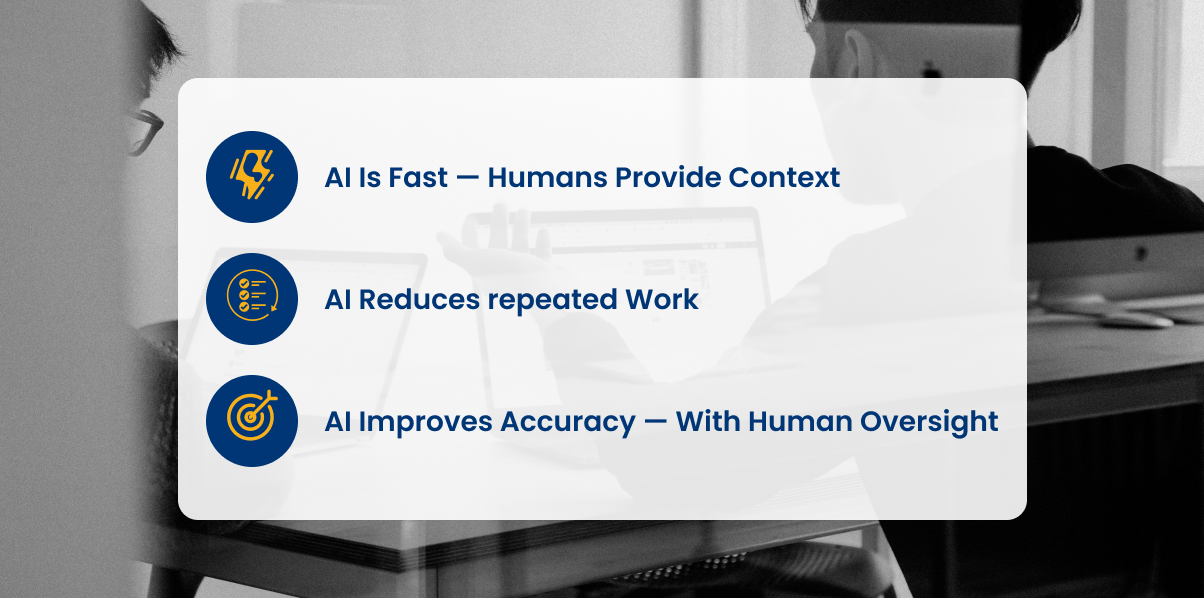
1. AI Is Fast — Humans Provide Context
AI can process data instantly. But humans understand shade, emotion, and business strategy.
2. AI Reduces repeated Work
Teams can automate:
- Data entry
- Initial drafts
- Report generation
- Customer segmentation
This frees people to focus on innovation and decision-making.
3. AI Improves Accuracy — With Human Oversight
When humans review AI outputs, the result is:
- Faster execution
- Fewer errors
- Better outcomes
The magic happens in the partnership.
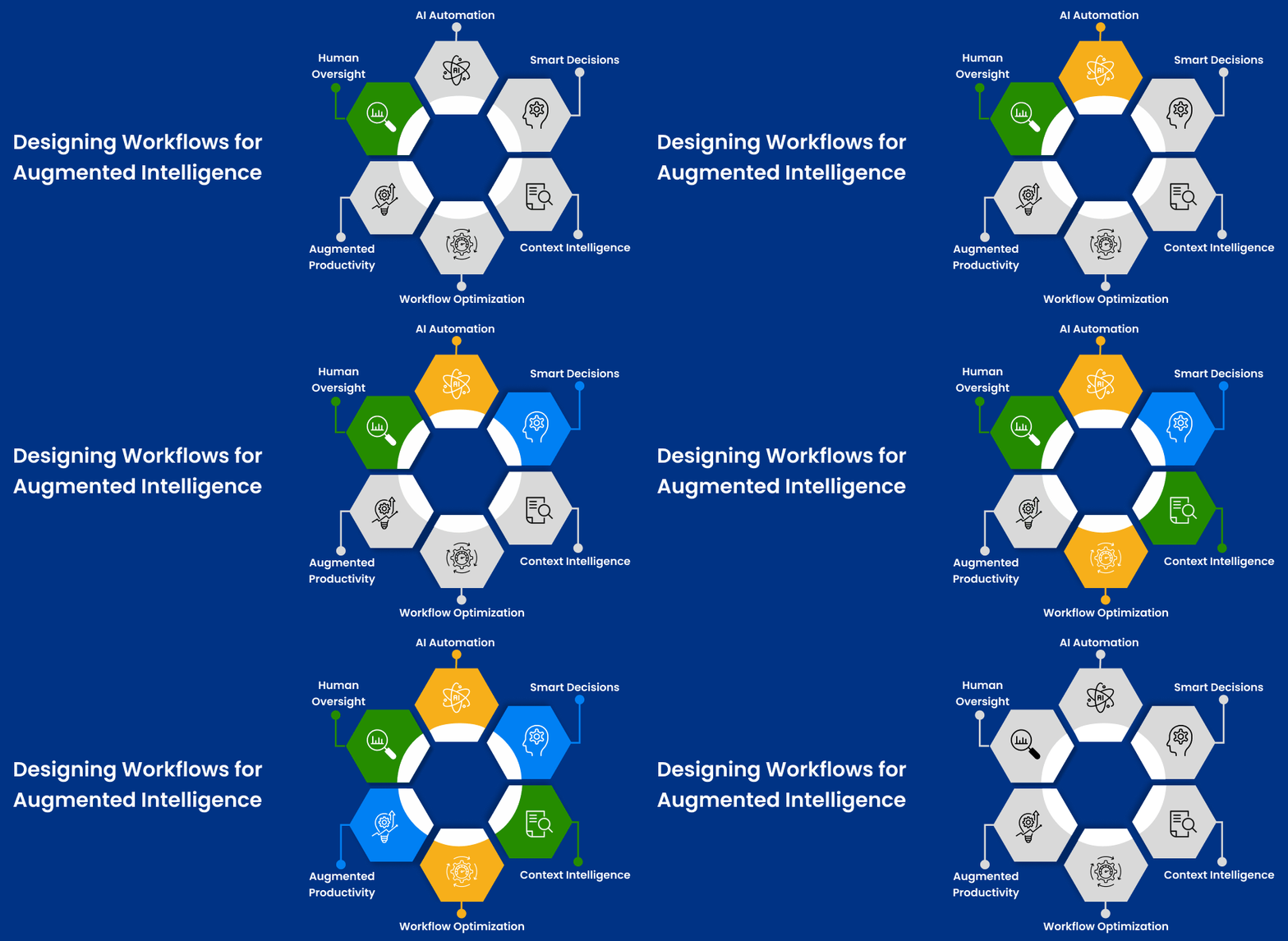
Designing Workflows for Augmented Intelligence
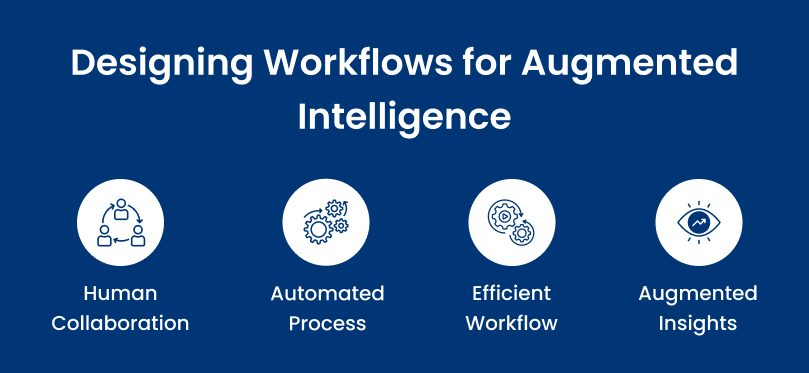
Simply buying AI tools isn’t enough. You need structured workflows.
Here’s how leading organizations are designing Human-AI collaboration in 2026:
Step 1: Identify High-Impact, Low-Judgment Tasks
Start by mapping tasks into two categories:
AI-Friendly Tasks
- Data analysis
- Pattern recognition
- Draft creation
- Report summarization
- Automated customer responses
Human-Critical Tasks
- Strategic decisions
- Ethical considerations
- Brand voice refinement
- Complex negotiations
The goal is not to replace people — but to elevate them.
Step 2: Define Clear Human Checkpoints
Every AI-driven workflow needs human validation stages.
For example:
Marketing Workflow Example
- AI generates campaign ideas
- Human reviews tone and brand alignment
- AI optimizes audience targeting
- Human approves final launch strategy
This layered process ensures speed without sacrificing quality.
Step 3: Create Feedback Loops
The most successful companies treat AI like a team member that learns over time.
- Track AI performance metrics
- Review errors and corrections
- Refine prompts and system rules
- Continuously improve outputs
Augmented intelligence improves when feedback is built into the system.
Step 4: Train Teams to Work With AI — Not Against It
One major barrier in 2026 isn’t technology — it’s mindset.
Teams need:
- Basic AI literacy
- Prompt engineering skills
- Understanding of AI limitations
- Ethical awareness
When employees see AI as a collaborator instead of a threat, productivity increases significantly.
Real-World Use Cases of Human-AI Collaboration
Let’s look at how different industries are applying augmented intelligence.
Healthcare
AI assists in analyzing medical scans and patient data. Doctors review insights and make final diagnoses.
Result: Faster detection, improved patient outcomes.
Finance
AI models flag suspicious transactions. Analysts investigate and confirm fraud.
Result: Reduced risk with human oversight.
Digital Marketing
AI generates ad variations and audience insights. Marketers refine messaging and adjust strategy.
Result: Faster campaigns, better ROI.
Across industries, the pattern is clear — AI handles scale, humans handle strategy.
Common Mistakes to Avoid
Even in 2026, many businesses struggle with AI implementation. Here are common pitfalls:
- Over-automation without oversight
- No clear accountability
- Ignoring ethical considerations
- Lack of team training
- Poor data quality
AI is only as good as the system around it.
The Future of Work: Augmentation Over Automation
The future isn’t human vs. AI.
It’s human + AI.
Organizations designing workflows around augmented intelligence are seeing:
- Higher productivity
- Smarter decisions
- Reduced operational costs
- More creative teams
When repetitive tasks disappear, people can focus on what they do best: thinking, innovating, and leading.
How to Start Building Human-AI Workflows Today
If you’re planning your AI strategy, start small:
- Audit repetitive processes
- Pilot AI in one department
- Build human review checkpoints
- Train teams
- Measure performance and refine
You don’t need full transformation overnight. You need smart, intentional integration.
Final Thoughts
In 2026, the most successful organizations are not the ones with the most advanced AI.
They’re the ones that design the best Human-AI cooperation workflows.
expanded knowledge isn’t about replacing talent. It’s about unlocking it.
When humans and AI work together with clear structure, defined roles, and continuous feedback and businesses move faster and smarter.
The future of work isn’t automated.
It’s expanded.
And those who design for collaboration today will lead tomorrow.
Frequently Asked Questions (FAQs)
1. What is the difference between AI automation and augmented intelligence?
AI automation focuses on replacing human tasks with machine work, while augmented intelligence improves human decision making by combining AI capacity with human judgment and oversight.
2. Why is Human-AI collaboration important in 2026?
As AI tools become more advanced, structured collaboration ensures accuracy, ethical use, and strategic alignment. Human-AI processes reduce errors while improving productivity.
3. Which tasks are best suited for AI in a collaborative workflow?
AI performs best in data-heavy, boring, and pattern-based tasks such as analytics, report generation, prediction, and draft creation.
4. What tasks should remain human-led?
Strategic planning, ethical decisions, brand positioning, leadership communication, and difficult negotiations should remain human-driven.
5. Will AI replace jobs in the future?
instead of full replacement, AI is shifting roles toward higher-value work. Employees who adapt and learn to work together with AI will remain highly valuable.