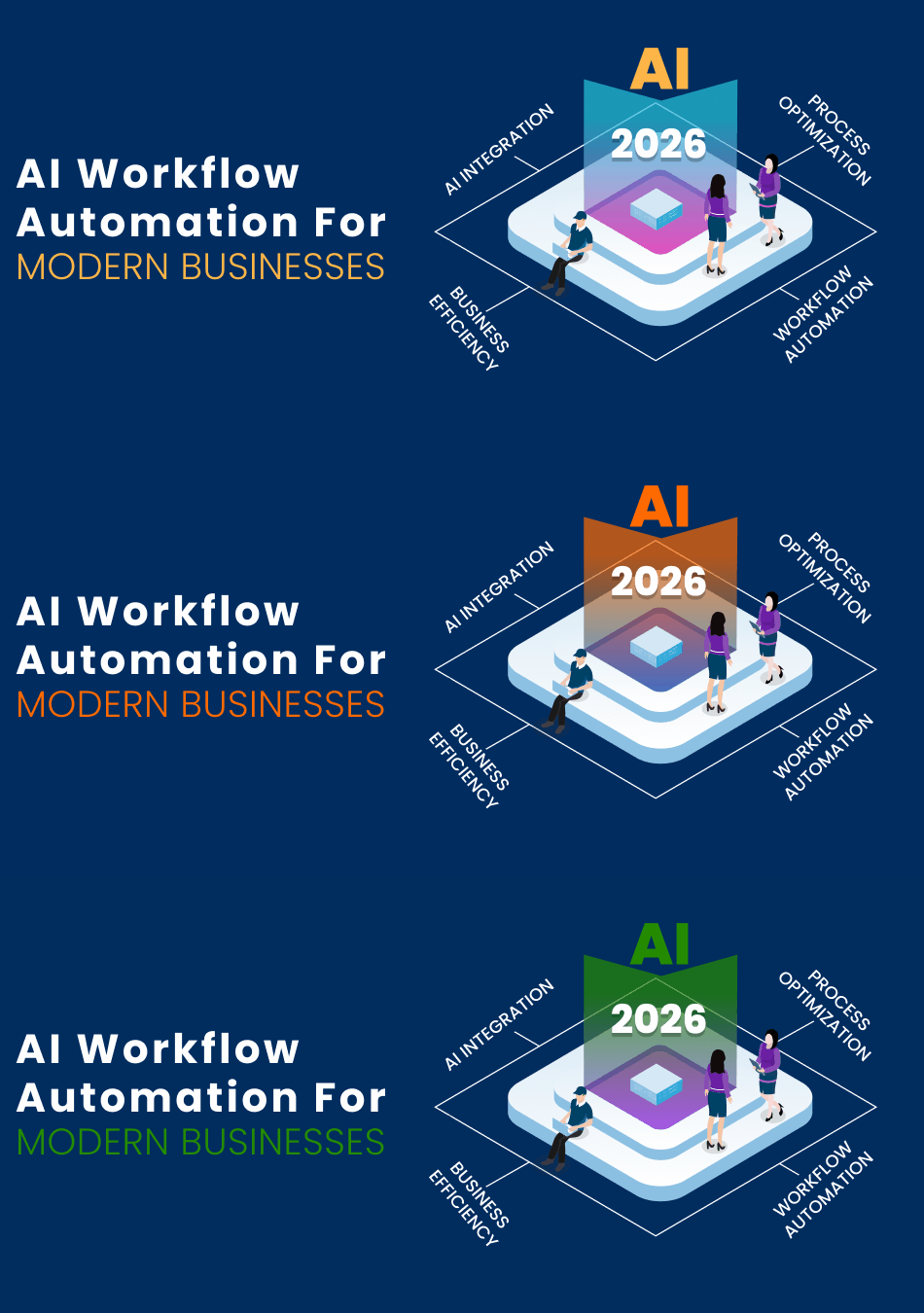
According to industry research, organizations are increasingly investing in AI-powered automation to improve productivity, reduce operational costs, and deliver better customer experiences. Unlike traditional automation, AI can analyze data, understand language, make decisions, and continuously improve over time.
Whether you’re a startup looking to automate repetitive tasks or a large enterprise aiming to streamline complex operations, AI workflow automation has become a business necessity rather than a luxury.
At KIS Works, we help businesses build intelligent AI workflow automation solutions tailored to their unique processes. From AI integration and custom AI development to AI agents and enterprise automation, our team develops scalable solutions that drive real business results.
In this comprehensive guide, you’ll learn everything about AI workflow automation, including how it works, its benefits, real-world applications, implementation steps, challenges, and future trends.
What Is AI Workflow Automation?
AI workflow automation is the use of Artificial Intelligence technologies to automate business processes that traditionally require human involvement.
Unlike rule-based automation, AI-powered systems can:
- Understand natural language
- Read documents and images
- Analyze structured and unstructured data
- Learn from previous interactions
- Predict outcomes
- Make intelligent decisions
- Improve continuously
Instead of simply following predefined rules, AI adapts to changing business scenarios.
Traditional Automation Example
A customer submits a contact form.
The system sends an automatic thank-you email.
Workflow ends.
AI Workflow Automation Example
A customer submits a contact form.
AI automatically:
- Understands customer intent
- Qualifies the lead
- Assigns a lead score
- Updates the CRM
- Schedules a sales follow-up
- Sends a personalized email
- Notifies the sales representative
- Creates future reminders
The entire workflow happens without manual intervention.
Why AI Workflow Automation Matters
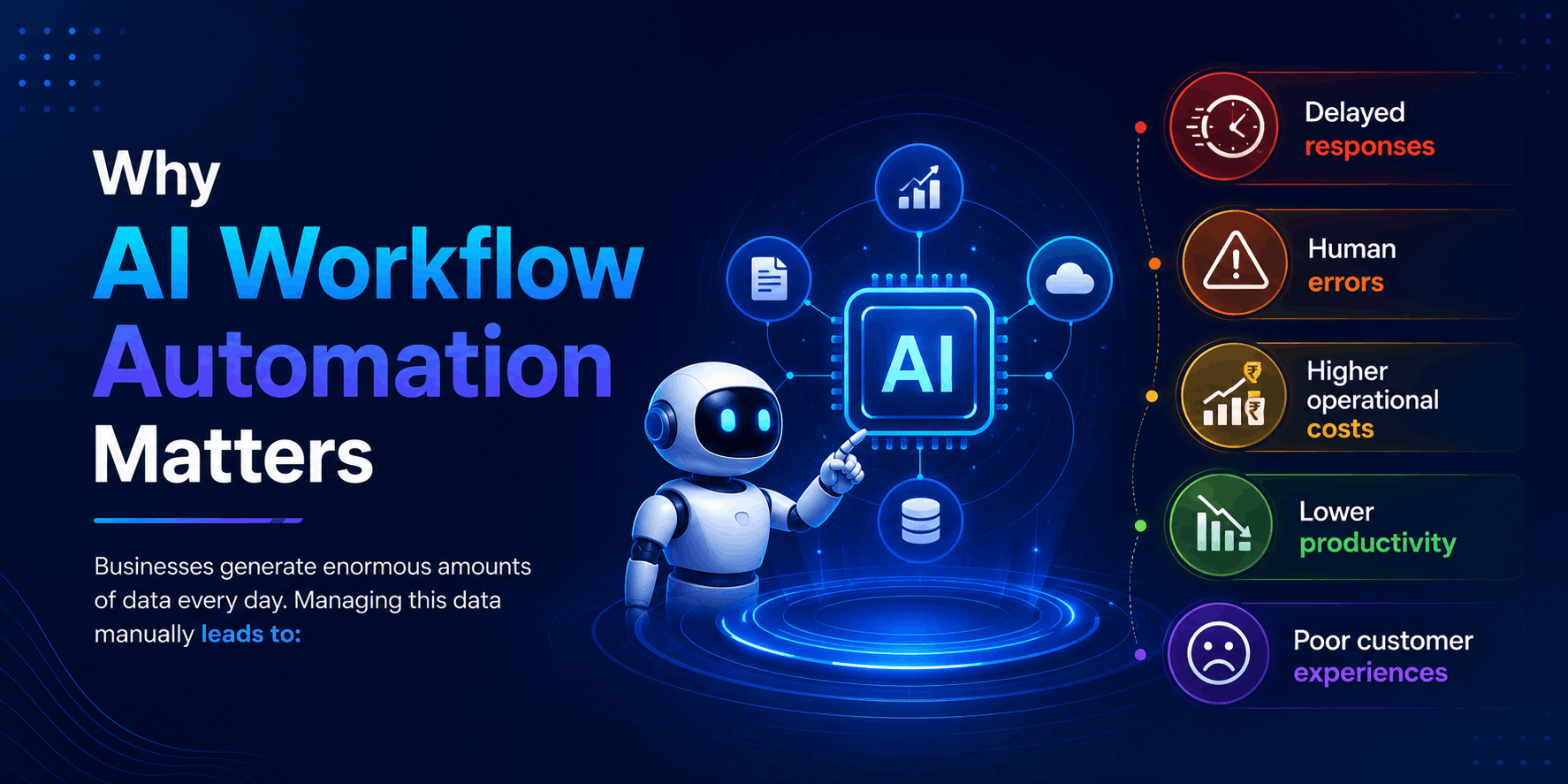
AI workflow automation eliminates these challenges by connecting people, software, and business processes into one intelligent ecosystem.
Instead of employees spending time on repetitive tasks, they can focus on strategic work such as customer relationships, innovation, and business growth.
How AI Workflow Automation Works
A successful AI workflow consists of multiple intelligent stages.
Step 1: Data Collection
AI gathers information from various sources including:
- CRM software
- ERP systems
- Emails
- Chatbots
- Mobile applications
- Websites
- Databases
- Cloud platforms
- APIs
- IoT devices
This creates a centralized source of business information.
Step 2: Data Processing
AI analyzes the collected information using technologies such as:
- Machine Learning (ML)
- Natural Language Processing (NLP)
- Computer Vision
- Optical Character Recognition (OCR)
- Large Language Models (LLMs)
For example, AI can:
- Extract information from invoices
- Read handwritten documents
- Understand customer emails
- Identify customer sentiment
- Detect fraudulent transactions
Step 3: Intelligent Decision-Making
Unlike traditional automation, AI doesn’t simply execute predefined rules.
It evaluates:
- Historical business data
- Customer behavior
- Business policies
- Risk factors
- Predictions
Then it determines the best action.
Examples include:
- Routing support tickets
- Approving expenses
- Prioritizing leads
- Detecting fraud
- Scheduling maintenance
Step 4: Workflow Execution
Once AI decides the next action, it automatically performs tasks such as:
- Sending emails
- Updating CRM records
- Creating invoices
- Scheduling meetings
- Notifying employees
- Updating ERP systems
- Assigning support tickets
Step 5: Continuous Learning
AI continuously improves by learning from:
- Customer interactions
- Business outcomes
- Employee feedback
- New business data
This allows workflows to become smarter over time.
Key Benefits of AI Workflow Automation
Saves Valuable Time
Employees spend a large portion of their day performing repetitive administrative tasks.
Examples include:
- Copying data
- Sending emails
- Preparing reports
- Scheduling meetings
- Processing forms
AI automates these tasks within seconds.
Result:
Employees spend more time on strategic work.
Improves Productivity
Automation enables teams to complete more work without increasing headcount.
Instead of hiring additional employees for repetitive tasks, organizations can automate operations and improve efficiency.
Reduces Human Errors
Manual processes often lead to:
- Incorrect invoices
- Duplicate entries
- Missed approvals
- Wrong customer information
AI performs tasks consistently with minimal errors.
Reduces Operational Costs
Automation reduces:
- Administrative workload
- Overtime expenses
- Processing costs
- Manual verification
Businesses can achieve significant long-term savings while improving service quality.
Faster Decision Making
AI processes thousands of data points within seconds.
Business leaders receive:
- Real-time insights
- Predictive analytics
- Automated recommendations
- Intelligent reports
This enables faster and more informed decisions.
Better Customer Experience
Modern customers expect immediate responses.
AI workflow automation enables businesses to:
- Respond instantly
- Personalize interactions
- Provide 24/7 support
- Resolve issues faster
Satisfied customers are more likely to remain loyal and recommend your business.
Easy Business Scalability
As businesses grow, manual operations become difficult to manage.
AI scales effortlessly by handling increasing workloads without compromising quality.
Improved Compliance
AI workflows automatically maintain:
- Audit trails
- Approval histories
- Regulatory documentation
- Security policies
This simplifies compliance with industry regulations.
Real-World AI Workflow Automation Use Cases
Customer Support Automation
AI-powered support systems can:
- Answer FAQs
- Categorize tickets
- Detect customer sentiment
- Escalate urgent issues
- Generate responses
Benefits include:
- Faster response times
- Reduced support costs
- Improved customer satisfaction
Sales & Lead Management
Sales teams can automate:
- Lead capture
- Lead qualification
- CRM updates
- Proposal generation
- Appointment scheduling
- Email follow-ups
Sales representatives spend more time closing deals instead of managing spreadsheets.
Marketing Automation
Marketing departments use AI for:
- Email campaigns
- Customer segmentation
- Personalized recommendations
- Content suggestions
- Campaign reporting
- Social media scheduling
AI also predicts customer behavior for more targeted marketing.
Human Resources
HR workflows become much faster through AI.
Examples include:
- Resume screening
- Candidate ranking
- Interview scheduling
- Employee onboarding
- Attendance management
- Payroll support
HR professionals can focus on employee engagement instead of administrative work.
Finance & Accounting
Finance teams automate:
- Invoice processing
- Expense approvals
- Tax documentation
- Budget reporting
- Fraud detection
- Payment reminders
This improves financial accuracy while reducing processing time.
Healthcare
Healthcare organizations use AI for:
- Patient scheduling
- Medical record management
- Insurance verification
- Clinical documentation
- Appointment reminders
Doctors spend more time with patients instead of paperwork.
Manufacturing
Manufacturers automate:
- Production planning
- Inventory management
- Equipment monitoring
- Predictive maintenance
- Quality inspections
This minimizes downtime and increases production efficiency.
Logistics & Supply Chain
AI workflows optimize:
- Route planning
- Shipment tracking
- Warehouse operations
- Inventory forecasting
- Delivery scheduling
Businesses reduce delays while improving customer satisfaction.
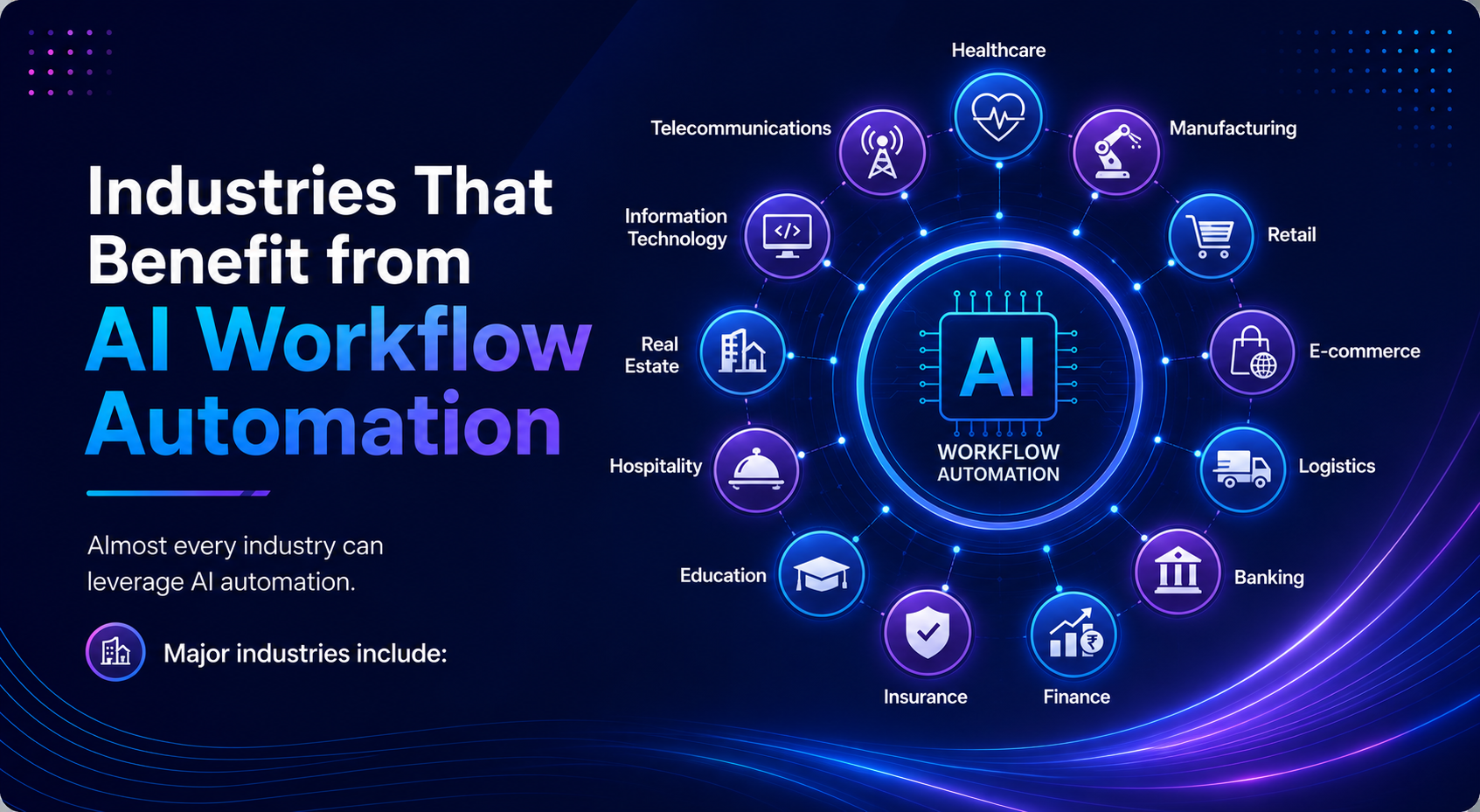
Industries That Benefit from AI Workflow Automation
Popular AI Workflow Automation Examples
Example 1: Customer Inquiry Automation
A customer submits a website inquiry.
AI automatically:
- Understands the request
- Identifies customer intent
- Creates a CRM record
- Assigns the inquiry
- Sends a personalized email
- Books a consultation
- Notifies the sales team
Entire process:
Less than one minute.
Example 2: Invoice Automation
Supplier sends an invoice.
AI:
- Reads the invoice
- Extracts information
- Matches purchase orders
- Checks for discrepancies
- Sends approval requests
- Updates accounting software
No manual data entry required.
Example 3: Employee Onboarding
Once HR marks an employee as hired:
AI automatically:
- Creates accounts
- Generates ID cards
- Sends welcome emails
- Assigns training
- Schedules meetings
- Notifies departments
Everything happens automatically.
Common Challenges in AI Workflow Automation
Although AI offers tremendous advantages, businesses should prepare for several challenges.
Poor Data Quality
AI relies on high-quality data.
Outdated or inconsistent information can reduce accuracy.
Legacy Systems
Older software often requires custom integrations.
Choosing an experienced AI development partner simplifies this process.
Security & Privacy
Businesses must protect sensitive information using:
- Encryption
- Access controls
- Secure cloud infrastructure
- Compliance standards
Employee Adoption
Employees may initially resist automation.
Providing proper training and demonstrating AI’s benefits encourages adoption.
Selecting the Right Use Cases
Not every process should be automated.
Businesses should start with repetitive, high-volume workflows before expanding.
How to Implement AI Workflow Automation Successfully
Step 1: Identify Repetitive Processes
Find tasks that:
- Consume excessive time
- Require manual effort
- Cause frequent errors
- Follow predictable patterns
Step 2: Define Clear Goals
Examples include:
- Reduce operational costs
- Improve customer service
- Increase productivity
- Accelerate approvals
- Enhance decision-making
Step 3: Choose the Right AI Technology
Depending on your business needs, consider:
- AI Agents
- Generative AI
- Machine Learning
- OCR
- NLP
- Predictive Analytics
- Intelligent Document Processing
Step 4: Integrate Existing Systems
Connect AI with:
- CRM
- ERP
- Accounting software
- HRMS
- Cloud platforms
- APIs
- Email systems
Integration ensures seamless automation across departments.
Step 5: Test & Optimize
Monitor important metrics such as:
- Time saved
- Cost reduction
- Error rates
- Customer satisfaction
- ROI
Refine workflows continuously for better performance.
Future Trends in AI Workflow Automation
AI workflow automation is evolving rapidly.
Emerging trends include:
- AI Agents capable of managing complete business processes
- Autonomous decision-making systems
- Voice-enabled workflow automation
- Hyperautomation combining AI with robotic process automation (RPA)
- Predictive business operations
- Industry-specific AI assistants
- Multi-agent collaboration for complex enterprise workflows
Businesses adopting these technologies early will gain a significant competitive advantage.
Why Choose KIS Works for AI Workflow Automation?
Implementing AI successfully requires more than selecting the right tools—it requires a strategy aligned with your business goals.
At KIS Works, we specialize in delivering secure, scalable, and custom AI workflow automation solutions that integrate seamlessly with your existing systems. Whether you need AI-powered customer support, intelligent document processing, sales automation, AI agents, or enterprise-wide workflow automation, our experienced team can help you design and implement solutions that deliver measurable business value.
Our AI services include:
- Custom AI Development
- AI Workflow Automation
- AI Agent Development
- AI Integration Services
- Generative AI Solutions
- AI API Integration
- Intelligent Business Automation
- Enterprise AI Consulting
- Cloud-Based AI Solutions
We focus on building AI systems that reduce manual work, improve efficiency, and support long-term business growth.
Conclusion
AI workflow automation is transforming the way businesses operate by replacing repetitive manual tasks with intelligent, data-driven processes. It helps organizations improve productivity, reduce operational costs, enhance customer experiences, and make faster, smarter decisions.
From customer support and sales to finance, HR, healthcare, and manufacturing, AI-powered workflows are becoming an essential part of modern business operations. Companies that invest in AI automation today will be better prepared to scale efficiently, respond to market changes, and stay competitive in the years ahead.
If you’re ready to automate your business processes and unlock the full potential of AI, KIS Works is here to help. Our team combines technical expertise with practical business understanding to develop AI workflow automation solutions that are tailored to your goals and deliver measurable results.
Ready to transform your business with AI? Contact KIS Works today to explore how our AI workflow automation services can help your organization save time, reduce costs, and accelerate growth.
Ready to transform your business with AI?
Contact KIS Works today to explore how our AI workflow automation services can help your organization save time, reduce costs, and accelerate growth.