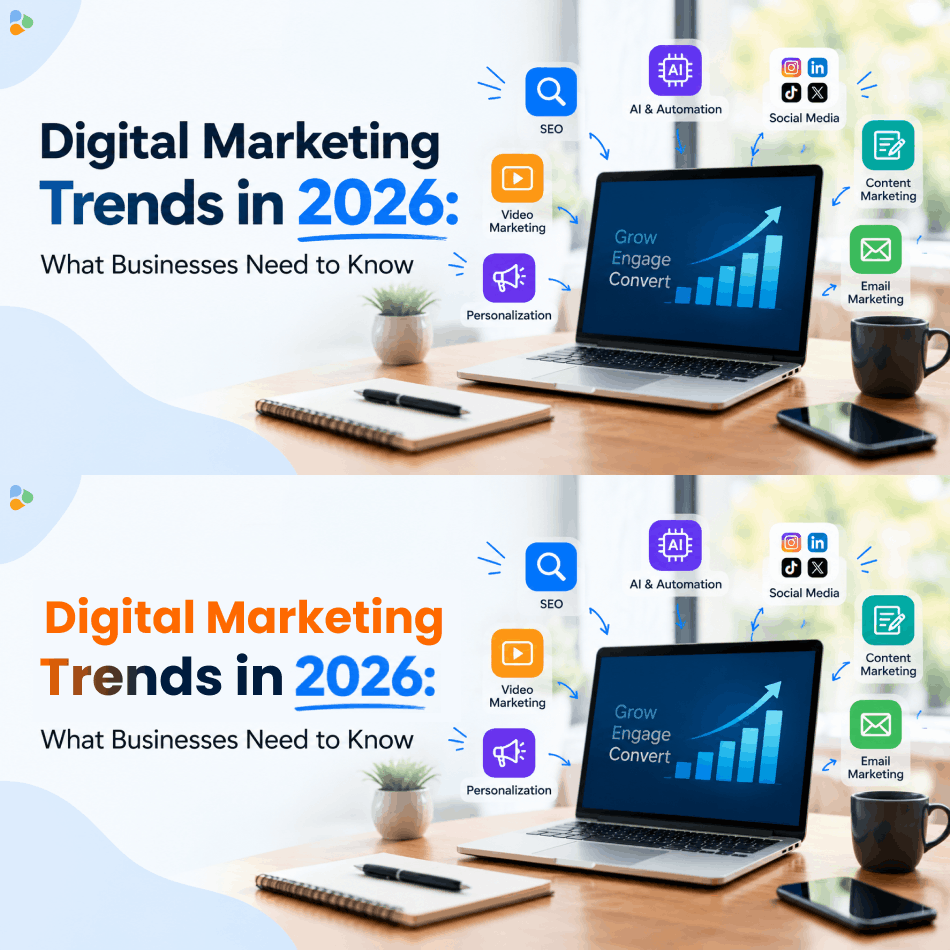
Digital marketing is changing faster than ever. Customers are discovering brands through search engines, social media, online videos, AI-powered tools, and recommendations from people they trust. As a result, businesses need more than a website and occasional social media posts to build a strong online presence.
In 2026, successful digital marketing is about understanding customer needs, creating useful content, using technology wisely, and measuring what actually drives business growth. Artificial intelligence is making marketing activities faster, but creativity, credibility, and a clear understanding of the audience remain essential.
For businesses, the goal is not to follow every new trend. It is to identify the strategies that match their audience, budget, and business objectives.
In this guide, we explore the major digital marketing trends shaping 2026 and explain how businesses can apply them to improve visibility, generate leads, and build lasting customer relationships.
1. Artificial Intelligence Is Becoming Part of Everyday Marketing
Artificial intelligence has moved beyond simple content generation. Marketing teams are using AI to research customer behaviour, identify audience interests, analyze campaign performance, generate creative ideas, and automate repetitive tasks.
AI tools can also help businesses develop email campaigns, prepare social media content, test advertising messages, and identify opportunities for improvement.
However, using AI does not automatically guarantee better results. Generic content, inaccurate information, and repetitive messaging can reduce customer trust if businesses publish everything without reviewing it.
How businesses can use AI effectively
- Content planning: Discover relevant topics, audience questions, and content opportunities.
- Campaign optimization: Analyze advertising performance and identify areas that need attention.
- Customer support: Use AI assistants to answer common questions and guide customers toward relevant services.
- Marketing automation: Automate routine follow-ups, reporting, and repetitive workflows.
- Performance analysis: Turn marketing data into insights that support better decisions.
The best approach is to combine AI efficiency with human judgment. AI can support research and execution, while marketers provide originality, context, quality control, and strategic direction.
2. Search Is Expanding Beyond Traditional Search Results
Search engine optimization remains important, but customers are increasingly exploring information through AI-powered search experiences and conversational assistants.
Instead of entering a short keyword, users may ask detailed questions about products, services, pricing, and business solutions. They expect clear answers that help them make decisions.
This change means businesses should create content that addresses genuine customer questions rather than focusing only on individual keywords.
How to improve visibility in modern search
- Create detailed, helpful pages that answer specific customer questions.
- Use descriptive headings and a logical content structure.
- Include relevant examples, original insights, and practical explanations.
- Keep business information accurate and consistent across online platforms.
- Strengthen website authority through trustworthy information and relevant industry mentions.
- Use structured data where appropriate to help search engines understand website content.
Businesses should also monitor traditional organic traffic, search impressions, conversions, and referral traffic from available AI platforms. These measurements help identify which channels are contributing to visibility and business outcomes.
The objective is simple: make your business easier to discover and your content genuinely useful wherever customers search for answers.
3. Short-Form Video Continues to Shape Brand Discovery
Short-form video has become an important way for businesses to explain their services, demonstrate products, share expertise, and connect with potential customers.
Platforms such as Instagram, YouTube, and Facebook give businesses opportunities to reach audiences through Reels, Shorts, and other video formats. A well-planned video can communicate an idea more quickly than a lengthy promotional message.
However, businesses do not need to produce expensive videos every day. Clear communication and relevant information are often more valuable than complicated production.
Video content ideas for businesses
- Answer frequently asked customer questions.
- Explain a product or service in under a minute.
- Share practical tips related to your industry.
- Demonstrate how a product or solution works.
- Introduce team members and show behind-the-scenes activities.
- Present customer experiences and genuine success stories.
Start each video with a clear hook, focus on one main message, and finish with a relevant next step. Add captions so viewers can follow the content without sound.
Track watch time, completion rate, saves, shares, profile visits, and qualified enquiries to understand which topics resonate with your audience.
4. Authentic Content Is Becoming More Valuable
AI tools have made it easier to produce large amounts of content. At the same time, audiences are exposed to more promotional messages, similar-looking posts, and repetitive articles.
This creates an opportunity for businesses that offer something distinctive: real experience, useful knowledge, original opinions, and transparent communication.
A generic article may explain what a service is, but a stronger article can explain when the service is useful, what problems it solves, which challenges businesses should expect, and how to choose the right solution.
How to create more credible content
- Share knowledge gained from actual projects and customer interactions.
- Include practical examples that demonstrate your expertise.
- Use original visuals, demonstrations, and explanations wherever possible.
- Review AI-generated material for accuracy and originality.
- Avoid unsupported claims, exaggerated promises, and misleading statistics.
- Keep information updated when products, platforms, or industry practices change.

Authenticity is not simply a writing style. It is the consistency between what a business communicates and what it delivers.
5. Social Media Is Becoming a Customer Research and Sales Channel
Social media is no longer limited to brand awareness. Customers use social platforms to research businesses, compare products, read comments, watch demonstrations, and ask questions before making decisions.
For this reason, a business’s social media presence should provide more than promotional graphics. It should help potential customers understand the brand and feel confident about taking the next step.
Build a balanced social media strategy
A practical content plan can include four categories:
Educational content: Share industry knowledge, tutorials, useful tips, and answers to common questions.
Trust-building content: Introduce your team, show your working process, share customer feedback, and demonstrate your expertise.
Engagement content: Use polls, questions, discussions, and interactive formats to encourage relevant conversations.
Conversion-focused content: Explain services, highlight suitable solutions, share offers, and direct interested customers toward an enquiry or purchase.
Businesses should select platforms according to their target audience. LinkedIn may be suitable for B2B services, while Instagram and YouTube may be useful for visual demonstrations, consumer discovery, and educational videos.
The goal is to create a consistent experience that moves customers from discovery to consideration and, eventually, conversion.
6. Personalization Depends on Better Customer Data
Customers respond better to messages that reflect their needs and interests. This has made personalization an important part of email marketing, advertising, website experiences, and customer communication.
Businesses can personalize communication using information customers have voluntarily provided, such as their service interests, purchase history, communication preferences, or previous enquiries.
However, collecting more data is not always the answer. Businesses need relevant, accurate, responsibly collected information that helps them serve customers better.
Practical ways to personalize marketing
- Segment email subscribers according to their interests.
- Send relevant follow-ups after a customer submits an enquiry.
- Recommend products or services based on demonstrated preferences.
- Create landing pages for specific audience needs.
- Use customer relationship management systems to organize leads and interactions.
- Respect consent, privacy requirements, and communication preferences.
First-party data, collected directly from customer interactions, can help businesses understand their audiences without depending entirely on external data sources.
Personalization works best when it makes the customer experience more useful rather than simply increasing the number of messages a person receives.
7. Paid Advertising Requires Stronger Measurement
Google Ads and social media advertising remain valuable for reaching relevant audiences, promoting services, and generating leads. AI-powered campaign features can help automate bidding, targeting, and creative testing.
However, automation cannot compensate for an unclear offer, a poorly designed landing page, or an ineffective sales process.
Businesses should evaluate paid campaigns according to their objectives instead of focusing only on clicks and impressions.
Ways to improve paid advertising performance
- Define the campaign objective before choosing the advertising platform.
- Match ad messaging to the audience’s needs and level of buying intent.
- Test different headlines, creative formats, and offers.
- Use landing pages that explain the offer clearly.
- Track form submissions, phone enquiries, purchases, and other meaningful conversions.
- Review lead quality alongside cost per lead.
- Adjust budgets based on reliable performance data.
For example, a business generating 100 enquiries is not necessarily performing better than a business generating 50 enquiries. If the second business receives more qualified leads and converts more of them into customers, its campaign may deliver greater value.
The important metric is business impact, not simply the amount of activity a campaign generates.
8. Email Marketing and Automation Help Build Long-Term Relationships
Social media and paid advertising can introduce a business to new audiences, but not every potential customer is ready to buy immediately.
Email marketing and automated communication help businesses stay connected with interested prospects over time. They can share useful resources, explain services, answer common questions, and remind customers about relevant next steps.
Email marketing practices worth adopting
- Send a helpful welcome email after someone subscribes.
- Share educational content related to subscriber interests.
- Follow up on enquiries with relevant information.
- Segment audiences instead of sending every message to everyone.
- Test subject lines and calls to action.
- Monitor delivery, engagement, unsubscribe rates, and conversions.
Automation can also help teams respond more consistently to enquiries and reduce manual work. However, automated messages should remain relevant and easy for customers to manage.
A thoughtful email strategy focuses on building trust over time rather than sending frequent promotional messages without a clear purpose.
9. Local Search and Online Reputation Still Matter
For businesses serving a specific city or region, local search visibility can connect them with customers who are actively looking for nearby services.
An accurate Google Business Profile, consistent business information, genuine customer reviews, and useful location-specific website content can help customers evaluate a business before contacting it.
Improve your local online presence
- Keep business hours, contact details, and service information accurate.
- Choose relevant categories for your Google Business Profile.
- Add genuine photos and updates that reflect your business.
- Encourage customers to share honest reviews.
- Respond professionally to feedback.
- Publish useful content related to your services and service areas.
- Review local search performance and customer enquiries regularly.
Reviews should be earned honestly, not purchased or fabricated. Businesses should also avoid publishing repetitive location pages that provide little value to visitors.
Local marketing works best when online information reflects the real customer experience.
10. Marketing Analytics Is Shifting Toward Business Outcomes
Digital marketing platforms provide extensive reporting, but more data does not automatically lead to better decisions.
Businesses need to understand how marketing activities contribute to leads, sales, customer acquisition, and retention. This requires clear objectives, reliable tracking, and regular analysis.
Google Analytics 4 can help businesses understand website activity, traffic sources, engagement, and configured conversion events. Advertising platforms and CRM systems can provide additional information about campaign performance and lead quality.
Metrics worth tracking
| Marketing objective | Useful metrics |
| Improve website visibility | Organic clicks, impressions, and relevant search traffic |
| Increase engagement | Meaningful interactions, video watch time, and returning visitors |
| Generate leads | Qualified enquiries, conversion rate, and cost per lead |
| Increase sales | Revenue, conversion rate, and customer acquisition cost |
| Improve retention | Repeat purchases, returning customers, and retention rate |
| Evaluate campaign profitability | Revenue attributed to campaigns and return on ad spend |
Businesses should establish a baseline before making major changes. They should also check tracking configurations to avoid counting duplicate or irrelevant actions as conversions.
Attribution can be imperfect because customers often interact with multiple channels before making a purchase. Marketing reports should therefore be interpreted alongside sales data and an understanding of the customer journey.
11. Integrated Marketing Creates a More Consistent Customer Journey
Customers rarely follow a perfectly straight path from discovering a business to becoming a customer. Someone might find a company through Google, watch its videos, visit its website, read reviews, and return later through an advertisement.
If every channel operates independently, the business may deliver inconsistent messages and miss opportunities to build trust.
An integrated marketing strategy connects content, SEO, paid advertising, social media, email, website experiences, and sales follow-ups around shared business objectives.
For example, a software company could publish an educational article, create short videos explaining the same topic, promote a relevant resource through LinkedIn, and use a targeted landing page to collect qualified enquiries. The sales team could then follow up with prospects using relevant information.
This approach helps businesses reuse strong ideas across multiple channels while maintaining a consistent message.
The key is not to be present on every platform. It is to connect the channels that genuinely support the customer journey.
How Businesses Can Prepare for Digital Marketing in 2026
Following every new platform update or marketing trend can waste time and resources. A more effective approach is to build a focused plan and improve it through regular measurement.
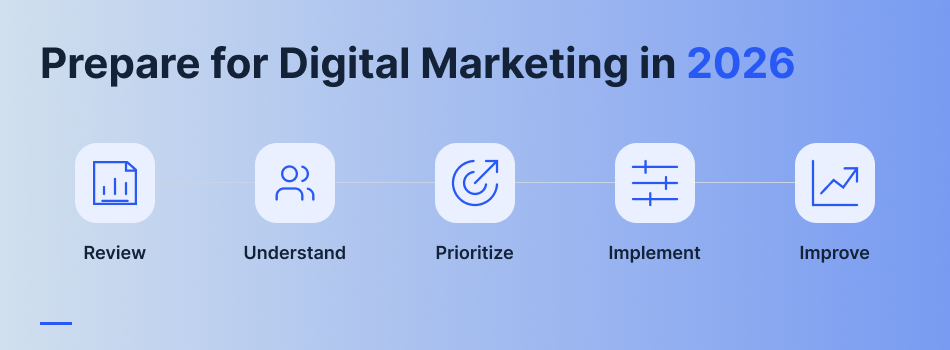
Businesses can start with these five steps:
Step 1: Review your current performance. Identify which channels generate meaningful traffic, enquiries, and sales.
Step 2: Understand your audience. Document customer needs, common questions, objections, and buying behaviour.
Step 3: Select your priorities. Choose a small number of strategies based on your goals, available budget, and internal capabilities.
Step 4: Implement suitable tools. Use analytics, automation, content management, and advertising tools where they solve real problems.
Step 5: Measure and improve. Review results regularly, identify weaknesses, test improvements, and invest more confidently in strategies that work.
A small business may benefit from improving its local presence and enquiry follow-up before investing heavily in advanced automation. A larger company may need better data integration, campaign attribution, and personalization across several channels.
The right strategy depends on the business, not on how many marketing trends it adopts.
Conclusion
Digital marketing in 2026 is becoming more intelligent, interconnected, and focused on customer experience. AI is helping teams work more efficiently, search is expanding into conversational experiences, video is creating new opportunities for discovery, and analytics is helping businesses make more informed decisions.
Yet the fundamentals remain important. Businesses still need a clear value proposition, useful content, a trustworthy online presence, relevant communication, and a reliable way to measure results.
Companies that combine modern technology with genuine customer understanding will be better positioned to adapt as the digital landscape continues to change.
At Krishna Innovative Software (KIS Works), businesses can explore technology-driven solutions that support digital growth, from website and application development to AI integration and automation. The most effective approach begins with understanding your business goals and choosing solutions that deliver practical value.
Ready to strengthen your digital presence? Start by reviewing your current marketing strategy, identifying your biggest growth opportunity, and building a plan around measurable business outcomes.