“If you position on Google, you win.”
But in 2026, that rule is breaking faster than most businesses realize.
Search behavior is changing. AI assistants are replacing traditional search patterns. People do not read through 10 blue links to find thier answers. Instead of that they are asking ChatGPT, Gemini, Claude, Perplexity, and other AI systems directly and also they are getting instant summarized responses.
That’s where GEO comes in.
And if you’re still only focusing on traditional SEO, you may already be behind.
Let’s talk about why SEO isn’t exactly “dead” — but why GEO (Generative Engine Optimization) is becoming the future of discoverability.
First, Is SEO Really Dead?
No. SEO is not dead.
But the version of SEO that worked from 2015–2023 absolutely is.
Keyword stuffing, low-quality backlinks, AI-generated spam blogs, and writing content just to rank but now it doesn’t work the way it used to be. Search engines have developed, and users have transformed even faster.
Today, users want:
- Instant answers
- Personalized recommendations
- Conversational responses
- Trusted sources
- Zero-click experiences
Google itself started this shift with featured snippets, AI overviews, and direct answers. But now AI-native search tools are accelerating it.
The real change is this:
People are no longer searching for websites.
They’re searching for answers.
And AI is becoming the middle layer between users and your content.
That changes everything.
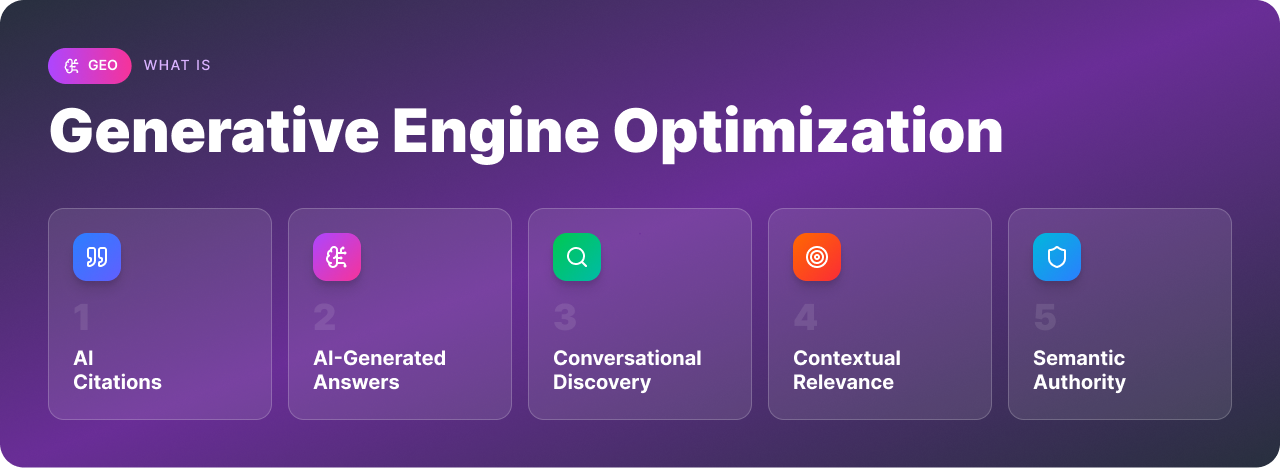
What is GEO (Generative Engine Optimization)?
Generative Engine Optimization (GEO) is the process of improving your content so AI systems can find and understand or trust and recommend the content in generated responses.
Instead of optimizing only for search engine rankings, GEO optimizes for:
- AI citations
- AI-generated answers
- Conversational discovery
- Contextual relevance
- Semantic authority
In simple words:
SEO helps you rank on search engines.
GEO helps AI recommend you.
And in 2026, recommendations matter more than rankings.
Why GEO Will Dominate Search in 2026
1. AI Search Is Becoming the Default
People now ask:
- “Which is the best CRM for startups?”
- “Summarize this topic.”
- “Compare these tools.”
- “What should I buy?”
- “Write a strategy for me.”
Instead of clicking blogs, users interact directly with AI assistants.
This means visibility no longer depends entirely on page rankings.
It depends on whether AI trusts your content enough to use it in answers.
If your brand isn’t part of AI-generated responses, you’re invisible to a growing segment of users.
2. Zero-Click Searches Are Exploding
Users are getting answers without visiting websites.
Google AI Overviews, ChatGPT browsing, and AI assistants are reducing clicks for informational queries.
Traditional SEO was all about the traffic.
GEO is working around influence.
Even if users never visit your site directly, your brand can still get better after taking the right decisions if AI mentions you consistently.
That is a huge shift.
3. Authority Matters More Than Keywords
In old-school SEO, you could rank with:
- Aggressive keyword targeting
- Programmatic content
- Backlink manipulation
- Thin articles
But AI systems prioritize:
- Expertise
- Credibility
- Brand mentions
- Trusted citations
- Original insights
AI engines don’t just scan keywords.
They evaluate meaning, consistency, reputation, and usefulness.
That means shallow content farms are losing power while authentic brands gain visibility.
4. Search Is Becoming Conversational
Search queries used to look like this:
“best running shoes 2020”
Now they look like this:
“I have flat feet and knee pain. Which running shoes should I buy for marathon training?”
This shift requires content that sounds human, answers naturally, and provides context.
Robotic keyword-heavy articles feel outdated because AI systems prefer content written the way humans actually communicate.
Ironically, the more human your content becomes, the better AI understands it.
The Biggest Difference Between SEO and GEO
| SEO | GEO |
| Optimize for search engines | Optimize for AI systems |
| Focus on rankings | Focus on references & visibility |
| Keyword-driven | Context-driven |
| Click-focused | Trust-focused |
| Search intent | Conversational intent |
| Backlinks matter most | Authority & entity recognition matter most |
SEO asks:
“How do I rank #1?”
GEO asks:
“How do I become the trusted answer?”
That mindset shift is critical.
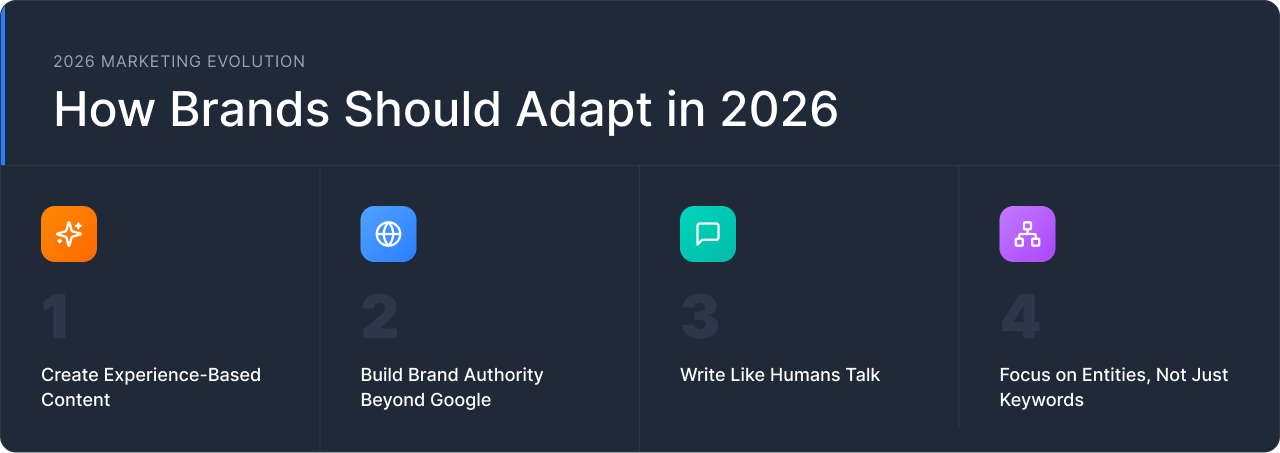
How Brands Should Adapt in 2026
1. Create Experience-Based Content
AI systems increasingly value original experiences and real expertise.
Generic content is everywhere now.
What stands out is:
- Case studies
- Personal insights
- Real examples
- Data-backed opinions
- Industry expertise
If your content could be written by anyone, AI has no reason to prioritize it.
2. Build Brand Authority Beyond Google
Mentions across the internet matter more than ever.
Your brand should exist across:
- YouTube
- Podcasts
- Industry forums
- News sites
- Communities
AI systems learn from broad web signals, not just your website.
The stronger your digital footprint, the stronger your AI visibility.
3. Write Like Humans Talk
This is one of the biggest shifts happening right now.
Over-enhanced SEO writing sounds abnormal.
GEO-friendly writing sounds conversational, helpful, and clear.
Instead of writing for algorithms, write for comprehension.
The funny part?
That’s exactly what modern algorithms now prefer.
4. Focus on Entities, Not Just Keywords
AI systems understand entities:
- Brands
- People
- Products
- Concepts
- Industries
This means your content should clearly establish:
- Who you are
- What you do
- Why you’re credible
- What topics you specialize in
In 2026, topical authority beats keyword density every single time.
What Will Happen to Traditional SEO Agencies?
Many agencies built entire businesses around outdated SEO tactics.
Those agencies will struggle.
The winners will be agencies that combine:
- AI content strategy
- Brand positioning
- Thought leadership
- Semantic search optimization
- Human storytelling
- GEO frameworks
The future belongs to businesses that understand both humans and AI systems.
Not just Google algorithms.
Will Websites Still Matter?
Yes absolutely.
But their role is changing.
Websites are becoming:
- Trust hubs
- Knowledge centers
- Source repositories
- Brand authority assets
Instead of simply attracting clicks, websites now help train AI understanding about your brand.
Your content becomes fuel for AI ecosystems.
That’s why quality matters more than quantity now.
The Future of Search Belongs to Trusted Brands
The internet is entering a new phase.
We are moving from:
Search Engine Optimization
to
Answer Engine Optimization
And eventually:
Generative Engine Optimization.
The brands that win in 2026 won’t necessarily publish the most content.
They’ll publish the most useful, credible, human, and AI-readable content.
SEO is not dying overnight.
But it is evolving rapidly.
And GEO is leading that evolution.
The question is no longer:
“How do I rank higher?”
The real question is:
“Will AI trust my brand enough to recommend it?”
Because in the next era of search, trust will be the ultimate ranking factor.
Final Thoughts
If you’re still treating SEO like it’s 2018, you’re optimizing for a version of the internet that no longer exists.
The future belongs to brands that:
- Build authority
- Create human-first content
- Understand AI discovery
- Prioritize trust over tricks
- Focus on real expertise
GEO isn’t a trend.
It’s the next evolution of digital visibility.
And the businesses that adapt early will dominate the next generation of search.