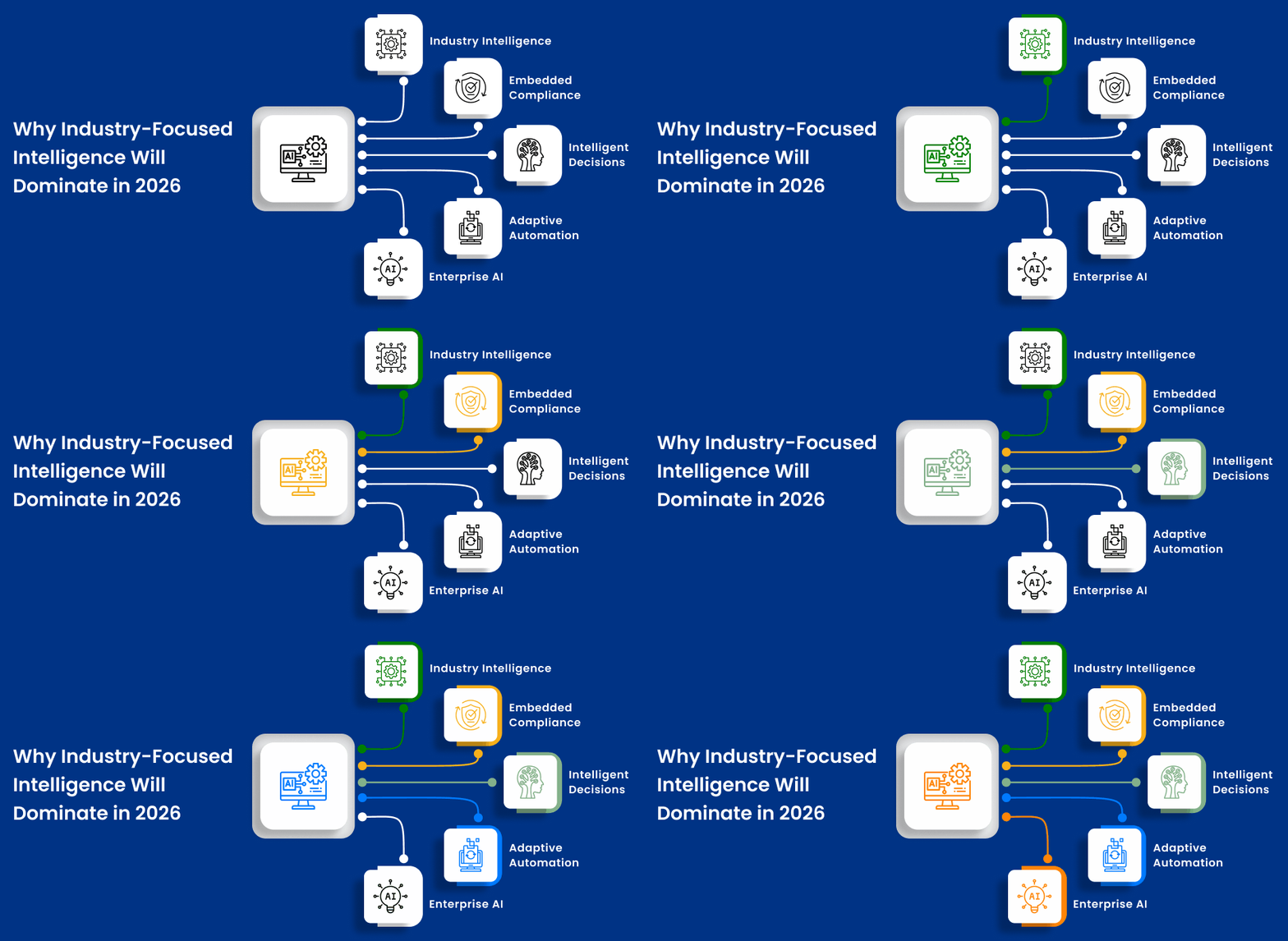
Artificial Intelligence is no longer just about building bigger models. In 2026, the real competitive advantage lies in building smarter, more focused ones. While general-purpose AI systems have accelerated innovation across industries, businesses are now shifting toward domain-specific AI models systems trained with deep expertise in a particular industry, function, or workflow.
This evolution is not simply a technical refinement. It represents a fundamental shift in how enterprises deploy AI for measurable outcomes, regulatory compliance, and operational precision.
Industry-focused intelligence is set to dominate in 2026 — and for good reason.
What Are Domain-Specific AI Models?
Domain-specific AI models are artificial intelligence systems trained on highly curated, industry-relevant datasets. Unlike general AI models that aim to respond to broad prompts across multiple subjects, domain-focused models specialize in a specific vertical such as healthcare, finance, legal, manufacturing, retail, or insurance.
These models understand:
- Industry terminology and context
- Regulatory requirements
- Operational workflows
- Sector-specific risks
- Structured and unstructured domain data
In simple terms, general AI knows “a little about everything.” Domain-specific AI knows “a lot about one thing.”
Why 2026 Is the Tipping Point for Industry-Focused AI
Several macro-level trends are accelerating the adoption of domain-specific intelligence.
1. Enterprises Demand Accuracy Over Generalization
Generic large language models are powerful but prone to hallucinations and contextual misunderstandings. In mission-critical industries, even small inaccuracies can result in financial loss, compliance violations, or reputational damage.
According to industry forecasts, more than 50 percent of enterprise AI deployments will rely on specialized models by 2028 — a trend already accelerating through 2026.
The focus has shifted from experimentation to precision.
2. Reduction in AI Hallucinations
One of the biggest challenges with large general models is hallucinated output. Specialized models trained on controlled datasets significantly reduce this risk. Industry analyses suggest that focused models can lower hallucination rates by up to 70–85 percent compared to general-purpose systems.
For sectors such as healthcare, legal advisory, and financial compliance, this difference is transformative.
3. Built-In Regulatory Alignment
Highly regulated industries require AI systems that comply with frameworks such as:
- HIPAA (Healthcare)
- GDPR (Data Privacy)
- SOX (Financial Reporting)
- Basel III (Banking Regulation)
Domain-specific AI can be designed with regulatory guardrails embedded into the architecture, making it more reliable for enterprise deployment.
4. Improved ROI and Cost Efficiency
Contrary to assumptions, specialized AI models can be more cost-efficient. Because they are narrower in scope:
- They require fewer compute resources
- They respond faster
- They are easier to fine-tune
- They reduce costly output errors
The return on investment becomes clearer when AI moves from experimentation to production-grade workflows.
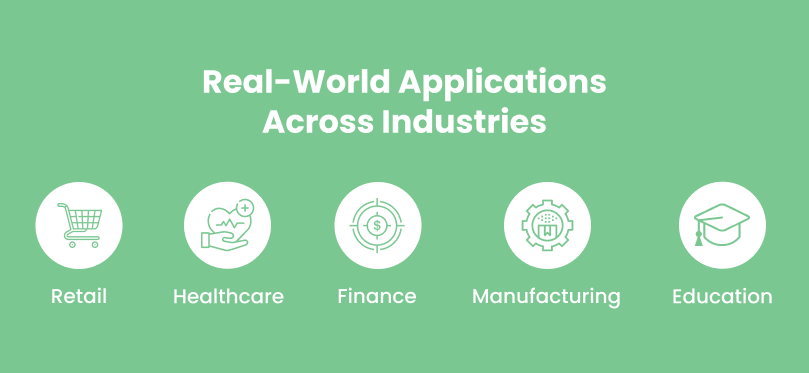
Real-World Applications Across Industries
Healthcare
Clinical AI models trained exclusively on medical literature and patient data assist in diagnostics, drug discovery, and patient triage. In radiology and pathology, domain-specific AI has demonstrated accuracy levels comparable to trained specialists in certain controlled environments.
Financial Services
Banks and fintech companies use specialized AI models for fraud detection, credit risk modeling, algorithmic trading, and compliance monitoring. Financial AI systems analyze transaction patterns with contextual awareness that general models cannot replicate.
Legal Technology
Legal AI systems trained on case law, contracts, and statutes assist with document review, litigation research, and compliance audits. These models understand legal structure and terminology at a granular level.
Manufacturing and Industrial Operations
Predictive maintenance models analyze machine sensor data to detect equipment failures before they occur. Industry-focused AI reduces downtime, improves safety, and enhances operational efficiency.
Retail and E-Commerce
AI recommendation systems trained on consumer behavior data can significantly increase conversion rates. Some major e-commerce platforms report that personalized AI recommendations contribute to more than 30 percent of total revenue.
Key Statistics Driving Adoption
- Over 50 percent of enterprise AI models are projected to become domain-specific within the next two to three years.
- Specialized AI systems can reduce hallucination rates by up to 85 percent compared to general LLMs.
- Personalized AI-driven recommendations can contribute 30–35 percent of e-commerce sales revenue.
- AI-powered predictive maintenance can reduce industrial downtime by 20–40 percent in optimized environments.
These numbers demonstrate that domain-focused AI is not a niche experiment — it is a strategic investment.
Domain-Specific AI vs. General AI: A Clear Comparison
| Factor | General AI Models | Domain-Specific AI Models |
| Knowledge Scope | Broad | Deep and specialized |
| Accuracy in Industry Tasks | Moderate | High |
| Compliance Readiness | Limited | Embedded |
| Risk of Hallucination | Higher | Significantly Lower |
| Production Deployment | Experimental in many cases | Enterprise-ready |
Challenges of Domain-Specific AI Implementation
While the benefits are significant, organizations must address key challenges.
Data Quality and Governance
Specialized AI depends on structured, high-quality datasets. Poor data results in biased or unreliable outputs. Strong data governance frameworks are essential.
Development Investment
Training or fine-tuning industry-focused models requires domain expertise, engineering capability, and infrastructure planning. However, the long-term ROI often justifies the initial investment.
Ethical and Bias Considerations
If training data reflects historical bias, AI systems may replicate it. Responsible AI frameworks, audits, and human oversight remain critical.
Emerging Trends Shaping Domain-Specific AI in 2026
Multimodal Industry Intelligence
Future domain models will integrate text, structured data, images, sensor inputs, and voice commands to provide holistic decision support.
Explainable AI (XAI)
Transparency will become mandatory in regulated industries. Explainable models that justify decisions will gain enterprise preference.
AI + Human Collaboration
Rather than replacing professionals, domain-specific AI will augment experts — assisting doctors, analysts, engineers, and lawyers in making better-informed decisions.
Vertical AI Platforms
We are entering the era of “Vertical AI SaaS,” where software platforms embed specialized AI engines directly into workflow systems.
Frequently Asked Questions
What is a domain-specific AI model?
A domain-specific AI model is trained using industry-focused datasets and optimized for tasks within a specific sector such as healthcare, finance, or manufacturing.
How is domain-specific AI different from large language models?
Large language models are designed for general-purpose tasks. Domain-specific AI models are fine-tuned or built specifically for industry use cases, offering greater accuracy and compliance readiness.
Are domain-specific AI models more secure?
They can be more secure because they are often deployed within private enterprise environments and trained on proprietary data rather than open internet data.
Is domain-specific AI expensive to build?
Initial development may require investment, but operational accuracy, reduced errors, and improved efficiency typically generate strong long-term returns.
Will general AI disappear?
No. General AI will continue to support creative tasks, research, and broad interactions. However, enterprise-critical workflows will increasingly rely on specialized intelligence.
Final Thoughts
The AI conversation in 2023 and 2024 revolved around scale. The conversation in 2026 revolves around specialization.
Businesses no longer ask, “Can AI do this?”
They now ask, “Can AI do this accurately, safely, and within our industry context?”
Domain-specific AI models answer that question with confidence.
As industries mature in their AI adoption, the winners will not be those using the largest models but those deploying the most intelligent, industry-aligned systems.
Industry-focused intelligence is not just the future of AI.
It is the future of competitive advantage.